


KCET · Chemistry · Surface Chemistry
Conductivity of a saturated solution of a sparingly soluble salt \( A B \) at \( 298 K \) is
\( 1.85 \times 10^{-5} \mathrm{Sm}^{-1} \). Solubility product of the salt AB at \( 298 \mathrm{~K} \) is
Given \( \Lambda{ }_{\mathrm{m}}^{\circ}(A B)=140 \times 10^{-4} \mathrm{~S} \mathrm{~m}^{2} \mathrm{~mol}^{-1} \)
- A \( 1.32 \times 10^{-12} \)
- B \( 1.74 \times 10^{-12} \)
- C \( 5.7 \times 10^{-12} \)
- D \( 7.5 \times 10^{-12} \)
Answer & Solution
Correct Answer
(B) \( 1.74 \times 10^{-12} \)
Step-by-step Solution
Detailed explanation
Given, \( \Lambda{ }_{\mathrm{m}}^{\circ}=140 \times 10^{-4} \mathrm{Sm}^{2} \mathrm{~mol}^{-1} \) \( K=1.85 \times 10^{-5} \mathrm{Sm}^{-1} \)
Now, molar conductivity of the saturated salt is,
\[
\begin{array}{l}
\left.\Lambda_{m}{ }^{\circ}=\frac{K}{1000 \times C}=\frac{1.85 \times 10^{-5}}{1000 \times S} \text { [Concentration }(\mathrm{C})=\text { Solubility }(S)\right] \\
140 \times 10^{-4}=\frac{1.85 \times 10^{-5}}{1000 \times S} \\
S=\frac{1.85 \times 10^{-5}}{1000 \times 140 \times 10^{-4}} \\
S=1.32 \times 10^{-6}
\end{array}
\]
For the saturated salt
\[
\begin{array}{l}
A B \rightarrow A^{+}+B^{-} \\
K_{s p}=\left[A^{+}\right]\left[B^{-}\right]=S^{2} \\
K_{s p}\left[A^{+}\right]\left[B^{-}\right]=S^{2} \\
K_{s p}=S^{2} \\
=\left(1.32 \times 10^{-6}\right)^{2} \\
=1.74 \times 10^{-12}
\end{array}
\]
Now, molar conductivity of the saturated salt is,
\[
\begin{array}{l}
\left.\Lambda_{m}{ }^{\circ}=\frac{K}{1000 \times C}=\frac{1.85 \times 10^{-5}}{1000 \times S} \text { [Concentration }(\mathrm{C})=\text { Solubility }(S)\right] \\
140 \times 10^{-4}=\frac{1.85 \times 10^{-5}}{1000 \times S} \\
S=\frac{1.85 \times 10^{-5}}{1000 \times 140 \times 10^{-4}} \\
S=1.32 \times 10^{-6}
\end{array}
\]
For the saturated salt
\[
\begin{array}{l}
A B \rightarrow A^{+}+B^{-} \\
K_{s p}=\left[A^{+}\right]\left[B^{-}\right]=S^{2} \\
K_{s p}\left[A^{+}\right]\left[B^{-}\right]=S^{2} \\
K_{s p}=S^{2} \\
=\left(1.32 \times 10^{-6}\right)^{2} \\
=1.74 \times 10^{-12}
\end{array}
\]
See the Complete Solution
Get step-by-step explanations for this and 2.5 Lakh+ more JEE, NEET & CET questions.
- Unlock all solutions
- Practice the full chapter
- Track accuracy across PYQs
4.8 rated on Google Play · 14,000+ reviews
More questions from Chemistry
- In chromite ore, the oxidation number of iron and chromium are respectivelyKCET 2011 Medium
- The IUPAC name of the complex ion formed when gold dissolves in aquaregia isKCET 2014 Medium
- When the same quantity of heat is absorbed by a system at two different temperatures \(T_{1}\) and \(T_{2}\), such that \(T_{1}>T_{2}\), change in entropies are \(\Delta S_{1}\) and \(\Delta S_{2}\) respectively. ThenKCET 2020 Medium
- A Lewis acid ' \(X\) ' reacts with \(\mathrm{LiAlH}_{4}\) in ether medium to give a highly toxic gas. This gas when heated with \(\mathrm{NH}_{3}\) gives a compound commonly known as inorganic benzene. The gas isKCET 2020 Hard
- Which one of the following is not a common component of photo-chemical smog?KCET 2017 Easy
- The temperature coefficient of a reaction is \( 2 \). When the temperature is increased from \( 30^{\circ} \mathrm{C} \) to
\( 90^{\circ} \mathrm{C} \), the rate of reaction is increased byKCET 2018 Hard
More PYQs from KCET
- Identify the incorrect statements among the following:
(a) All enthalpies of fusion are positive
(b) The magnitude of enthalpy change does not depend on the strength of the intermolecular interactions in the substance undergoing phase transformations.
(c) When a chemical reaction is reversed, the value of \(\Delta \mathrm{rH}^{\circ}\) is reversed in sign.
(d) The change in enthalpy is dependent of path between initial state (reactants) and final state (products)
(e) For most of the ionic compounds, \(\Delta_{\text {sol }} \mathrm{H}^{\circ}\) is negativeKCET 2025 Medium - A planet moving around sun sweeps area \(\mathrm{A}_{1}\) in 2 days, \(\mathrm{A}_{2}\) in 3 days and \(\mathrm{A}_{3}\) in 6 days. Then, the relation between \(\mathrm{A}_{1}, \mathrm{~A}_{2}\) and \(\mathrm{A}_{3}\) is
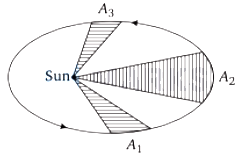 KCET 2012 Medium
 - If \( A=\left[\begin{array}{cc}0 & 1 \\ 1 & 0\end{array}\right] \), then \( A^{2} \) equal toKCET 2015 Medium
- The maximum value of \(z=3 x+4 y\), subject to the constraints \(x+y \leq 40, x+2 y \leq 60\) and \(x, y \geq 0\) isKCET 2025 Medium
- The chemical substances which are produced by some microbes which can kill or retard the growth of other microbes are known asKCET 2024 Hard
- The differential coefficient of \( \log _{10} x \) with respect to \( \log _{x} 10 \) isKCET 2016 Easy