


KCET · Chemistry · General Principles and Processes of Isolation of Metals
The acid strength of active methylene group in
(a) \( \mathrm{CH}_{3} \mathrm{COCH}_{2} \mathrm{COOC}_{2} \mathrm{H}_{5} \)
(b) \( \mathrm{CH}_{3} \mathrm{COCH}_{2} \mathrm{COCH}_{3} \)
(c) \( \mathrm{C}_{2} \mathrm{H}_{5} \mathrm{OOCCH}_{2} \mathrm{COOC}_{2} \mathrm{H}_{5} \)
decreases as
- A \( a>b>0 \)
- B c> a> b
- C \( a>c>b \)
- D \( b>a>c \)
Answer & Solution
Correct Answer
(D) \( b>a>c \)
Step-by-step Solution
Detailed explanation
An active methylene compound is a compound that has the following general structural formula.

Where, \( E_{1} \) and \( E_{2} \) are functional group that withdraws electron by resonance. After the removal of hydrogen from the
active methylene groups, the carbanion thus, formed is stabilized by the resonance. Greater the stabilization of the
carbanion, greater will be the acidic strength of the active methylene groups.
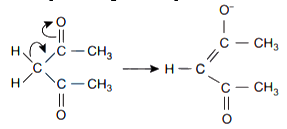
(।) \( \mathrm{CH}_{3} \mathrm{COCH}_{2} \mathrm{COOC}_{2} \mathrm{H}_{5} \)

So, ketonic groups stabilized more carbanion ion than the ester or carboxylic groups. Therefore, compound having more
number of ketonic groups is more acidic active methylene compound.
(II) \( \mathrm{CH}_{3} \mathrm{COCH}_{2} \mathrm{COCH}_{3} \)
(III) \( \mathrm{CH}_{3} \mathrm{COOCH}_{2} \mathrm{COOCH}_{3} \)
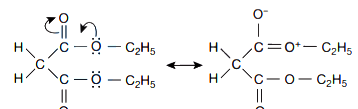
Where, \( E_{1} \) and \( E_{2} \) are functional group that withdraws electron by resonance. After the removal of hydrogen from the
active methylene groups, the carbanion thus, formed is stabilized by the resonance. Greater the stabilization of the
carbanion, greater will be the acidic strength of the active methylene groups.
(।) \( \mathrm{CH}_{3} \mathrm{COCH}_{2} \mathrm{COOC}_{2} \mathrm{H}_{5} \)
So, ketonic groups stabilized more carbanion ion than the ester or carboxylic groups. Therefore, compound having more
number of ketonic groups is more acidic active methylene compound.
(II) \( \mathrm{CH}_{3} \mathrm{COCH}_{2} \mathrm{COCH}_{3} \)
(III) \( \mathrm{CH}_{3} \mathrm{COOCH}_{2} \mathrm{COOCH}_{3} \)
See the Complete Solution
Get step-by-step explanations for this and 2.5 Lakh+ more JEE, NEET & CET questions.
- Unlock all solutions
- Practice the full chapter
- Track accuracy across PYQs
4.8 rated on Google Play · 14,000+ reviews
More questions from Chemistry
- Which of the following halides cannot be hydrolysed?KCET 2024 Medium
- Homoleptic complexes among the following are
(A) \(\mathrm{K}_3\left[\mathrm{Al}\left(\mathrm{C}_2 \mathrm{O}_4\right)_3\right]\)
(B) \(\left[\mathrm{CoCl}_2(\mathrm{en})_2\right]^{+}\)
(C) \(\mathrm{K}_2\left[\mathrm{Zn}(\mathrm{OH})_4\right]\)KCET 2021 Easy - \( \left[\mathrm{Fe}\left(\mathrm{NO}_{2}\right)_{3} \mathrm{Cl}_{3}\right] \) and \( \left[\mathrm{Fe}(\mathrm{O}-\mathrm{NO})_{} \mathrm{Cl}_{3}\right] \) showsKCET 2018 Easy
- The IUPAC name of
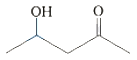
isKCET 2012 Easy - The correct order in which the first ionisation potential increases isKCET 2008 Medium
- In which one of the following pairs, both the elements does not have \((n-1) d^{10} n s^2\) configuration in its elementary state?KCET 2023 Easy
More PYQs from KCET
- Two equal and opposite charges of masses \( \mathrm{m}_{1} \) and \( \mathrm{m}_{2} \) are accelerated in an uniform electric field through the same distance. What is the ratio of their accelerations if their mi ratio of masses is \( \frac{\mathrm{m}_{1}}{\mathrm{~m}_{2}}=0.5 \) ?KCET 2014 Medium
- The angle of minimum deviation for an incident light ray on an equilateral prism is equal to its refracting angle. The refractive index of its material isKCET 2009 Medium
- If ' \( X \) ' has a binomial distribution with parameters \( n=6, p \) and \( P(X=2)=12, P(X=3)=5 \) then
\( P= \)KCET 2019 Easy - \( 25 \mathrm{~cm}^{3} \) of oxalic acid completely neutralized \( 0.064 \mathrm{~g} \) of sodium hydroxide. Molarity of the
oxalic acid solution isKCET 2014 Medium - If an electron in hydrogen atom jumps from an orbit of level \( n=3 \) to an orbit of level \( n=2 \). the emitted radiation has a frequency ( \( R= \) Rydberg constant, \( C= \) velocity of light)KCET 2015 Easy
- For what distance is ray optics is good approximation when the aperture is \( 4 \mathrm{~mm} \) and the
wavelength of light is \( 400 \mathrm{~nm} \) ?KCET 2016 Medium