


KCET · Chemistry · Electrochemistry
Match the following select the correct option for the quantity of electricity, in \(\mathrm{Cmol}^{-1}\) required to deposit various metals at cathode
\begin{array}{|l|l|l|l|}\hline & List - I & & List- II \\\hline a & \mathrm{Ag}^{+} & i & 386000 \mathrm{Cmol}^{-1} \\\hline b & \mathrm{Mg}^{2+} & ii & 289500 \mathrm{Cmol}^{-1} \\\hline c & \mathrm{Al}^{3+} & iii & 96500 \mathrm{Cmol}^{-1} \\\hline d & \mathrm{Ti}^{4+} & iv & 193000 \mathrm{Cmol}^{-1} \\\hline\end{array}
- A \(a-i i, b-i, c-i v, d-i i i\)
- B \(a-i i i, b-i v, c-i i, d-i\)
- C \(a-i v, b-i i i, c-i, d-i i\)
- D \(a-i, b-i i, c-i i i, d-i v\)
Answer & Solution
Correct Answer
(B) \(a-i i i, b-i v, c-i i, d-i\)
Step-by-step Solution
Detailed explanation
\(\begin{aligned}
1 \mathrm{~F}=96500 \mathrm{C} & \\
\mathrm{Ag}^{+}+\mathrm{e}^{-} & \rightarrow \mathrm{Ag}\left[\frac{\mathrm{C}}{\mathrm{~mol}}=1 \times 96500 \mathrm{C}=96500 \mathrm{C}\right] \\
1 \mathrm{~F} & \\
\mathrm{Mg}^{2+}+2 \mathrm{e}^{-} & \rightarrow \mathrm{Mg}\left[\frac{\mathrm{C}}{\mathrm{~mol}}=2 \times 96500 \mathrm{C}=193000\right. \\
2 \mathrm{~F} & \\
\mathrm{Al}^{3+}+3 \mathrm{e}^{-} & \rightarrow \mathrm{Al}\left[\frac{\mathrm{C}}{\mathrm{~mol}}=3 \times 96500 \mathrm{C}=289500\right] \\
3 \mathrm{~F} & \\
\mathrm{Ti}^{4+}+4 \mathrm{e}^{-} & \rightarrow \mathrm{Ti}\left[\frac{\mathrm{C}}{\mathrm{~mol}}=4 \times 96500 \mathrm{C}=386000\right] \\
4 \mathrm{~F} &
\end{aligned}\)
1 \mathrm{~F}=96500 \mathrm{C} & \\
\mathrm{Ag}^{+}+\mathrm{e}^{-} & \rightarrow \mathrm{Ag}\left[\frac{\mathrm{C}}{\mathrm{~mol}}=1 \times 96500 \mathrm{C}=96500 \mathrm{C}\right] \\
1 \mathrm{~F} & \\
\mathrm{Mg}^{2+}+2 \mathrm{e}^{-} & \rightarrow \mathrm{Mg}\left[\frac{\mathrm{C}}{\mathrm{~mol}}=2 \times 96500 \mathrm{C}=193000\right. \\
2 \mathrm{~F} & \\
\mathrm{Al}^{3+}+3 \mathrm{e}^{-} & \rightarrow \mathrm{Al}\left[\frac{\mathrm{C}}{\mathrm{~mol}}=3 \times 96500 \mathrm{C}=289500\right] \\
3 \mathrm{~F} & \\
\mathrm{Ti}^{4+}+4 \mathrm{e}^{-} & \rightarrow \mathrm{Ti}\left[\frac{\mathrm{C}}{\mathrm{~mol}}=4 \times 96500 \mathrm{C}=386000\right] \\
4 \mathrm{~F} &
\end{aligned}\)
See the Complete Solution
Get step-by-step explanations for this and 2.5 Lakh+ more JEE, NEET & CET questions.
- Unlock all solutions
- Practice the full chapter
- Track accuracy across PYQs
4.8 rated on Google Play · 14,000+ reviews
More questions from Chemistry
- In which of the following compounds, an element exhibits two different oxidation states?KCET 2022 Easy
- Mercury is a liquid metal becauseKCET 2008 Easy
- Silver iodide is used for producing artificial rain because AglKCET 2012 Easy
- n-Propyl chloride reacts with sodium metal in dry ether to giveKCET 2018 Medium
- \(10^{-6} \mathrm{M} \mathrm{NaOH}\) is diluted 100 times. The \(\mathrm{pH}\) of the diluted base isKCET 2009 Easy
- Which of the following system in an octahedral complex has maximum unpaired electrons?KCET 2023 Medium
More PYQs from KCET
- Three concurrent co-planar forces \(1 \mathrm{~N}, 2 \mathrm{~N}\) and \(3 \mathrm{~N}\) acting along different directions on a bodyKCET 2009 Easy
- A horizontal force of \(5\) N is applied on a stationary body of mass \(5\) kg, which is initially at rest on a frictionless table. The change in kinetic energy of the body in \(10\) s isKCET 2026 Easy
- In the following scheme of reaction.
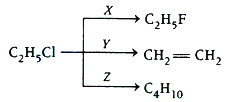
\(X, Y\) and \(Z\) respectively areKCET 2024 Hard - An electric bulb of \(60 \mathrm{~W}, 120 \mathrm{~V}\) is to be connected to 220 V source. What resistance should be connected in series with the bulb, so that the bulb glows properly?KCET 2024 Medium
- A solution of \( 1.25 \mathrm{~g} \) of ' \( \mathrm{P} \) ' in \( 50 \mathrm{~g} \) of water lowers freezing point by \( 0.3{ }^{\circ} \mathrm{C} \). Molar mass of ' \( \mathrm{P} \) ' is
94. \( K_{\mathrm{f}(\text { water })}=1.86 \mathrm{Kg} \mathrm{mol}^{-1} \). The degree of association of ' \( \mathrm{P} \) ' in water isKCET 2014 Easy - The height \(y\) and the distance \(x\) along the horizontal plane of a projectile on a certain planet (with no surrounding atmosphere) are given by \(y=8 t-5 t^{2} \mathrm{~m}\) and \(x=6 t \mathrm{~m}\), where \(t\) is in seconds. The velocity with which the projectile is projected isKCET 2011 Medium