


KCET · Chemistry · Coordination Compounds
Match the following.
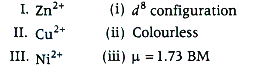
Codes
- A \(\text{I} \to \text{(i) II} \to \text{(ii) III} \to \text{(iii)}\)
- B \(\text{I} \to \text{(ii) II} \to \text{(iii) III} \to \text{(i)}\)
- C \(\text{I} \to \text{(ii) II} \to \text{(i) III} \to \text{(iii)}\)
- D \(\text{I} \to \text{(i) II} \to \text{(iii) III} \to \text{(ii)}\)
Answer & Solution
Correct Answer
(B) \(\text{I} \to \text{(ii) II} \to \text{(iii) III} \to \text{(i)}\)
Step-by-step Solution
Detailed explanation
The correct match is I-(ii), II-(iii), III-(i)
- \(\mathrm{Zn}^{2+}(Z=30)\) The outer electronic configuration of \(\mathrm{Zn}^{2+}\) is \(3 d^{10}\). Thus, it has no unpaired electrons. Hence, it is colourless.
- \(\mathrm{Cu}^{2+}(Z=29)\) The outer electronic configuration of \(\mathrm{Cu}^{2+}\) is \(3 d^9\). Hence, it contains one unpaired electron. So, \(\mu=\sqrt{1(1+2)}=1.73 \mathrm{BM}\)
- \(\mathrm{Ni}^{2+}(Z=28)\) The outer electronic configuration of \(4 d^8 \mathrm{Ni}^{2+}\) is \(3 d^8\). Hence, its configuration is \(d^8\).
- \(\mathrm{Zn}^{2+}(Z=30)\) The outer electronic configuration of \(\mathrm{Zn}^{2+}\) is \(3 d^{10}\). Thus, it has no unpaired electrons. Hence, it is colourless.
- \(\mathrm{Cu}^{2+}(Z=29)\) The outer electronic configuration of \(\mathrm{Cu}^{2+}\) is \(3 d^9\). Hence, it contains one unpaired electron. So, \(\mu=\sqrt{1(1+2)}=1.73 \mathrm{BM}\)
- \(\mathrm{Ni}^{2+}(Z=28)\) The outer electronic configuration of \(4 d^8 \mathrm{Ni}^{2+}\) is \(3 d^8\). Hence, its configuration is \(d^8\).
See the Complete Solution
Get step-by-step explanations for this and 2.5 Lakh+ more JEE, NEET & CET questions.
- Unlock all solutions
- Practice the full chapter
- Track accuracy across PYQs
4.8 rated on Google Play · 14,000+ reviews
More questions from Chemistry
- The glycosidic linkage involved in linking the glucose units in amylose part of starch isKCET 2018 Easy
- During the formation of a chemical bondKCET 2007 Medium
- For the reaction \(2 \mathrm{~N}_2 \mathrm{O}_{5_{(8)}} \rightarrow 4 \mathrm{NO}_{2_{(\mathrm{g})}}+\mathrm{O}_{2_{(8)}}\) initial concentration of \(\mathrm{N}_2 \mathrm{O}_5\) is \(2.0 \mathrm{molL}^{-1}\) and after 300 \(\min\), it is reduced to \(1.4 \mathrm{molL}^{-1}\). The rate of production of \(\mathrm{NO}_2\left(\right.\) in \(\mathrm{molL}^{-1} \mathrm{~min}^{-1}\) ) isKCET 2025 Medium
- Which of the following oxides shows electrical properties like metals?KCET 2018 Hard
- Which of the following is the correct order of radius?KCET 2018 Easy
- A first order reaction is \(60 \%\) complete in 20 minutes. How long will the reaction take to be \(84 \%\) complete?KCET 2012 Medium
More PYQs from KCET
- Exoskeleton of arthropods is made up of unique complex polysaccharide known asKCET 2024 Medium
- The focus of the parabola \(y=2 x^{2}+x\) isKCET 2007 Medium
- If \(\mathrm{A}=\frac{1}{\pi}\left[\begin{array}{ll}\sin ^{-1}(\mathrm{x} \pi) & \tan ^{-1}\left(\frac{\mathrm{x}}{\pi}\right) \\ \sin ^{-1}\left(\frac{\mathrm{x}}{\pi}\right) & \cot ^{-1}(\pi \mathrm{x})\end{array}\right] \mathrm{B}=\left[\begin{array}{cc}-\cos ^{-1}(\mathrm{x} \pi) & \tan ^{-1}\left(\frac{\mathrm{x}}{\pi}\right) \\ \sin ^{-1}\left(\frac{\mathrm{x}}{\pi}\right) & -\tan ^{-1}(\pi x)\end{array}\right]\) then \(\mathrm{A}-\mathrm{B}\) equal toKCET 2016 Medium
- Empirical formula of a compound is \(\mathrm{CH}_{2} \mathrm{O}\) and its molecular mass is 90 , the molecular formula of the compound isKCET 2013 Hard
- n-Propyl chloride reacts with sodium metal in dry ether to giveKCET 2018 Medium
- The brain capacity of Homo habilis isKCET 2019 Medium