


KCET · Maths · Matrices
If \(\mathrm{A}=\frac{1}{\pi}\left[\begin{array}{ll}\sin ^{-1}(\mathrm{x} \pi) & \tan ^{-1}\left(\frac{\mathrm{x}}{\pi}\right) \\ \sin ^{-1}\left(\frac{\mathrm{x}}{\pi}\right) & \cot ^{-1}(\pi \mathrm{x})\end{array}\right] \mathrm{B}=\left[\begin{array}{cc}-\cos ^{-1}(\mathrm{x} \pi) & \tan ^{-1}\left(\frac{\mathrm{x}}{\pi}\right) \\ \sin ^{-1}\left(\frac{\mathrm{x}}{\pi}\right) & -\tan ^{-1}(\pi x)\end{array}\right]\) then \(\mathrm{A}-\mathrm{B}\) equal to
- A I
- B \( 0 \)
- C ( \( 2 I \)
- D \( \frac{1}{2} I \)
Answer & Solution
Correct Answer
(D) \( \frac{1}{2} I \)
Step-by-step Solution
Detailed explanation
We have, \(A=\left[\begin{array}{ll}\frac{1}{\pi} \sin ^{-1}(x \pi) & \frac{1}{\pi} \tan ^{-1}\left(\frac{x}{\pi}\right) \\ \frac{1}{\pi} \sin ^{-1}\left(\frac{x}{\pi}\right) & \frac{1}{\pi} \cot ^{-1}(\pi x)\end{array}\right] B=\left[\begin{array}{cc}-\frac{1}{\pi} \cos ^{-1}(x \pi) & \frac{1}{\pi} \tan ^{-1}\left(\frac{x}{\pi}\right) \\ \frac{1}{\pi} \sin ^{-1}\left(\frac{x}{\pi}\right) & -\frac{1}{\pi} \tan ^{-1}(\pi x)\end{array}\right]\)
\(\therefore A-B=\left[\begin{array}{ll}
\frac{1}{\pi}\left(\sin ^{-1} x \pi+\cos ^{-1} x \pi\right) & \frac{1}{\pi}\left(\tan ^{-1} \frac{x}{\pi}-\tan ^{-1} \frac{x}{\pi}\right) \\
\frac{1}{\pi}\left(\sin ^{-1} \frac{x}{\pi}-\sin ^{-1} \frac{x}{\pi}\right) & \frac{1}{\pi}\left(\cot ^{-1} \pi x\right)+\tan ^{-1} \pi x
\end{array}\right]\)
\(\left[\begin{array}{cc}
\frac{1}{\pi} \cdot \frac{\pi}{2} & 0 \\
0 & \frac{1}{\pi} \cdot \frac{\pi}{2}
\end{array}\right]\left[\begin{array}{l}
\because \sin ^{-1} x+\cos ^{-1} x=\frac{\pi}{2} \\
\text { and } \tan ^{-1} x+\cot ^{-1} x=\frac{\pi}{2}
\end{array}\right]\)
\(=\frac{1}{2}\left[\begin{array}{ll}
1 & 0 \\
0 & 1
\end{array}\right]=\frac{1}{2} \mathrm{I}\)
\(\therefore A-B=\left[\begin{array}{ll}
\frac{1}{\pi}\left(\sin ^{-1} x \pi+\cos ^{-1} x \pi\right) & \frac{1}{\pi}\left(\tan ^{-1} \frac{x}{\pi}-\tan ^{-1} \frac{x}{\pi}\right) \\
\frac{1}{\pi}\left(\sin ^{-1} \frac{x}{\pi}-\sin ^{-1} \frac{x}{\pi}\right) & \frac{1}{\pi}\left(\cot ^{-1} \pi x\right)+\tan ^{-1} \pi x
\end{array}\right]\)
\(\left[\begin{array}{cc}
\frac{1}{\pi} \cdot \frac{\pi}{2} & 0 \\
0 & \frac{1}{\pi} \cdot \frac{\pi}{2}
\end{array}\right]\left[\begin{array}{l}
\because \sin ^{-1} x+\cos ^{-1} x=\frac{\pi}{2} \\
\text { and } \tan ^{-1} x+\cot ^{-1} x=\frac{\pi}{2}
\end{array}\right]\)
\(=\frac{1}{2}\left[\begin{array}{ll}
1 & 0 \\
0 & 1
\end{array}\right]=\frac{1}{2} \mathrm{I}\)
See the Complete Solution
Get step-by-step explanations for this and 2.5 Lakh+ more JEE, NEET & CET questions.
- Unlock all solutions
- Practice the full chapter
- Track accuracy across PYQs
4.8 rated on Google Play · 14,000+ reviews
More questions from Maths
- If \(P=\left[\begin{array}{lll}1 & \alpha & 3 \\ 1 & 3 & 3 \\ 2 & 4 & 4\end{array}\right]\) is the adjoint of a \(3 \times 3\)
matrix \(A\) and \(|A|=4\), then \(\alpha\) is equal toKCET 2024 Easy - The length of the subtangent at \(t\) on the curve \(\mathrm{x}=\mathrm{a}(\mathrm{t}+\sin \mathrm{t}), \mathrm{y}=\mathrm{a}(1-\cos \mathrm{t})\) isKCET 2009 Hard
- The symmetric part of the matrix \( A=\left(\begin{array}{ccc}1 & 2 & 4 \\ 6 & 8 & 2 \\ 2 & -2 & 7\end{array}\right) \) isKCET 2014 Medium
- The function \(f(x)=\log (1+x)-\frac{2 x}{2+x}\) is increasing onKCET 2022 Medium
- If \(1, \omega, \omega^{2}\) are the cube roots of unity, then \((1+\omega)\left(1+\omega^{2}\right)\left(1+\omega^{4}\right)\left(1+\omega^{8}\right)\) is equal toKCET 2007 Easy
- The general solution of \(\left(\frac{d y}{d x}\right)^{2}=1-x^{2}-y^{2}+x^{2} y^{2}\) isKCET 2011 Easy
More PYQs from KCET
- Match List-I with List-II
\begin{array}{|l|l|l|l|}\hline & \text{List-I (Types of redox reactions)} & & \text{List-II (Examples)} \\\hline \text{a}. & \text{Combination reaction} & \text{(i)} & \mathrm{Cl}_{2(\mathrm{~g})}+2 \mathrm{Br}_{(\mathrm{aq})}^{-} \rightarrow 2 \mathrm{Cl}_{(\mathrm{aq})}^{-}+\mathrm{Br}_{2(\mathrm{l})} \\\hline \text{b.} & \text{Decomposition reaction} & \text{(ii)} & 2 \mathrm{H}_2 \mathrm{O}_{2(\mathrm{aq})} \rightarrow 2 \mathrm{H}_2 \mathrm{O}_{(1)}+\mathrm{O}_{2(\mathrm{~g})} \\\hline \text{c.} & \text{Displacement reaction} & \text{(iii)} & \mathrm{CH}_{4(\mathrm{~g})}+2 \mathrm{O}_{2(\mathrm{~g})} \xrightarrow{\Delta} \mathrm{CO}_{2(\mathrm{~g})}+2 \mathrm{H}_2 \mathrm{O}_{(1)} \\\hline \text{d.} & \text{Disproportionation reaction} & \text{(iv)} & \mathrm{H}_2 \mathrm{O}_{(1)} \xrightarrow{\Delta} 2 \mathrm{H}_{2(\mathrm{~g})}+\mathrm{O}_{2(\mathrm{~g})} \\\hline\end{array}
Choose the correct answer from the options given below.KCET 2025 Medium - What range of electromagnetic spectrum is considered as light?KCET 2026 Easy
- If the angle of minimum deviation is equal to angle of a prism for an equilateral prism, then the speed of light inside the prism is .....KCET 2024 Medium
- A block of certain mass is placed on a rough inclined plane. The angle between the plane and the horizontal is \(30^{\circ}\). The coefficients of static and kinetic frictions between the block and the inclined plane are 0.6 and 0.5 respectively. Then, the magnitude of the acceleration of the block is [Take \(\left.g=10 \mathrm{~ms}^{-2}\right]\)
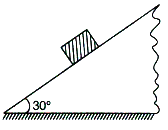 KCET 2024 Medium
 - The probability distribution of \( x \) is
\(\begin{array}{|l|l|l|l|l|}
\hline \mathbf{x} & 0 & 1 & 2 & 3 \\
\hline \mathbf{P}(\mathbf{x}) & 0.2 & k & k & 2 k \\
\hline
\end{array}\)
find the value of \( k \)KCET 2015 Hard - Electron from excited chlorophyll molecules of photosystem II are accepted first byKCET 2013 Hard