


KCET · Chemistry · Alcohols Phenols and Ethers
Arrange the following compounds in the increasing order of their acidic strength :
i. m-nitrophenol
ii. m-cresol
iii. phenol
iv. m-chlorophenol
- A iii \( < \mathrm{ii} < \mathrm{i} < \mathrm{iv} \)
- B ii \( < \) iv \( < \mathrm{iii} < i \)
- C \( \mathrm{ii} < \mathrm{iii} < \mathrm{iv} < \mathrm{i} \)
- D ii \( < \mathrm{iii} < \mathrm{i} < \mathrm{iv} \)
Answer & Solution
Correct Answer
(C) \( \mathrm{ii} < \mathrm{iii} < \mathrm{iv} < \mathrm{i} \)
Step-by-step Solution
Detailed explanation
Nitro group has both \( -R \) effect and \( -1 \) effect; but \( -R \) effect predominates. Due to stronger electron withdrawing nature of
\( \mathrm{NO}_{2} \) group, phenoxide ion is stabilized. Hence, m-nitrophenol is more acidic than phenol. Methyl group destabilizes the
phenoxide ion by \( +I \) effect and hyperconjugation. Hence m-cresol is weaker acid than phenol. Chlorine have both +R
and \( -1 \) effect but \( -1 \) effect predominates
Hence m-chlorophenol is more acidic than phenol. \( -R \) effect of nitro group is stronger than \( -1 \) effect of chlorine hence, m-
nitrophenol is more acidic than m-chlorophenol.
Therefore, the correct order of acidic strength is \( m \)-nitrophenol \( >m \)-chlorophenol \( >p h e n o l>m \)-cresol.
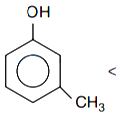
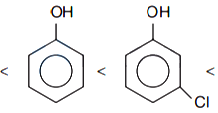
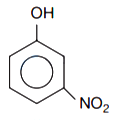
(II)
(III)
(IV)
(I)
\( \mathrm{NO}_{2} \) group, phenoxide ion is stabilized. Hence, m-nitrophenol is more acidic than phenol. Methyl group destabilizes the
phenoxide ion by \( +I \) effect and hyperconjugation. Hence m-cresol is weaker acid than phenol. Chlorine have both +R
and \( -1 \) effect but \( -1 \) effect predominates
Hence m-chlorophenol is more acidic than phenol. \( -R \) effect of nitro group is stronger than \( -1 \) effect of chlorine hence, m-
nitrophenol is more acidic than m-chlorophenol.
Therefore, the correct order of acidic strength is \( m \)-nitrophenol \( >m \)-chlorophenol \( >p h e n o l>m \)-cresol.
(II)
(III)
(IV)
(I)
See the Complete Solution
Get step-by-step explanations for this and 2.5 Lakh+ more JEE, NEET & CET questions.
- Unlock all solutions
- Practice the full chapter
- Track accuracy across PYQs
4.8 rated on Google Play · 14,000+ reviews
More questions from Chemistry
- In the reaction between hydrogen sulphide and acidified permanganate solution,KCET 2025 Medium
- An alkali metal hydride \( (\mathrm{NaH}) \) reacts with diborane in ' \( A \) ' to give a tetrahedral compound 'ET
which is extensively used as reducing agent in organic synthesis. The compounds 'A' and 'ET
respectively areKCET 2015 Medium - When the vapours of tertiary butyl alcohol are passed through heated copper at \( 573 \mathrm{~K} \), the
product formed isKCET 2018 Hard - A: Entropy of a perfect crystalline solid at absolute zero approaches zero.
B: For spontaneity of a reaction, \(T\Delta S > \Delta H\).
Among the two statements given above, identify the correct answer from the options given below.KCET 2026 Medium - Phenol can be distinguished from propanol by using the reagentKCET 2025 Easy
- Empirical formula of a compound is \(\mathrm{CH}_{2} \mathrm{O}\) and its molecular mass is 90 , the molecular formula of the compound isKCET 2013 Hard
More PYQs from KCET
- Which one of the following has no unpaired electrons?KCET 2012 Easy
- The number of ATP produced when a molecule of glucose undergoes fermentation isKCET 2011 Easy
- Flash spectrum confirms a/an\KCET 2011 Easy
- The maximum height attained by a projectile when thrown at an angle \(\theta\) with the horizontal is found to be half the horizontal range. Then \(\theta\) is equal toKCET 2007 Easy
- Mass number of the elements A, B, C and D are \(30,60,90\) and 120 respectively. The specific binding energy of them are \(5 \mathrm{MeV}, 8.5 \mathrm{MeV}\), \(8 \mathrm{MeV}\) and \(7 \mathrm{MeV}\) respectively. Then, in which of the following reaction/s energy is released?
1. \(\mathrm{D} \rightarrow 2 \mathrm{~B}\)
2. \(\mathrm{C} \rightarrow \mathrm{B}+\mathrm{A}\)
3. \(\mathrm{B} \rightarrow 2 \mathrm{~A}\)KCET 2012 Medium - Which one of the following pairs will show positive deviation from Raoult's law?KCET 2024 Easy