


KCET · Chemistry · Ionic Equilibrium
A \(0.15\) mole of pyridinium chloride has been added to \(500\text{ cm}^3\) of \(0.2\) M pyridine solution (a base). Assuming there is no change in volume upon mixing(Given: \(pK_b\) of pyridine = 8.82), the pH of the resulting solution is
- A \(5\)
- B \(6\)
- C \(7\)
- D \(8\)
Answer & Solution
Correct Answer
(A) \(5\)
Step-by-step Solution
Detailed explanation
Moles of pyridine (base) \(= 0.2 \times 0.5 = 0.1\) mol
Moles of pyridinium chloride (salt) \(= 0.15\) mol
Using the Henderson-Hasselbalch equation for a basic buffer:
\(pOH = pK_b + \log\left(\dfrac{\text{Moles of salt}}{\text{Moles of base}}\right)\)
\(pOH = 8.82 + \log\left(\dfrac{0.15}{0.10}\right)\)
\(pOH = 8.82 + \log(1.5)\)
\(pOH = 8.82 + 0.176 \approx 9\)
\(pH = 14 - pOH = 14 - 9 = 5\)
Answer: \(5\)
Moles of pyridinium chloride (salt) \(= 0.15\) mol
Using the Henderson-Hasselbalch equation for a basic buffer:
\(pOH = pK_b + \log\left(\dfrac{\text{Moles of salt}}{\text{Moles of base}}\right)\)
\(pOH = 8.82 + \log\left(\dfrac{0.15}{0.10}\right)\)
\(pOH = 8.82 + \log(1.5)\)
\(pOH = 8.82 + 0.176 \approx 9\)
\(pH = 14 - pOH = 14 - 9 = 5\)
Answer: \(5\)
See the Complete Solution
Get step-by-step explanations for this and 2.5 Lakh+ more JEE, NEET & CET questions.
- Unlock all solutions
- Practice the full chapter
- Track accuracy across PYQs
4.8 rated on Google Play · 14,000+ reviews
More questions from Chemistry
- Gram molecular volume of oxygen at STP isKCET 2007 Medium
- During the electrolysis of brine, by using inert electrodes,KCET 2023 Medium
-
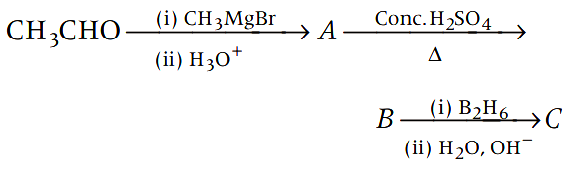
\(A\) and \(C\) areKCET 2021 Medium - Excess of \(\mathrm{PCl}_{5}\) reacts with conc \(\mathrm{H}_{2} \mathrm{SO}_{4}\) givingKCET 2008 Medium
- The electronic configuration of \(\mathrm{Cu}^{2+}\) ion isKCET 2013 Easy
- In an alkaline medium, glycine predominantly exists as/in a/anKCET 2011 Easy
More PYQs from KCET
- Reactions in Zeolite catalyst depend on,KCET 2016 Easy
- A wheel starting from rest gains an angular velocity of \(10 \mathrm{rad} / \mathrm{s}\) after uniformly accelerated for \(5 \mathrm{~s}\). The total angle through which it has turned isKCET 2020 Easy
- If \(\mathbf{a}+2 \mathbf{b}+3 \mathbf{c}=0\) and \((\mathbf{a} \times \mathbf{b})+(\mathbf{b} \times \mathbf{c})+(\mathbf{c} \times \mathbf{a})=\lambda(\mathbf{b} \times \mathbf{c})\), then the value of \(\lambda\) is equal toKCET 2023 Easy
- \(1 \mathrm{dm}^{3}\) solution containing \(10^{-5}\) moles each of \(\mathrm{Cl}^{-}\)ions and \(\mathrm{CrO}_{4}^{2-}\) ions is treated with \(10^{-4}\) moles of silver nitrate. Which one of the following observations is made?
\(\begin{aligned} {\left[\mathrm{K}_{\mathrm{sp}} \mathrm{Ag}_{2} \mathrm{CrO}_{4}\right.} &\left.=4 \times 10^{-12}\right] \\ {\left[\mathrm{K}_{\mathrm{sp}} \mathrm{AgCl}\right.} &\left.=1 \times 10^{-10}\right] \end{aligned}\)KCET 2010 Medium - The value of \(\lambda\) for which the vectors \(\vec{a} = 2\hat{i} + \lambda\hat{j} + \hat{k}\) and \(\vec{b} = \hat{i} + 2\hat{j} + 3\hat{k}\) are orthogonal isKCET 2026 Easy
- A cycle tyre bursts suddenly. What is the type of this process?KCET 2014 Medium