


KCET · Physics · Rotational Motion
A wheel starting from rest gains an angular velocity of \(10 \mathrm{rad} / \mathrm{s}\) after uniformly accelerated for \(5 \mathrm{~s}\). The total angle through which it has turned is
- A \(25 \mathrm{rad}\)
- B \(100 \mathrm{rad}\)
- C \(25 \pi \mathrm{rad}\)
- D \(50 \pi \mathrm{rad}\) and a vertical axis
Answer & Solution
Correct Answer
(A) \(25 \mathrm{rad}\)
Step-by-step Solution
Detailed explanation
Initial angular velocity of wheel, \(\omega_{0}=0\)
Final angular velocity, \(\omega=10 \mathrm{rad} / \mathrm{s}\)
\(t=5 \mathrm{~s}\)
By first equation of rotational motion,
\(\omega=\omega_{0}+\alpha t \)
\( \Rightarrow 10=0+\alpha \times 5 \)
\( \Rightarrow \alpha=\frac{10}{5}=2 \mathrm{rad} / \mathrm{s}^{2}\)
If \(\theta\) be the total angle through which wheel has turned, then from,
\(\theta =\omega_{0} t+\frac{1}{2} \alpha t^{2} \)
\( =0 \times 5+\frac{1}{2} \times 2 \times 5^{2}=0+25 \)
\( \Rightarrow \theta =25 \mathrm{rad}\)
Final angular velocity, \(\omega=10 \mathrm{rad} / \mathrm{s}\)
\(t=5 \mathrm{~s}\)
By first equation of rotational motion,
\(\omega=\omega_{0}+\alpha t \)
\( \Rightarrow 10=0+\alpha \times 5 \)
\( \Rightarrow \alpha=\frac{10}{5}=2 \mathrm{rad} / \mathrm{s}^{2}\)
If \(\theta\) be the total angle through which wheel has turned, then from,
\(\theta =\omega_{0} t+\frac{1}{2} \alpha t^{2} \)
\( =0 \times 5+\frac{1}{2} \times 2 \times 5^{2}=0+25 \)
\( \Rightarrow \theta =25 \mathrm{rad}\)
See the Complete Solution
Get step-by-step explanations for this and 2.5 Lakh+ more JEE, NEET & CET questions.
- Unlock all solutions
- Practice the full chapter
- Track accuracy across PYQs
4.8 rated on Google Play · 14,000+ reviews
More questions from Physics
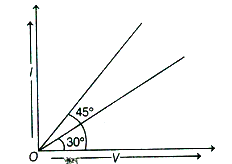
- The \(I-V\) graph for a conductor at two different temperatures \(100^{\circ} \mathrm{C}\) and \(400^{\circ} \mathrm{C}\) is as shown in the figure. The temperature coefficient of resistance of the conductor is about (in per degree Celsius)
 KCET 2024 Hard
 - An object is placed at a distance of \( 20 \mathrm{~cm} \) from the pole of a concave mirror of focal length \( 10 \)
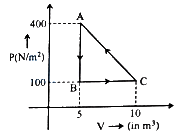
\( \mathrm{cm} \). The distance of the image formed isKCET 2018 Medium - A thermodynamic system undergoes a cyclic process \( A B C \) as shown in the diagram. The work done by the system per cycle is
 KCET 2019 Medium
 - A wire of resistance \(3 \Omega\) is stretched to twice its original length. The resistance of the new wire will beKCET 2021 Easy
- Two metal plates are separated by \( 2 \mathrm{~cm} \). The potentials of the plates are \( -10 \mathrm{~V} \) and \( +30 \mathrm{~V} \).
The electric field between the two plates is :KCET 2019 Medium - An electron isKCET 2007 Easy
More PYQs from KCET
- The development of quick immune response in a person infected with deadly microbes by administering performed antibodies isKCET 2021 Medium
- \(a\text{C}_2\text{O}_4^{2-} + b\text{MnO}_4^- + c\text{H}^+ \rightarrow x\text{Mn}^{2+} + y\text{H}_2\text{O} + z\text{CO}_2\)
\(a\) and \(x\) respectively areKCET 2026 Medium - A group \((G, *)\) has 10 elements. The minimum number of elements of \(G\), which are their own inverses isKCET 2007 Medium
- In the following equation representing \(\beta^{-}\) decay, the number of neutrons in the nucleus \(X\) is
\({ }_{83}^{210} \mathrm{Bi} \longrightarrow X+e^{-1}+\bar{v}\)KCET 2023 Easy - If \(A=\left[\begin{array}{ll}1 & 2 \\ 3 & 4\end{array}\right]\), then \(\mathrm{A}^{-1}\) is equal toKCET 2008 Easy
- A capacitor of capacitance \(5 \mu \mathrm{~F}\) is charged by a battery of emf 10 V . At an instant of time, the potential difference across the capacitors is 4 V and the time rate of change of potential difference across the capacitor is \(0.6 \mathrm{Vs}^{-1}\). Then, the time rate at which energy is stored in the capacitor at any instant isKCET 2024 Hard