


KCET · Chemistry · p Block Elements (Group 15, 16, 17 & 18)
\( 0.44 \mathrm{~g} \) of a monohydric alcohol when added to methylmagnesium iodide in ether liberates at
S.T.P., \( 112 \mathrm{~cm}^{3} \) of methane. With PCC the same alcohol forms a carbonyl compound that
answers silver mirror test. The monohydric alcohol is
- A \( \left(\mathrm{CH}_{3}\right)_{3} \mathrm{C}-\mathrm{CH}_{2} \mathrm{OH} \)
- B \( \left(\mathrm{CH}_{3}\right)_{2} \mathrm{CH}-\mathrm{CH}_{2} \mathrm{OH} \)
Answer & Solution
Correct Answer
(A) \( \left(\mathrm{CH}_{3}\right)_{3} \mathrm{C}-\mathrm{CH}_{2} \mathrm{OH} \)
Step-by-step Solution
Detailed explanation
At STP \(112 \mathrm{~cm}^{3}\) of methane liberated, \(22400 \mathrm{~cm}^{3}=1 \mathrm{~mol}\) at ST
\(1 \mathrm{~cm}^{3}=\frac{1}{22400} \mathrm{~mol}\)
\(112 \mathrm{~cm}^{3}=\frac{1}{22400} \times 112 \mathrm{~mol}\)
\(=0.005\) mol of methane liberated
1 mol of monohydric alcohol react with 1 mol of methyl magnesium iodide to produces \(1 \mathrm{~mol}\) of methane, according to
the reaction,
Monohydric alcohol+ \(\mathrm{CH}_{3} \mathrm{M} \mathrm{gl}-\overline{\text { Either }}\)
\(\Rightarrow 0.005\) mol of monohydric alcohol produces \(0.005\) mol of methane
Now, molar mass of monohydric alcohol
\(=\frac{\text { Given mass of monohydric alcohol }}{\mathrm{Number} \text { of moles of monohydric alcohol }}\)
\(=\frac{0.44}{0.005}=88 \mathrm{~g}\)
Monohydric alcohol from the given option having \(88 \mathrm{~g}\) molar mass is \(\left(\mathrm{CH}_{3}\right)_{3} \mathrm{C}-\mathrm{CH}_{2} \mathrm{OH}\)
\(\left(\mathrm{CH}_{3}\right)_{3} \mathrm{C}-\mathrm{CH}_{2} \mathrm{OH}+\mathrm{CH}_{3} \mathrm{M} \mathrm{gI}-\mathrm{Either}\)
When react with \(\mathrm{PCC}\), aldehyde is formed which give positive silver mirror test.
( \(\mathrm{CH}_{3}\) ) \(\left._{3} \mathrm{C}-\mathrm{CH}_{2} \mathrm{OH}-\mathrm{CH}_{3}\right)_{3} \mathrm{C}-\mathrm{CH}_{2} \mathrm{OM} \mathrm{gI}+\mathrm{CH}_{4}\)
( \(\mathrm{CH}_{3}\) ) \(_{3} \mathrm{C}-\mathrm{CHO}\)
\(1 \mathrm{~cm}^{3}=\frac{1}{22400} \mathrm{~mol}\)
\(112 \mathrm{~cm}^{3}=\frac{1}{22400} \times 112 \mathrm{~mol}\)
\(=0.005\) mol of methane liberated
1 mol of monohydric alcohol react with 1 mol of methyl magnesium iodide to produces \(1 \mathrm{~mol}\) of methane, according to
the reaction,
Monohydric alcohol+ \(\mathrm{CH}_{3} \mathrm{M} \mathrm{gl}-\overline{\text { Either }}\)
\(\Rightarrow 0.005\) mol of monohydric alcohol produces \(0.005\) mol of methane
Now, molar mass of monohydric alcohol
\(=\frac{\text { Given mass of monohydric alcohol }}{\mathrm{Number} \text { of moles of monohydric alcohol }}\)
\(=\frac{0.44}{0.005}=88 \mathrm{~g}\)
Monohydric alcohol from the given option having \(88 \mathrm{~g}\) molar mass is \(\left(\mathrm{CH}_{3}\right)_{3} \mathrm{C}-\mathrm{CH}_{2} \mathrm{OH}\)
\(\left(\mathrm{CH}_{3}\right)_{3} \mathrm{C}-\mathrm{CH}_{2} \mathrm{OH}+\mathrm{CH}_{3} \mathrm{M} \mathrm{gI}-\mathrm{Either}\)
When react with \(\mathrm{PCC}\), aldehyde is formed which give positive silver mirror test.
( \(\mathrm{CH}_{3}\) ) \(\left._{3} \mathrm{C}-\mathrm{CH}_{2} \mathrm{OH}-\mathrm{CH}_{3}\right)_{3} \mathrm{C}-\mathrm{CH}_{2} \mathrm{OM} \mathrm{gI}+\mathrm{CH}_{4}\)
( \(\mathrm{CH}_{3}\) ) \(_{3} \mathrm{C}-\mathrm{CHO}\)
See the Complete Solution
Get step-by-step explanations for this and 2.5 Lakh+ more JEE, NEET & CET questions.
- Unlock all solutions
- Practice the full chapter
- Track accuracy across PYQs
4.8 rated on Google Play · 14,000+ reviews
More questions from Chemistry
- A solution of \( 1.25 \mathrm{~g} \) of ' \( \mathrm{P} \) ' in \( 50 \mathrm{~g} \) of water lowers freezing point by \( 0.3{ }^{\circ} \mathrm{C} \). Molar mass of ' \( \mathrm{P} \) ' is
94. \( K_{\mathrm{f}(\text { water })}=1.86 \mathrm{Kg} \mathrm{mol}^{-1} \). The degree of association of ' \( \mathrm{P} \) ' in water isKCET 2014 Easy - The time required for \(60 \%\) completion of a first order reaction is \(50 \mathrm{~min}\).
The time required for \(93.6 \%\) completion of the same reaction will beKCET 2020 Medium - An organic compound \( \mathrm{X} \) is oxidised by using acidified \( \mathrm{K}_{2} \mathrm{Cr}_{2} \mathrm{O}_{7} \) solution. The product obtained
reacts with phenyl hydrazine but does not answer silver mirror test. The compound \( X \) is,KCET 2016 Medium - \( \mathrm{HCl} \) gas is covalent and \( \mathrm{NaCl} \) is an ionic compound. This is becauseKCET 2016 Medium
- The general name of the compound formed by the reaction between aldehyde and alcohol isKCET 2022 Easy
- Cooking is fast in a pressure cooker, becauseKCET 2009 Easy
More PYQs from KCET
- A box has \( 100 \) pens of which \( 10 \) are defective. The probability that out of a sample of \( 5 \) pens
drawn one by one with replacement and at most one is defective isKCET 2017 Easy - In the given figure, the magnetic field at \(O\).
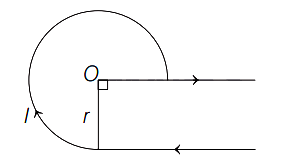 KCET 2020 Easy
 - The negation of the statement
"For every real number \(x ; x^2+5\) is positive" isKCET 2024 Easy - Which of the following is an empty set?KCET 2023 Easy
- A cyclotron is used to accelerate protons \(\left({ }_{1}^{1} \mathrm{H}\right)\) deuterons \(\left({ }_{1}^{2} \mathrm{H}\right)\) and \(\alpha\)-particles \(\left({ }_{2}^{4} \mathrm{He}\right)\). While exiting under similar conditions, the minimum KE is gained byKCET 2020 Medium
- Which of the following characters is not requires for autogamy?KCET 2017 Medium