


KCET · Physics · Magnetic Effects of Current
A cyclotron is used to accelerate protons \(\left({ }_{1}^{1} \mathrm{H}\right)\) deuterons \(\left({ }_{1}^{2} \mathrm{H}\right)\) and \(\alpha\)-particles \(\left({ }_{2}^{4} \mathrm{He}\right)\). While exiting under similar conditions, the minimum KE is gained by
- A \(\alpha\)-particles
- B protons
- C deuterons
- D Same for all
Answer & Solution
Correct Answer
(C) deuterons
Step-by-step Solution
Detailed explanation
When a charged particle is accelerated by a potential difference \(V\) volts, then the radius of the trajectory of the path of the particle is given as,
\(r =\frac{\sqrt{2 K m}}{B q}=\frac{\sqrt{2 q V m}}{B q} \)
\( \Rightarrow K =\frac{1}{2} \frac{B^{2} q^{2} r^{2}}{m} \text { or } K \propto \frac{q^{2}}{m} ...(i)\)
For protons \(\left({ }_{1}^{1} \mathrm{H}\right)\), deuterons \(\left({ }_{1}^{2} \mathrm{H}\right)\) and \(\alpha\)-particles \(\left({ }_{2}^{4} \mathrm{He}\right)\),
\(q_{p}: q_{d}: q_{\alpha}=1: 1: 2 ...(ii)\)
\( m_{p}: m_{d}: m_{\alpha} =1: 2: 4 ...(iii)\)
From Eqs. (i), (ii) and (iii), we can write
\(\Rightarrow K_{p}: K_{d}: K_{\alpha}=1: \frac{1}{4}: 1\)
Thus, minimum kinetic energy is gained by deuterons.
\(r =\frac{\sqrt{2 K m}}{B q}=\frac{\sqrt{2 q V m}}{B q} \)
\( \Rightarrow K =\frac{1}{2} \frac{B^{2} q^{2} r^{2}}{m} \text { or } K \propto \frac{q^{2}}{m} ...(i)\)
For protons \(\left({ }_{1}^{1} \mathrm{H}\right)\), deuterons \(\left({ }_{1}^{2} \mathrm{H}\right)\) and \(\alpha\)-particles \(\left({ }_{2}^{4} \mathrm{He}\right)\),
\(q_{p}: q_{d}: q_{\alpha}=1: 1: 2 ...(ii)\)
\( m_{p}: m_{d}: m_{\alpha} =1: 2: 4 ...(iii)\)
From Eqs. (i), (ii) and (iii), we can write
\(\Rightarrow K_{p}: K_{d}: K_{\alpha}=1: \frac{1}{4}: 1\)
Thus, minimum kinetic energy is gained by deuterons.
See the Complete Solution
Get step-by-step explanations for this and 2.5 Lakh+ more JEE, NEET & CET questions.
- Unlock all solutions
- Practice the full chapter
- Track accuracy across PYQs
4.8 rated on Google Play · 14,000+ reviews
More questions from Physics
- A graph of pressure versus volume for an ideal gas for different processes is as shown. In the graph curve \(O C\) represents
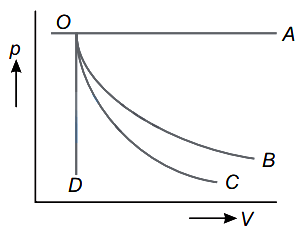 KCET 2009 Easy
 - The cylindrical tube of a spray pump has a cross-section of \(8 \mathrm{~cm}^{2}\), one end of which has 40 fine holes each of area \(10^{-8} \mathrm{~m}^{2}\). If the liquid flows inside the tube with a speed of \(0.15 \mathrm{~m} \mathrm{~min}^{-1}\), the speed with which the liquid is ejected through the holes isKCET 2007 Medium
- The particles emitted in the decay of \( { }_{92}^{238} U \) to \( { }_{92}^{234} U \):KCET 2017 Medium
- A straight wire of length \( 50 \mathrm{~cm} \) carrying a current of \( 2.5 \mathrm{~A} \) is suspended in mid-air by a uniform magnetic field of \( 0.5 \mathrm{~T} \) (as shown in figure). The mass of the wire is \( \left(\mathrm{g}=10 \mathrm{~m} \mathrm{~s}^{-2}\right) \)KCET 2017 Hard
- Two cells of internal resistance \( r_{1} \) and \( r_{2} \) and of same emf are connected in series across a resistor of resistance \( R \). If the terminal potential difference across the cells of internal resistance \( r_{1} \) is zero, then the value of \( \mathrm{R} \) isKCET 2018 Easy
- If an electron is revolving in its Bohr orbit having Bohr radius of \(0.529 Å\), then the radius of third orbit isKCET 2022 Easy
More PYQs from KCET
- If \(p\left(\frac{1}{q}+\frac{1}{r}\right), q\left(\frac{1}{r}+\frac{1}{p}\right), r\left(\frac{1}{p}+\frac{1}{q}\right)\) are in \(\mathrm{AP}\), then \(p, q, r\)KCET 2023 Hard
- Which noble gas has least tendency to form compounds?KCET 2022 Easy
- Hofmann's bromamide reaction is to convertKCET 2007 Medium
- How many Coulombs of electricity are required for the oxidation of one mol of water to
dioxygen?KCET 2015 Medium - If \(y=\cos ^{2} \frac{3 x}{2}-\sin ^{2} \frac{3 x}{2}\), then \(\frac{d^{2} y}{d x^{2}}\) isKCET 2007 Medium
- If \(\left|\begin{array}{ccc}1+\sin ^{2} \theta & \cos ^{2} \theta & 4 \sin 2 \theta \\ \sin ^{2} \theta & 1+\cos ^{2} \theta & 4 \sin 2 \theta \\ \sin ^{2} \theta & \cos ^{2} \theta & 4 \sin 2 \theta-1\end{array}\right|=0\) and \(0 < \theta < \frac{\pi}{2}\), then \(\cos 4 \theta\) is equal toKCET 2009 Hard