


KCET · Physics · Magnetic Effects of Current
In the given figure, the magnetic field at \(O\).
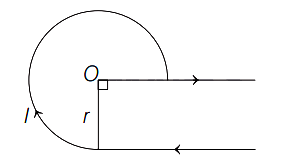
- A \(\frac{3}{4} \frac{\mu_{0} I}{r}+\frac{\mu_{0} I}{4 \pi r}\)
- B \(\frac{3}{10} \frac{\mu_{0} I}{r}-\frac{\mu_{0} I}{4 \pi r}\)
- C \(\frac{3}{8} \frac{\mu_{0} I}{r}+\frac{\mu_{0} I}{4 \pi r}\)
- D \(\frac{3}{8} \frac{\mu_{0} I}{r}-\frac{\mu_{0} I}{4 \pi r}\)
Answer & Solution
Correct Answer
(C) \(\frac{3}{8} \frac{\mu_{0} I}{r}+\frac{\mu_{0} I}{4 \pi r}\)
Step-by-step Solution
Detailed explanation
According to the figure, magnetic field at point is given as
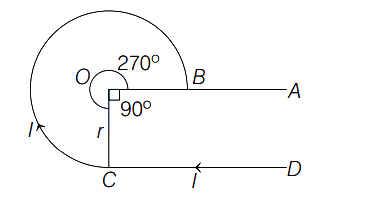
\(B_{\text {net }}=\) magnetic field due to straight wire \(A B+\)
magnetic field due to straight wire \(C D+\) magnetic field due circular wire \(B C\)
Since, point \(O\) is along the length of the wire \(B A\). So, \(B_{A B}=0\)
\(\begin{aligned}
B_{\text {net }} &=0+\frac{\mu_{0}}{4 \pi} \cdot \frac{I}{r}+\frac{270}{360}\left(\frac{\mu_{0} I}{2 r}\right) \\
&=\frac{\mu_{0} I}{4 \pi r}+\frac{3}{4} \cdot \frac{\mu_{0} I}{2 r} \\
&=\frac{\mu_{0} I}{4 \pi r}+\frac{3 \mu_{0} I}{8 r}(\text { downward })
\end{aligned}\)
\(B_{\text {net }}=\) magnetic field due to straight wire \(A B+\)
magnetic field due to straight wire \(C D+\) magnetic field due circular wire \(B C\)
Since, point \(O\) is along the length of the wire \(B A\). So, \(B_{A B}=0\)
\(\begin{aligned}
B_{\text {net }} &=0+\frac{\mu_{0}}{4 \pi} \cdot \frac{I}{r}+\frac{270}{360}\left(\frac{\mu_{0} I}{2 r}\right) \\
&=\frac{\mu_{0} I}{4 \pi r}+\frac{3}{4} \cdot \frac{\mu_{0} I}{2 r} \\
&=\frac{\mu_{0} I}{4 \pi r}+\frac{3 \mu_{0} I}{8 r}(\text { downward })
\end{aligned}\)
See the Complete Solution
Get step-by-step explanations for this and 2.5 Lakh+ more JEE, NEET & CET questions.
- Unlock all solutions
- Practice the full chapter
- Track accuracy across PYQs
4.8 rated on Google Play · 14,000+ reviews
More questions from Physics
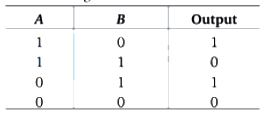
- The following truth table with \(\mathrm{A}\) and \(\mathrm{B}\) as inputs is for ........ gate.
 KCET 2012 Easy
 - A car covers the first half of the distance between two places at \(40\) km/h and another half at \(50\) km/h. The average speed of the car isKCET 2026 Easy
- A mass of \(1\) kg is executing SHM. Its displacement is given by \(x = 6.0\cos(100t + \pi/4)\) cm. What is the maximum kinetic energy?KCET 2026 Medium
- During inelastic collision between two objects, which of the following quantity always remains
conserved?KCET 2019 Easy - Two thin lenses have a combined power of +9D. When they are separated by a distance of \(20 \mathrm{~cm}\), their equivalent power becomes \(+\frac{27}{5}\) D. Their individual powers (in dioptre) areKCET 2011 Medium
- A certain current on passing through a galvanometer produces a deflection of 100 divisions. When a shunt of one ohm is connected, the deflection reduces to 1 division. The galvanometer resistance isKCET 2008 Easy
More PYQs from KCET
- Two identical rods \(A C\) and \(C B\) made of two different metals having thermal conductivities in the ratio \(2: 3\) are kept in contact with each other at the end \(C\) as shown in the figure. \(A\) is at \(100^{\circ} \mathrm{C}\) and \(B\) is at \(25^{\circ} \mathrm{C}\). Then the junction \(C\) is atKCET 2007 Medium
- \(\int^{e^{x} \cdot x^{5}} d x\) isKCET 2008 Hard
- Phenol can be distinguished from ethanol by the reagentKCET 2018 Easy
- Incorrectly matched pair isKCET 2020 Easy
- If \( \alpha \) and \( \beta \) are roots of the equation \( \chi^{2}+x+1=0 \) then \( \alpha^{2}+\beta^{2} \) isKCET 2019 Medium
- The upper level of valence band and lower level of conduction band overlap in the case ofKCET 2024 Medium