


KCET · BIOLOGY · STD 12 - 10. Biotechnology and Its Applications
Pollen grains of a plant whose 2n = 28 are cultured to get callus by tissue culture method. What would be the number of chromosomes in the cells of the callus?
- A 14
- B 56
- C 28
- D 21
Answer & Solution
Correct Answer
(A) 14
Step-by-step Solution
Detailed explanation
(A) 14,
When immature pollen grains, which are haploid with (n) chromosomes, are cultured and induced to grow into callus tissue, they maintain their haploid nature. This tissue culture method aims to produce haploid palnt, so the callus will also have (n) chromosomes. For a plant with a diploid number of 28 (2n = 28), the callus derived from haploid pollen will have 14 chromosomes (n = 14).
When immature pollen grains, which are haploid with (n) chromosomes, are cultured and induced to grow into callus tissue, they maintain their haploid nature. This tissue culture method aims to produce haploid palnt, so the callus will also have (n) chromosomes. For a plant with a diploid number of 28 (2n = 28), the callus derived from haploid pollen will have 14 chromosomes (n = 14).
See the Complete Solution
Get step-by-step explanations for this and 2.5 Lakh+ more JEE, NEET & CET questions.
- Unlock all solutions
- Practice the full chapter
- Track accuracy across PYQs
4.8 rated on Google Play · 14,000+ reviews
More questions from BIOLOGY
- If in a normal menstruating woman, menses occur on 5th April, what will be the expected date of ovulation?KCET 2019 Easy
- The number of codons effective in coding twenty amino acidsKCET 2022 Hard
- Cell theory was formulated byKCET 2022 Easy
- Which statement about photosynthesis is false?KCET 2009 Hard
- The rate of formation of new organic matter by deer in a forest ecosystem is calledKCET 2016 Easy
- Match for M and N with species-area relationship shown in the graphic representation below and choose the correct option.
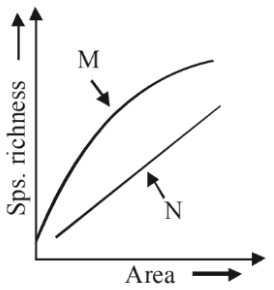 KCET 2018 Hard
More PYQs from KCET
- A copper wire of length \(1 \mathrm{~m}\) and uniform cross-sectional area \(5 \times 10^{-7} \mathrm{~m}^{2}\) carries a current of \(1 \mathrm{~A}\). Assuming that, there are \(8 \times 10^{28}\) free electrons per \(\mathrm{m}^{3}\) in copper, how long will an electron take to drift from one end of the wire to the other?KCET 2021 Hard
- The potential difference between and in the following figure is
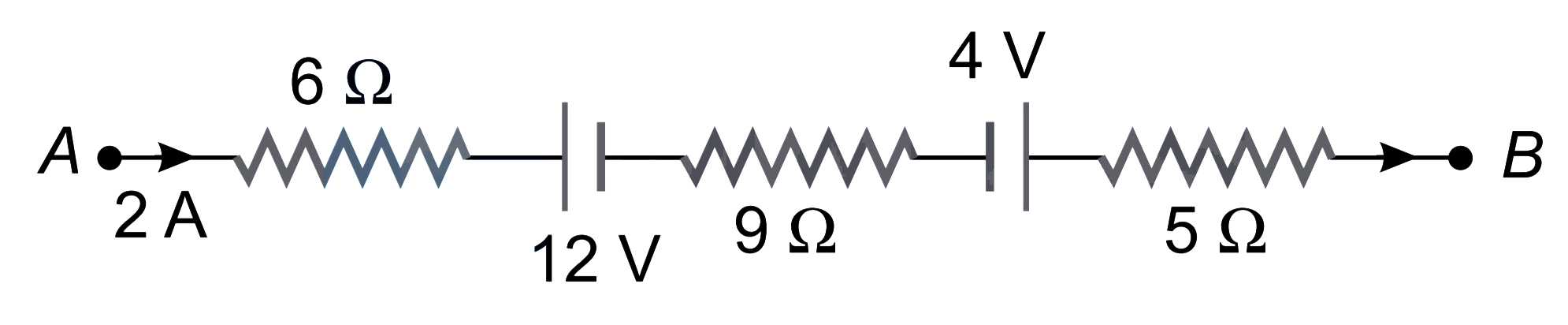 KCET 2008 Hard
 - An electron isKCET 2007 Easy
- If \( \vec{a} \) and \( \vec{b} \) are unit vectors then what is the angle between \( \vec{a} \) and \( \vec{b} \) for \( \sqrt{3} \vec{a}-\vec{b} \) to be unit
vector?KCET 2016 Medium - In a transistor, the collector current varies by \( 0.49 \mathrm{~mA} \) and emitter current varies by \( 0.50 \mathrm{~mA} \).
Current gain \( \beta \) measured isKCET 2016 Easy - If \(\mathbf{a}, \mathbf{b}\) and \(\mathbf{c}\) are unit vectors such that \(\mathbf{a}+\mathbf{b}+\mathbf{c}=\mathbf{0}\), then angle between \(\mathbf{a}\) and \(\mathbf{b}\) isKCET 2011 Medium