


KCET · Physics · Semiconductors
In a transistor, the collector current varies by \( 0.49 \mathrm{~mA} \) and emitter current varies by \( 0.50 \mathrm{~mA} \).
Current gain \( \beta \) measured is
- A 19
- B \( 150 \)
- C \( 99 \)
- D \( 100 \)
Answer & Solution
Correct Answer
(A) 19
Step-by-step Solution
Detailed explanation
Given, collector current variation, \( \Delta I_{\mathrm{c}}=0.49 \mathrm{~mA} \) emittercurrent variation, \( \Delta I_{\mathrm{E}}=0.50 \mathrm{~mA} \)
Now, current gain,
\[
\begin{array}{l}
\beta=\frac{\Delta I_{C}}{\Delta I_{B}}=\frac{\Delta I_{C}}{\Delta I_{E}-\Delta I_{C}}=\frac{0.49 \mathrm{~mA}}{(0.50-0.49) \mathrm{mA}} \\
\beta=\frac{0.49 \mathrm{~mA}}{0.01 \mathrm{~mA}}=49
\end{array}
\]
Therefore, current gain \( \beta \) is \( 49 \).
Now, current gain,
\[
\begin{array}{l}
\beta=\frac{\Delta I_{C}}{\Delta I_{B}}=\frac{\Delta I_{C}}{\Delta I_{E}-\Delta I_{C}}=\frac{0.49 \mathrm{~mA}}{(0.50-0.49) \mathrm{mA}} \\
\beta=\frac{0.49 \mathrm{~mA}}{0.01 \mathrm{~mA}}=49
\end{array}
\]
Therefore, current gain \( \beta \) is \( 49 \).
See the Complete Solution
Get step-by-step explanations for this and 2.5 Lakh+ more JEE, NEET & CET questions.
- Unlock all solutions
- Practice the full chapter
- Track accuracy across PYQs
4.8 rated on Google Play · 14,000+ reviews
More questions from Physics
- The following truth table with \(\mathrm{A}\) and \(\mathrm{B}\) as inputs is for ........ gate.
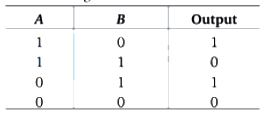 KCET 2012 Easy
 - Three concurrent co-planar forces \(1 \mathrm{~N}, 2 \mathrm{~N}\) and \(3 \mathrm{~N}\) acting along different directions on a bodyKCET 2009 Easy
- Two tangent galvanometers \(A\) and \(B\) have coils of radii \(8 \mathrm{~cm}\) and \(16 \mathrm{~cm}\) respectively and resistance \(8 \Omega\) each. They are connected in parallel with a cell of emf \(4 \mathrm{~V}\) and negligible internal resistance. The deflections produced in the tangent galvanometers \(A\) and \(B\) are \(30°\) and \(60°\) respectively. If A has 2 turns, then B must haveKCET 2007 Hard
- A nucleus with mass number 220 initially at rest emits an alpha particle. If the \(Q\) value of reaction is \(5.5 \mathrm{MeV}\). Calculate the value of kinetic energy of alpha particleKCET 2023 Hard
- Four metal plates are arranged as shown. Capacitance between \( X \) and \( Y \)
(A \( \rightarrow \) Area of each plate, \( d \rightarrow \) distance between the plates)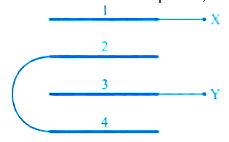 KCET 2016 Medium
 - The power factor of \(R-L\) circuit is \(\frac{1}{\sqrt{3}}\). If the inductive reactance is \(2 \Omega\). The value of resistance isKCET 2020 Easy
More PYQs from KCET
- The family of curves whose \(x\) and \(y\) intercepts of a tangent at any point are respectively double the \(x\) and \(y\) coordinates of that point isKCET 2024 Hard
- The kinetic energy of a body of mass \( 4 \mathrm{~kg} \) and momentum \( 6 \mathrm{Ns} \) will beKCET 2015 Easy
- A coil of inductive reactance \( \frac{1}{\sqrt{3}} \Omega \) and resistance \( 1 \Omega \) is connected to a \( 200 \mathrm{~V}, 50 \mathrm{~Hz} \) ac.
supply. The time lag between maximum voltage and current isKCET 2017 Easy - A particle of specific charge \(q / m=\pi \mathrm{C} \mathrm{kg}^{-1}\) is projected the origin towards positive \(X\)-axis with the velocity \(10 \mathrm{~ms}^{-1}\) in a uniform magnetic field \(\mathbf{B}=-2 \hat{\mathbf{k}}\) T. The velocity \(\mathbf{v}\) of particle after time \(t=\frac{1}{12} \mathrm{~s}\) will be (in \(\mathrm{ms}^{-1}\) )KCET 2024 Hard
- The variations of kinetic energy \(\mathrm{K}(\mathrm{x})\), potential energy \(\mathrm{U}(\mathrm{x})\) and total energy as a function of displacement of a particle in SHM is as shown in the figure. The value of \(\left|x_0\right|\) is
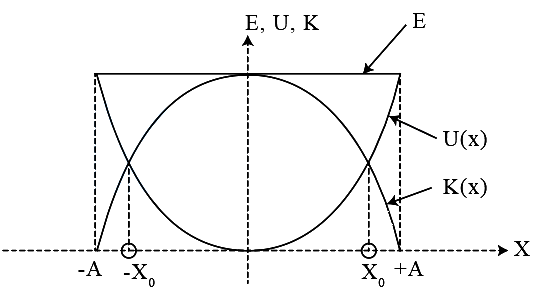 KCET 2025 Medium
 - When limestone is heated, \(\mathrm{CO}_{2}\) is given off. The metallurgical operation isKCET 2013 Easy