


KCET · Maths · Vector Algebra
If \(\mathbf{a}, \mathbf{b}\) and \(\mathbf{c}\) are unit vectors such that \(\mathbf{a}+\mathbf{b}+\mathbf{c}=\mathbf{0}\), then angle between \(\mathbf{a}\) and \(\mathbf{b}\) is
- A \(\frac{\pi}{2}\)
- B \(\frac{\pi}{3}\)
- C \(\frac{2 \pi}{3}\)
- D \(\pi\)
Answer & Solution
Correct Answer
(C) \(\frac{2 \pi}{3}\)
Step-by-step Solution
Detailed explanation
Given, \(\mathbf{a}, \mathbf{b}, \mathbf{c}\) are unit vectors.
\[
\begin{array}{lc}
\Rightarrow & |a|=|b|=|c|=1 \\
\text { Also, given } & \mathbf{a}+\mathbf{b}+\mathbf{c}=0 \\
\Rightarrow & (a+b)=-c
\end{array}
\]
Squaring on both sides, we get
\[
\begin{array}{lc}
\Rightarrow & (\mathbf{a}+\mathbf{b})^{2}=(\mathbf{c})^{2} \\
\Rightarrow & (\mathbf{a})^{2}+(\mathbf{b})^{2}+2 \mathbf{a} \cdot \mathbf{b}=(\mathbf{c})^{2} \\
\Rightarrow & |\mathbf{a}|^{2}+|\mathbf{c}|^{2}+2 \mathbf{a} \cdot \mathbf{b}=|\mathbf{c}|^{2} \\
& \quad\left[\because(\mathbf{a})^{2}=|\mathbf{a}|^{2}\right] \\
\Rightarrow & 1+1+2 \mathbf{a} \cdot \mathbf{b}=1[\text { from Eq. (i) }] \\
\Rightarrow & 2 \mathbf{b}=-1 \\
\Rightarrow & \mathbf{a} \cdot \mathbf{b}=-1 / 2=|\mathbf{a}||\mathbf{b}| \cos \theta \\
\Rightarrow & \cos 0=-1 / 2=\cos 2 \pi / 3 \quad[\text { from Eq. (i) }] \\
\Rightarrow & \theta=2 \pi / 3
\end{array}
\]
\[
\begin{array}{lc}
\Rightarrow & |a|=|b|=|c|=1 \\
\text { Also, given } & \mathbf{a}+\mathbf{b}+\mathbf{c}=0 \\
\Rightarrow & (a+b)=-c
\end{array}
\]
Squaring on both sides, we get
\[
\begin{array}{lc}
\Rightarrow & (\mathbf{a}+\mathbf{b})^{2}=(\mathbf{c})^{2} \\
\Rightarrow & (\mathbf{a})^{2}+(\mathbf{b})^{2}+2 \mathbf{a} \cdot \mathbf{b}=(\mathbf{c})^{2} \\
\Rightarrow & |\mathbf{a}|^{2}+|\mathbf{c}|^{2}+2 \mathbf{a} \cdot \mathbf{b}=|\mathbf{c}|^{2} \\
& \quad\left[\because(\mathbf{a})^{2}=|\mathbf{a}|^{2}\right] \\
\Rightarrow & 1+1+2 \mathbf{a} \cdot \mathbf{b}=1[\text { from Eq. (i) }] \\
\Rightarrow & 2 \mathbf{b}=-1 \\
\Rightarrow & \mathbf{a} \cdot \mathbf{b}=-1 / 2=|\mathbf{a}||\mathbf{b}| \cos \theta \\
\Rightarrow & \cos 0=-1 / 2=\cos 2 \pi / 3 \quad[\text { from Eq. (i) }] \\
\Rightarrow & \theta=2 \pi / 3
\end{array}
\]
See the Complete Solution
Get step-by-step explanations for this and 2.5 Lakh+ more JEE, NEET & CET questions.
- Unlock all solutions
- Practice the full chapter
- Track accuracy across PYQs
4.8 rated on Google Play · 14,000+ reviews
More questions from Maths
- If the events \( A \) and \( B \) are independent if \( P\left(A^{\prime}\right)=\frac{2}{3} \) and \( P\left(B^{\prime}\right)=\frac{2}{7} \), then \( P(A \cap B) \) is equal to
O examsnet comKCET 2014 Hard - If \( \left(\frac{1-i}{1+i}\right)^{96}=a+i b \) then \( (a, b) \) isKCET 2018 Medium
- The function \(f(x)=\sqrt{3} \sin 2 x-\cos 2 x+4\) is one-one in the intervalKCET 2021 Easy
- If \( a, b, c \) are three consecutive terms of an \( A P \) and \( x, y, z \) are three consecutive terms of a G.P.,
then thevalue of \( X^{b-c}, Y^{c-a}, Z^{a-b} \)
isKCET 2018 Easy - Which of the following is false?KCET 2012 Easy
- Foot of the perpendicular drawn from the point \( (1,3,4) \) to the plane \( 2 x-y+z+3=0 \) isKCET 2019 Easy
More PYQs from KCET
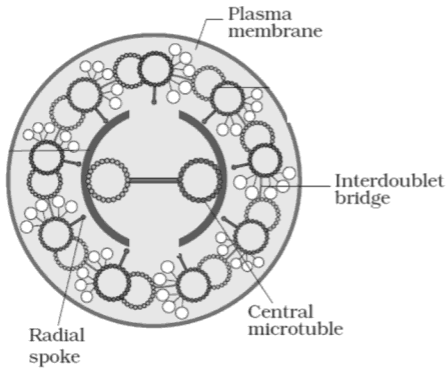
- In the below diagram, identify the part which connects the peripheral microtubles to the central shealth.
 KCET 2020 Easy
 - The point \((1,-3,4)\) lies in the octantKCET 2020 Medium
- Marchantia is considered as a heterothallic plant because it isKCET 2014 Easy
- Continued self pollination results inKCET 2015 Medium
- A particle is in uniform circular motion, related to one complete revolution of the particle, which among the statements is incorrect?KCET 2023 Easy
- A particle is in uniform circular motion. The equation of its trajectory is given by \((x-2)^2+y^2=25\), where x and y are in meter. The speed of the particle is \(2 \mathrm{~ms}^{-1}\), when the particle attains the lowest ' \(y\) ' co-ordinate, the acceleration of the particle is (in \(\mathrm{ms}^{-2}\) )KCET 2025 Medium