


KCET · Physics · Current Electricity
A copper wire of length \(1 \mathrm{~m}\) and uniform cross-sectional area \(5 \times 10^{-7} \mathrm{~m}^{2}\) carries a current of \(1 \mathrm{~A}\). Assuming that, there are \(8 \times 10^{28}\) free electrons per \(\mathrm{m}^{3}\) in copper, how long will an electron take to drift from one end of the wire to the other?
- A \(0.8 \times 10^{3} \mathrm{~s}\)
- B \(1.6 \times 10^{3} \mathrm{~s}\)
- C \(3.2 \times 10^{3} \mathrm{~s}\)
- D \(6.4 \times 10^{3} \mathrm{~s}\)
Answer & Solution
Correct Answer
(D) \(6.4 \times 10^{3} \mathrm{~s}\)
Step-by-step Solution
Detailed explanation
Given, \(l=1 \mathrm{~m}\)
\(\begin{aligned}
&A=5 \times 10^{-7} \mathrm{~m}^{2} \\
&I=1 \mathrm{~A} \\
&n=8 \times 10^{28} \text { electrons } / \mathrm{m}^{3}
\end{aligned}\)
Time taken by an electron to take the drift from one end to the other is given as
\(T=\frac{l}{v_{d}}...(i)\)
where, \(v_{d}\) is the drift velocity.
As, \(v_{d}=\frac{I}{n e A}\)
\(=\frac{1}{8 \times 10^{28} \times 1.6 \times 10^{-19} \times 5 \times 10^{-7}}=\frac{1}{6.4 \times 10^{3}}\)
So, substituting the given values in Eq. (i), we get
\(T=\frac{1}{\frac{1}{6.4 \times 10^{3}}}=6.4 \times 10^{3} \mathrm{~s}\)
\(\begin{aligned}
&A=5 \times 10^{-7} \mathrm{~m}^{2} \\
&I=1 \mathrm{~A} \\
&n=8 \times 10^{28} \text { electrons } / \mathrm{m}^{3}
\end{aligned}\)
Time taken by an electron to take the drift from one end to the other is given as
\(T=\frac{l}{v_{d}}...(i)\)
where, \(v_{d}\) is the drift velocity.
As, \(v_{d}=\frac{I}{n e A}\)
\(=\frac{1}{8 \times 10^{28} \times 1.6 \times 10^{-19} \times 5 \times 10^{-7}}=\frac{1}{6.4 \times 10^{3}}\)
So, substituting the given values in Eq. (i), we get
\(T=\frac{1}{\frac{1}{6.4 \times 10^{3}}}=6.4 \times 10^{3} \mathrm{~s}\)
See the Complete Solution
Get step-by-step explanations for this and 2.5 Lakh+ more JEE, NEET & CET questions.
- Unlock all solutions
- Practice the full chapter
- Track accuracy across PYQs
4.8 rated on Google Play · 14,000+ reviews
More questions from Physics
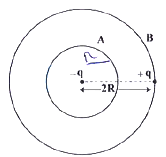
- You are given a dipole of charge \(+q\) and \(-q\) separated by a distance 2R. A sphere 'A' of radius ' \(R\) ' passes through the centre of the dipole as shown below and another sphere ' \(B\) ' of radius ' \(2 R\) ' passes through the charge +q . Then the electric flux through the sphere \(A\) is
 KCET 2025 Easy
 - A galvanometer coil has a resistance of \( 50 \Omega \) and the meter shows full scale deflection for a current of \( 5 \mathrm{~mA} \), This galvanometer is converted into voltmeter of range \( 0-20 \mathrm{~V} \) by connectingKCET 2016 Medium
- In fog, photographs of the objects taken with infrared radiations are more clear than those obtained during visible light becauseKCET 2009 Medium
- Spheres of iron and lead having same mass are completely immersed in water. Density of lead is more than that of iron. Apparent loss of weight is \(w_{1}\) for iron sphere and \(w_{2}\) for lead sphere, Then, \(\frac{w_{1}}{w_{2}}\) isKCET 2012 Hard
- A coin placed on a rotating turn table just slips if it is placed at a distance of \(4 \mathrm{~cm}\) from the centre. If the angular velocity of the turn table is doubled it will just slip at a distance ofKCET 2021 Easy
- A nucleus at rest splits into two nuclear parts having radii in the ratio \( 1: 2 \). Their velocities are
in the ratioKCET 2015 Easy
More PYQs from KCET
- A flow of liquid is streamline if the Reynold number isKCET 2014 Hard
- \( \lim _{x \rightarrow 0} \frac{1-\cos x}{x^{2}} \) isKCET 2015 Hard
- The value of \(\int \frac{x^{2} d x}{\sqrt{x^{6}+a^{6}}}\) is equal toKCET 2021 Medium
- Equation of the plane perpendicular to the line \( \frac{x}{1}=\frac{y}{2}=\frac{z}{3} \) and passing through the point \( (2, \),
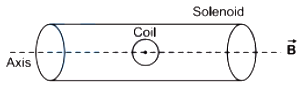
\( 3,4) \) isKCET 2014 Easy - The torque required to hold a small circular coil of 10 turns, area \(1 \mathrm{~mm}^{2}\) and carrying a current of \(\left(\frac{21}{44}\right)\) A in the middle of a long solenoid of \(10^{3}\) turns/m carrying a current of \(2.5 \mathrm{~A}\), with its axis perpendicular to the axis of the solenoid is
 KCET 2011 Hard
 - If \(P=\left[\begin{array}{lll}1 & \alpha & 3 \\ 1 & 3 & 3 \\ 2 & 4 & 4\end{array}\right]\) is the adjoint of a \(3 \times 3\)
matrix \(A\) and \(|A|=4\), then \(\alpha\) is equal toKCET 2024 Easy