


JEE Mains · Physics · STD 11 - 13. oscillations
The kinetic energy and potential energy of a particle executing simple harmonic motion will be equal, when displacement (amplitude = \(a\)) is
- A \(\frac{a}{2}\)
- B \(a\sqrt 2 \)
- C \(\frac{a}{{\sqrt 2 }}\)
- D \(\frac{{a\sqrt 2 }}{3}\)
Answer & Solution
Correct Answer
(C) \(\frac{a}{{\sqrt 2 }}\)
Step-by-step Solution
Detailed explanation
(c) Suppose at displacement \(y\) from mean position potential energy = kinetic energy ==> \(\frac{1}{2}m({a^2} - {y^2}){\omega ^2} = \frac{1}{2}m{\omega ^{\rm{2}}}{y^2}\) ==> \({a^2} = 2{y^2}\) ==> \(y = \frac{a}{{\sqrt 2 }}\)
See the Complete Solution
Get step-by-step explanations for this and 2.5 Lakh+ more JEE, NEET & CET questions.
- Unlock all solutions
- Practice the full chapter
- Track accuracy across PYQs
4.8 rated on Google Play · 14,000+ reviews
More questions from Physics
- A satellite is in an elliptical orbit around a planet \(P.\) It is observed that the velocity of the satellite when it is farthest from the planet is \(6\) time less than that when it is closest to the planet. The ratio of distances between the satellite and the planet at closest and farthest points is\(......\)JEE Mains 2020 Medium
- A car \(P\) travelling at \(20\,ms ^{-1}\) sounds its horn at a frequency of \(400\,Hz\). Another car \(Q\) is travelling behind the first car in the same direction with a velocity \(40\,ms ^{-1}\). The frequency heard by the passenger of the car \(Q\) is approximately \(.......\,Hz\) [Take, velocity of sound \(=360\,ms ^{-1}\) ]JEE Mains 2023 Easy
- The masses and radii of the earth and moon are \(\left({M}_{1}, {R}_{1}\right)\) and \(\left({M}_{2}, {R}_{2}\right)\) respectively. Their centres are at a distance ' \({r}\) ' apart. Find the minimum escape velocity for a particle of mass ' \({m}\) ' to be projected from the middle of these two masses:JEE Mains 2021 Hard
- A person of \(80\, kg\) mass is standing on the rim of a circular platform of mass \(200\, kg\) rotating about its axis as \(5\) revolutions per minute \((rpm).\) The person now starts moving towards the centre of the platform. What will be the rotational speed (in \(rpm\) ) of the platform when the person reaches its centre \(......rpm\)JEE Mains 2020 Medium
- Three point particles of masses \(1.0\; \mathrm{kg} .1 .5 \;\mathrm{kg}\) and \(2.5\; kg\) are placed at three comers of a right angle triangle of sides \(4.0\; \mathrm{cm}, 3.0 \;\mathrm{cm}\) and \(5.0\; \mathrm{cm}\) as shown in the figure. The center of mass of the system is at a point
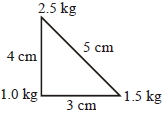 JEE Mains 2020 Medium
 - A tuning fork of frequency \(480\, Hz\) is used in an experiment for measuring speed of sound \((\nu )\) in air by resonance tube method. Resonance is observed to occur at two successive lengths of the air column, \({\ell _1} = 30\,cm\) and \({\ell _2} = 70\,cm\). Then \(\nu\) is equal to ..... \(ms^{-1}\)JEE Mains 2019 Hard
More PYQs from JEE Mains
- A body of mass \(2\,kg\) makes an elastic collision with a second body at rest and continues to move in the original direction but with one fourth of its original speed. What is the mass of the second body? ................ \( \mathrm{kg}\)JEE Mains 2019 Medium
- The half-life of a radioactive substance is \(T\). The time taken, for disintegrating \(\frac{7}{8}\) th part of its original mass will beJEE Mains 2023 Medium
- The velocity time graph of a body moving in a straight line is shown in figure.The ratio of displacement to distance travelled by the body in time \(0\) to \(10\,s\) is
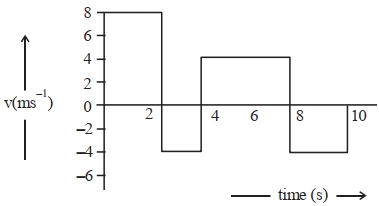 JEE Mains 2023 Medium
 - Let \([t]\) denote the greatest integer \(\leq t\) and \(\mathop {\lim }\limits_{x \to 0} x\left[\frac{4}{x}\right]=A .\) Then the function. \(\mathrm{f}(\mathrm{x})=\left[\mathrm{x}^{2}\right] \sin (\pi \mathrm{x})\) is discontinuous, when \(\mathrm{x}\) is equal toJEE Mains 2020 Hard
- Let \( \frac{\pi}{2}<\theta<\pi \) and \( cot\theta=-\frac{1}{2\sqrt{2}} \). Then the value of \( sin(\frac{15\theta}{2})(cos8\theta+sin8\theta)+cos(\frac{15\theta}{2})(cos8\theta-sin8\theta) \) is equal to:JEE Mains 2026 Easy
- Let \(a_1, a_2, a_3 \ldots a_n\) be \(n\) positive consecutive terms of an arithmetic progression. If \(d > 0\) is its common difference, then \(\lim _{n \rightarrow \infty} \sqrt{\frac{d}{n}}\left(\frac{1}{\sqrt{a_1}+\sqrt{a_2}}+\frac{1}{\sqrt{a_2}+\sqrt{a_3}}+\ldots \ldots .+\frac{1}{\sqrt{a_{n-1}}+\sqrt{a_n}}\right)\)JEE Mains 2023 Hard