


JEE Mains · Physics · STD 11 - Motion in straight line
- JEE Mains 2022
- Hard
- Numerical
From the top of a tower, a ball is thrown vertically upward which reaches the ground in \(6 \,s\). A second ball thrown vertically downward from the same position with the same speed reaches the ground in \(1.5\, s\). A third ball released, from the rest from the same location, will reach the ground in........ \(s\).
Pick an option to check your answer.
Answer & Solution
Correct Answer
(D) \(3\)
Step-by-step Solution
Detailed explanation
Let height of tower be \(h\) and speed of projection in first two cases be \(u\).
For case-I : \(2^{\text {nd }}\) equation \(s=u t+\frac{1}{2}\) at \(^{2}\)
\(h =- u (6)+\frac{1}{2}\, g (6)^{2}\)
\(H =-6 u +18\,g \ldots\) \((i)\)
For case-II \(: h = u (1.5)+\frac{1}{2}\, g (1.5)^{2}\)
\(h =1.5 u +\frac{2.25 g }{2} \ldots\) \((ii)\)
Multiplying equation \((ii)\) by \(4\) we get
\(4 h =6 u +4.5\, g \ldots .\) \((iii)\)
equation \((i)\) \(+\) equation \((iii)\) we get \(5 h =22.5 g\)
\(h =4.5 g \ldots\) \((iv)\)
For case\(-III\)
\(h =0+\frac{1}{2} gt ^{2} \ldots\) \((v)\)
Using equation \((4)\)and equation \((5)\)
\(4.5 g=\frac{1}{2} g t^{2}\)
\(t ^{2}=9 \Rightarrow t =3 s\)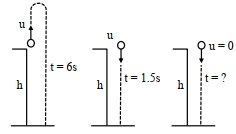
More questions from Physics
- \(0.056 \,kg\) of Nitrogen is enclosed in a vessel at a temperature of \(127\,^{\circ} C\). The amount of heat required to double the speed of its molecules is k cal. (Take \(R =2\) \(cal \,mole\) \(^{-1} K ^{-1}\) )JEE Mains 2022 Medium
- A light wave described by \(E =60 \sin \left(3 \times 10^{15}\right) t + \sin \left(12 \times 10^{15}\right)\) t] (in SI units) falls on a metal surface of work function 2.8 eV . The maximum kinetic energy of ejected photoelectron is (approximately) _________ eV .JEE Mains 2026 Medium
- A circular loop of radius \(20\text{ cm}\) and resistance \(2\ \Omega\) is placed in a time varying magnetic field \(\vec{B} = (2t^2 + 2t + 3)\text{ T}\). At \(t = 0\), for the plane of the loop being perpendicular to the magnetic field and, the induced current in the loop at \(t = 3\text{ s}\) is \(\dfrac{\alpha}{50}\text{ A}\). The value of \(\alpha\) is _______.
(Take \(\pi = 22/7\))JEE Mains 2026 Medium - A particle of mass \(2\, kg\) is moving such that at time \(t\), its position, in meter, is given by \(\overrightarrow r \left( t \right) = 5\hat i - 2{t^2}\hat j\) . The angular momentum of the particle at \(t\, = 2\, s\) about the origin in \(kg\, m^{-2}\, s^{-1}\) isJEE Mains 2013 Medium
- A gas molecule of mass \(M\) at the surface of the Earth has kinetic energy equivalent to \(0\,^oC\). If it were to go up straight without colliding with any other molecules, how high it would rise? Assume that the height attained is much less than radius of the earth. (\(k_B\) is Boltzmann constant)JEE Mains 2014 Medium
- Three students \(S_{1}, S_{2}\) and \(S_{3}\) perform an experiment for determining the acceleration due to gravity \((g)\) using a simple pendulum. They use different lengths of pendulum and record time for different number of oscillations. The observations are as shown in the table.
(Least count of length \(=0.1 \,{m}\), least count for time \(=0.1\, {s}\) ) If \(E_{1}, E_{2}\) and \(E_{3}\) are the percentage errors in \('g'\) for students \(1,2\) and \(3\) respectively, then the minimum percentage error is obtained by student no. ....... .Student No. Length of pendulum \((cm)\) No. of osci \((n)\) Total time for osci Time period \((s)\) \(1.\) \(64.0\) \(8\) \(128.0\) \(16.0\) \(2.\) \(64.0\) \(4\) \(64.0\) \(16.0\) \(3.\) \(20.0\) \(4\) \(36.0\) \(9.0\) JEE Mains 2021 Hard
More PYQs from JEE Mains
- For a body executing \(S.H.M. :\) \((a)\) Potential energy is always equal to its \(K.E.\) \((b)\) Average potential and kinetic energy over any given time interval are always equal. \((c)\) Sum of the kinetic and potential energy at any point of time is constant. \((d)\) Average \(K.E.\) in one time period is equal to average potential energy in one time period. Choose the most appropriate option from the options given below:JEE Mains 2021 Medium
- The kinetic energy of an electron, \(\alpha\)-particle and a proton are given as \(4K,2K\) and \(K\) respectively. The de-Broglie wavelength associated with electron ( \(\lambda e), \alpha\)-particle \((\lambda \alpha)\) and the proton \((\lambda p)\) are as follows:JEE Mains 2023 Medium
- A system consists of two types of gas molecules \(A\) and \(B\) having same number density \(2 \times\) \(10^{25}\, / {m}^{3}\). The diameter of \({A}\) and \({B}\) are \(10\, \stackrel{\circ}{{A}}\) and \(5\, \stackrel{\circ}{{A}}\) respectively. They suffer collision at room temperature. The ratio of average distance covererd by the molecule \(A\) to that of \(B\) between two successive collision is \(.....\,\times 10^{-2}\)JEE Mains 2021 Medium
- A convex lens of focal length \(20\,cm\) is placed in front of convex mirror with principal axis coinciding each other. The distance between the lens and mirror is \(10\,cm\). A point object is placed on principal axis at a distance of \(60\,cm\) from the convex lens. The image formed by combination coincides the object itself. The focal length of the convex mirror is \(...cm\).JEE Mains 2022 Medium