


JEE Mains · Physics · STD 11 - 13. oscillations
A particle executes simple harmonic motion represented by displacement function as \(x(t)=A \sin (\omega t+\phi)\) If the position and velocity of the particle at \(t=0\, {s}\) are \(2\, {cm}\) and \(2\, \omega \,{cm} \,{s}^{-1}\) respectively, then its amplitude is \(x \sqrt{2} \,{cm}\) where the value of \(x\) is ..... .
- A \(3\)
- B \(1\)
- C \(2\)
- D \(6\)
Answer & Solution
Correct Answer
(C) \(2\)
Step-by-step Solution
Detailed explanation
As given \(v(t)=A \omega \cos (\omega t+\phi)\) \(2=A \sin \phi.....(1)\) \(2 \omega=A \omega \cos \phi.....(2)\) From \((1)\) and \((2)\) \(\tan \phi=1\) \(\phi=45^{\circ}\) Putting value of \(\phi\) in equation \((1)\) \(2=A\left\{\frac{1}{\sqrt{2}}\right\}\) \(A=2 \sqrt{2}\)…
See the Complete Solution
Get step-by-step explanations for this and 2.5 Lakh+ more JEE, NEET & CET questions.
- Unlock all solutions
- Practice the full chapter
- Track accuracy across PYQs
4.8 rated on Google Play · 14,000+ reviews
More questions from Physics
- A particle of mass \(m\) moves in a circular orbit in a central potential field \(U ( r )= U _{0} r ^{4}\). If Bohr's quantization conditions are applied, radii of possible orbitals \(r _{ n }\) vary with \(n ^{1 / \alpha}\), where \(\alpha\) is ....... .JEE Mains 2021 Hard
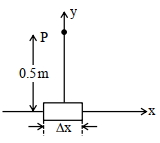
- An element \(\Delta l=\Delta \mathrm{xi}\) is placed at the origin and carries a large current \(\mathrm{I}=10 \mathrm{~A}\). The magnetic field on the \(y\)-axis at a distance of \(0.5 \mathrm{~m}\) from the elements \(\Delta \mathrm{x}\) of \(1 \mathrm{~cm}\) length is _______.
 JEE Mains 2024 Hard
 - If the binding energy of ground state electron in a hydrogen atom is \(13.6\,eV\), then, the energy required to remove the electron from the second excited state of \(Li ^{2+}\) will be: \(x \times 10^{-1}\,eV\). The value of \(x\) is \(...........\)JEE Mains 2023 Medium
- In Young's double slit experiment, carried out with light of wavelength \(5000\) \(A\), the distance between the slits is \(0.3 \mathrm{~mm}\) and the screen is at \(200 \mathrm{~cm}\) from the slits. The central maximum is at \(x=0 \mathrm{~cm}\). The value of \(\mathrm{x}\) for third maxima is _______ \(\mathrm{mm}\).JEE Mains 2024 Hard
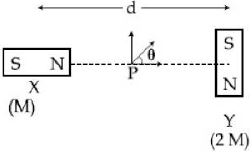
- Two magnetic dipoles \(X\) and \(Y\) are placed at a separation \(d\), with their axes perpendicular to each other. The dipole moment of \(Y\) is twice that of \(X\). A particle of charge \(q\) is passing through their mid-point \(P\), at angle \(\theta = 45^o\) with the horizontal line as shown in the figure. What would be the magnitude of force on the particle at that instant ? (\(d\) is much larger than the dimensions of the dipole)
 JEE Mains 2019 Hard
 - In Young's double slit experiment, light from two identical sources are superimposing on a screen. The path difference between the two lights reaching at a point on the screen is \(\frac{7 \lambda}{4}\). The ratio of intensity of fringe at this point with respect to the maximum intensity of the fringe is _______.JEE Mains 2024 Hard
More PYQs from JEE Mains
- Let \(S=\{4,6,9\}\) and \(T=\{9,10,11, \ldots, 1000\}\). If \(A=\left\{a_{1}+a_{2}+\ldots+a_{k}: k \in N, a_{1}, a_{2}, a_{3}, \ldots, a_{k} \in S\right\}\) then the sum of all the elements in the set \(T - A\) is equal to \(......\)JEE Mains 2022 Hard
- Let \( A(1,2) \) and \( C(-3,-6) \) be two diagonally opposite vertices of a rhombus, whose sides AD and BC are parallel to the line \( 7x-y=14 \). If \( B(\alpha, \beta) \) and \( D(\gamma, \delta) \) are the other two vertices, then \( |\alpha+\beta+\gamma+\delta| \) is equal to:JEE Mains 2026 Hard
- The energy \(E\) and momentum \(p\) of a moving body of mass \(m\) are related by some equation. Given that c represents the speed of light, identify the correct equation.JEE Mains 2025 Easy
- The number of distinct real roots of the equation \(|\mathrm{x}+1||\mathrm{x}+3|-4|\mathrm{x}+2|+5=0\), is ...........JEE Mains 2024 Hard
- In two separate Young's double-slit experimental set-ups, two monochromatic light sources of different wavelengths are used to get fringes of equal width. The ratios of the slit separations and that of the wavelengths of light used are \(2: 1\) and \(1: 2\) respectively. The corresponding ratio of the distances between the slits and the respective screens ( \(D_1 / D_2\) ) is ___________ .JEE Mains 2026 Easy
- Two ideal polyatomic gases at temperatures \(T _{1}\) and \(T _{2}\) are mixed so that there is no loss of energy. If \(F _{1}\) and \(F _{2}, m _{1}\) and \(m _{2}, n _{1}\) and \(n _{2}\) be the degrees of freedom, masses, number of molecules of the first and second gas respectively, the temperature of mixture of these two gases isJEE Mains 2021 Hard