


JEE Mains · Maths · STD 12 - 6. Application of derivatives
The function \(f(x)=x^{3}-6 x^{2}+a x+b\) is such that \(f(2)=f(4)=0\). Consider two statements. \((S_1)\) there exists \(\mathrm{x}_{1}, \mathrm{x}_{2} \in(2,4), \mathrm{x}_{1}<\mathrm{x}_{2}\), such that \(f^{\prime}\left(x_{1}\right)=-1\) and \(f^{\prime}\left(x_{2}\right)=0\) \((S_2)\) there exists \(\mathrm{x}_{3}, \mathrm{x}_{4} \in(2,4), \mathrm{x}_{3}<\mathrm{x}_{4}\), such that \(f\) is decreasing in \(\left(2, x_{4}\right)\), increasing in \(\left(x_{4}, 4\right)\) and \(2 f^{\prime}\left(x_{3}\right)=\sqrt{3} f\left(x_{4}\right)\). Then
- A both \((S_1)\) and \((S_2)\) are true
- B \((S_1)\) is false and \((S_2)\) is true
- C both \((S_1)\) and \((S_2)\) are false
- D \((S_1)\) is true and \((S_2)\) is false
Answer & Solution
Correct Answer
(A) both \((S_1)\) and \((S_2)\) are true
Step-by-step Solution
Detailed explanation
\(f(x)=x^{3}-6 x^{2}+a x+b\) \(f(2)=8-24+2 a+b=0\) \(2 a+b=16 \ldots(1)\) \(f(4)=64-96+4 a+b=0\) \(4 a+b=32 \ldots .(2)\) Solving \((1)\) and \((2)\) \(a=8, b=0\) \(f(x)=x^{3}-6 x^{2}+8 x\) \(f(x)=x^{3}-6 x^{2}+8 x\) \(f^{\prime}(x)=3 x^{2}-12 x+8\)…
See the Complete Solution
Get step-by-step explanations for this and 2.5 Lakh+ more JEE, NEET & CET questions.
- Unlock all solutions
- Practice the full chapter
- Track accuracy across PYQs
4.8 rated on Google Play · 14,000+ reviews
More questions from Maths
- If \(y =\sum \limits_{ k =1}^{6} k \cos ^{-1}\left\{\frac{3}{5} \cos k x -\frac{4}{5} \sin k x \right\}\) then \(\frac{ dy }{ dx }\) at \(x =0\) isJEE Mains 2020 Medium
- If the system of linear equations \(2 \mathrm{x}+2 \mathrm{ay}+\mathrm{az}=0\) ; \(2 x+3 b y+b z=0\) ; \(2 \mathrm{x}+4 \mathrm{cy}+\mathrm{cz}=0\) ; where \(a, b, c \in R\) are non-zero and distinct; has a non-zero solution, thenJEE Mains 2020 Hard
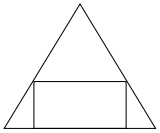
- If a rectangle is inscribed in an equilateral triangle of side length \(2 \sqrt{2}\) as shown in the figure, then the square of the largest area of such a rectangle is \(....\)
 JEE Mains 2021 Hard
 - Let \([\bullet]\) denote the greatest integer function, and let \(f(x)=\min \left\{\sqrt{2} x, x^2\right\}\). Let \(S=\{x \in(-2,2):\) the function \(g ( x )=| x |\left[ x ^2\right]\) is discontinuous at x \(\}\). Then \(\sum_{x \in S} f(x)\) equals :JEE Mains 2026 Easy
- The value of \(lim_{x\rightarrow0}\frac{log_{e}(sec(ex) \cdot sec(e^{2}x)\cdot...\cdot sec(e^{10}x))}{e^{2}-e^{2cos~x}}\) is equal toJEE Mains 2026 Hard
- Let \(P (-2,-1,1)\) and \(Q \left(\frac{56}{17}, \frac{43}{17}, \frac{111}{17}\right)\) be the vertices of the rhombus PRQS. If the direction ratios of the diagonal \(RS\) are \(\alpha,-1, \beta\), where both \(\alpha\) and \(\beta\) are integers of minimum absolute values, then \(\alpha^{2}+\beta^{2}\) is equal to \(.....\)JEE Mains 2022 Hard
More PYQs from JEE Mains
- Let \(\quad f(x)=\left|\begin{array}{ccc}1+\sin ^2 x & \cos ^2 x & \sin 2 x \\ \sin ^2 x & 1+\cos ^2 x & \sin 2 x \\ \sin ^2 x & \cos ^2 x & 1+\sin 2 x\end{array}\right|\), \(x \in\left[\frac{\pi}{6}, \frac{\pi}{3}\right]\). If \(\alpha\) and \( \beta\) respectively are the maximum and the minimum values of \(f\), thenJEE Mains 2023 Hard
- Let the equations of two ellipses be \({E_1}:\,\frac{{{x^2}}}{3} + \frac{{{y^2}}}{2} = 1\) and \({E_2}:\,\frac{{{x^2}}}{16} + \frac{{{y^2}}}{b^2} = 1,\) If the product of their eccentricities is \(\frac {1}{2},\) then the length of the minor axis of ellipse \(E_2\) isJEE Mains 2013 Hard
- The sum of first \(20\) terms of the sequence \(0.7,0.77,0.777, . . . \) isJEE Mains 2013 Medium
- If the line \(y\, = \,mx\, + \,7\sqrt 3 \) is normal to the hyperbola \(\frac{{{x^2}}}{{24}} - \frac{{{y^2}}}{{18}} = 1,\) then a value of \(m\) isJEE Mains 2019 Hard
- If the area of the triangle formed by the positive \(x-\)axis, the normal and the tangent to the circle \((x-2)^{2}+(y-3)^{2}=25\) at the point \((5,7)\) is \(A\) then \(24 A\) is equal to ...... .JEE Mains 2021 Hard
- Let \(f\) and \(g\) be two differentiable functions on \(R\) such that \(f'(x) > 0\) and \(g'(x) < 0\) for all \(x\in R\) .Then for all \(x\)JEE Mains 2014 Hard