


JEE Mains · Maths · STD 12 - 6. Application of derivatives
Let \(\quad f(x)=\left|\begin{array}{ccc}1+\sin ^2 x & \cos ^2 x & \sin 2 x \\ \sin ^2 x & 1+\cos ^2 x & \sin 2 x \\ \sin ^2 x & \cos ^2 x & 1+\sin 2 x\end{array}\right|\), \(x \in\left[\frac{\pi}{6}, \frac{\pi}{3}\right]\). If \(\alpha\) and \( \beta\) respectively are the maximum and the minimum values of \(f\), then
- A \(\beta^2-2 \sqrt{\alpha}=\frac{19}{4}\)
- B \(\beta^2+2 \sqrt{\alpha}=\frac{19}{4}\)
- C \(\alpha^2-\beta^2=4 \sqrt{3}\)
- D \(\alpha^2+\beta^2=\frac{9}{2}\)
Answer & Solution
Correct Answer
(A) \(\beta^2-2 \sqrt{\alpha}=\frac{19}{4}\)
Step-by-step Solution
Detailed explanation
\(C _1 \rightarrow C _1+ C _2+ C _3\) \(f(x)=\left|\begin{array}{ccc}2+\sin 2 x & \cos ^2 x & \sin 2 x \\ 2+\sin 2 x & 1+\cos ^2 x & \sin 2 x \\ 2+\sin 2 x & \cos ^2 x & 1+\sin 2 x\end{array}\right|\)…
See the Complete Solution
Get step-by-step explanations for this and 2.5 Lakh+ more JEE, NEET & CET questions.
- Unlock all solutions
- Practice the full chapter
- Track accuracy across PYQs
4.8 rated on Google Play · 14,000+ reviews
More questions from Maths
- If the value of the integral \(\int_{0}^{5} \frac{x+[x]}{e^{x-[x]}} \,d x=\alpha e^{-1}+\beta\) where \(\alpha, \beta \in R, 5 \alpha+6 \beta=0\), and \([\mathrm{x}]\) denotes the greatest integer less than or equal to \(x\); then the value of \((\alpha+\beta)^{2}\) is equal to :JEE Mains 2021 Hard
- If \(\theta \in\left[-\frac{7 \pi}{6}, \frac{4 \pi}{3}\right]\), then the number of solutions of \(\sqrt{3} \operatorname{cosec}^2 \theta-2(\sqrt{3}-1) \operatorname{cosec} \theta-4=0\), is equal toJEE Mains 2025 Medium
- The area of the region bounded by the curves \(x\left(1+y^2\right)=1\) and \(y^2=2 x\) is:JEE Mains 2025 Easy
- An arithmetic progression is written in the following way
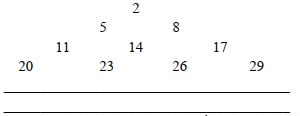
The sum of all the terms of the \(10^{\text {th }}\) row is ..........JEE Mains 2024 Hard - If \(\cos \,\left( {\alpha + \beta } \right) = \frac{3}{5},\,\sin \,\left( {\alpha - \beta } \right) = \frac{5}{{13}}\) and \(0 < \alpha ,\beta < \frac{\pi }{4}\) then \(\tan \,\left( {2\alpha } \right)\) is equal toJEE Mains 2019 Hard
- If the area of the triangle whose one vertex is at the vertex of the parabola, \({y^2} + 4\,\left( {x - {a^2}} \right) = 0\) and the other two vertices are the points of intersection of the parabola and \(y -\) axis, is \(250\, sq\). units, then a value of \(‘a’\) isJEE Mains 2019 Hard
More PYQs from JEE Mains
- The integral \(\int{ \cfrac{d x}{(x+4)^{\frac{8}{7}}(x-3)^{\frac{6}{7}}}}\) is equal to (where \(\mathrm{C}\) is a constant of integration)JEE Mains 2020 Hard
- Let \(A (-3, 2)\) and \(B (-2, 1)\) be the vertices of a triangle \(ABC\). If the centroid of this triangle lies on the line \(3x + 4y + 2 = 0\), then the vertex \(C\) lies on the lineJEE Mains 2013 Hard
- Let \(\lambda^{*}\) be the largest value of \(\lambda\) for which the function \(f _{\lambda}( x )=4 \lambda x ^{3}-36 \lambda x ^{2}+36 x +48\) is increasing for all \(x \in R\). Then \(f _{\lambda} *(1)+ f _{\lambda} *(-1)\) is equal toJEE Mains 2022 Hard
- If the sum of solutions of the system of equations \(2 \sin ^{2} \theta-\cos 2 \theta=0\) and \(2 \cos ^{2} \theta+3 \sin \theta=0\) in the interval \([0,2 \pi]\) is \(k \pi\), then \(k\) is equal to.JEE Mains 2022 Hard
- Let \(S_{n}=1 \cdot(n-1)+2 \cdot(n-2)+3 \cdot(n-3)+\ldots+\) \((\mathrm{n}-1) \cdot 1, \mathrm{n} \geq 4\) The sum \(\sum_{n=4}^{\infty}\left(\frac{2 S_{n}}{n !}-\frac{1}{(n-2) !}\right)\) is equal to :JEE Mains 2021 Hard
- If the function \(f\left( x \right) = \left\{ {\begin{array}{*{20}{c}}
{\frac{{\sqrt {2 + \cos \,x} - 1}}{{\left( {\pi - {x^2}} \right)}},}&{x \ne \pi } \\
{k\,\,\,\,\,\,\,\,\,\,\,\,\,\,\,\,\,\,\,\,\,,}&{x = \pi }
\end{array}} \right.\) is continuous at \(x\, =\pi \) , then \(k\) equalsJEE Mains 2014 Hard