


JEE Mains · Maths · STD 12 - 13. probability
Let \(a, b\) and \(c\) denote the outcome of three independent rolls of a fair tetrahedral die, whose four faces are marked \(1,2,3,4\). If the probability that \(a x^2+b x+c=0\) has all real roots is \(\frac{m}{n}\), \(\operatorname{gcd}(\mathrm{m}, \mathrm{n})=1\), then \(\mathrm{m}+\mathrm{n}\) is equal to ..........
- A \(19\)
- B \(20\)
- C \(6\)
- D \(71\)
Answer & Solution
Correct Answer
(A) \(19\)
Step-by-step Solution
Detailed explanation
\(a, b, c \in\{1,2,3,4\}\) Tetrahedral dice \(a x^2+b x+c=0\) has all real roots \( \Rightarrow \mathrm{D} \geq 0 \) \( \Rightarrow \mathrm{b}^2-4 \mathrm{ac} \geq 0\) Let \(b=1 \Rightarrow 1-4 a c \geq 0\) (Not feasible) \( \mathrm{b}=2 \Rightarrow 4-4 \mathrm{ac} \geq 0 \)…
See the Complete Solution
Get step-by-step explanations for this and 2.5 Lakh+ more JEE, NEET & CET questions.
- Unlock all solutions
- Practice the full chapter
- Track accuracy across PYQs
4.8 rated on Google Play · 14,000+ reviews
More questions from Maths
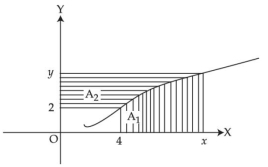
- Consider a curve \(y=y(x)\) in the first quadrant as shown in the figure. Let the area \(A_{1}\) is twice the area \(A _{2}\). Then the normal to the curve perpendicular to the line \(2 x -12 y =15\) does NOT pass through the point.
 JEE Mains 2022 Hard
 - Let \([\bullet]\) denote the greatest integer function, and let \(f(x)=\min \left\{\sqrt{2} x, x^2\right\}\). Let \(S=\{x \in(-2,2):\) the function \(g ( x )=| x |\left[ x ^2\right]\) is discontinuous at x \(\}\). Then \(\sum_{x \in S} f(x)\) equals :JEE Mains 2026 Easy
- The distance of the point having position vector \( - \,\hat i\, + \,2\hat j\, + 6\hat k\) from the straight line passing through the point \((2, 3, -4)\) and parallel to the vector \(6\,\hat i\, + 3\hat j\, - 4\hat k\) isJEE Mains 2019 Easy
- Let the hyperbola \(H : \frac{ x ^{2}}{ a ^{2}}-\frac{ y ^{2}}{ b ^{2}}=1\) pass through the point \((2 \sqrt{2},-2 \sqrt{2})\). A parabola is drawn whose focus is same as the focus of \(H\) with positive abscissa and the directrix of the parabola passes through the other focus of \(H\). If the length of the latus rectum of the parabola is e times the length of the latus rectum of \(H\), where \(e\) is the eccentricity of \(H\), then which of the following points lies on the parabola?JEE Mains 2022 Hard
- The number of seven digit positive integers formed using the digits \(1,2,3\) and \(4\) only and sum of the digits equal to \(12\) is \(...........\).JEE Mains 2023 Hard
- The locus of the point of intersection of the straight lines, \(tx -2y-3t=0\) \(x - 2ty+ 3 = 0\) \(\left( {t \in R} \right)\), isJEE Mains 2017 Hard
More PYQs from JEE Mains
- Let the line \( y-x=1 \) intersect the ellipse \( \frac{x^{2}}{2}+\frac{y^{2}}{1}=1 \) at the points A and B. Then the angle made by the line segment AB at the center of the ellipse is:JEE Mains 2026 Easy
- The sum of the roots of the equation, \({x^2}\, + \,\left| {2x - 3} \right|\, - \,4\, = \,0,\) isJEE Mains 2014 Hard
- Let \(S\) be the set of all \((\lambda, \mu)\) for which the vectors \(\lambda \hat{ i }-\hat{ j }+\hat{ k }, \hat{ i }+2 \hat{ j }+\mu \hat{ k }\) and \(3 \hat{ i }-4 \hat{ j }+5 \hat{ k }\), where \(\lambda-\mu=5\), are coplanar, then \(\sum_{(\lambda, \mu) \in S} 80\left(\lambda^2+\mu^2\right)\) is equal to :JEE Mains 2023 Hard
- The number of ways of choosing \(10\) objects out of \(31\) objects of which \(10\) are identical and the remaining \(21\) are distinct, isJEE Mains 2019 Hard
- The maximum volume (in \(cu.m\)) of the right circular cone having slant height \(3\, m\) isJEE Mains 2019 Hard
- Let \(f:(-2,2) \rightarrow\) IR be defined by \(f(x)=\left\{\begin{array}{cc}x[x] & ,-2 < x < 0 \\(x-1)[x] & , 0 \leq x < 2\end{array}\right.\) Where \([x]\) denotes the greatest integer function. If \(m\) and \(n\) respectively are the number of points in \((-2,2)\) at which \(y =|f(x)|\) is not continuous and not differentiable, then \(m + n\) is equal to \(...........\).JEE Mains 2023 Hard