


JEE Mains · Maths · STD 12 - 10. vector algebra
A hall has a square floor of dimension \(10\, \mathrm{~m} \times 10\, \mathrm{~m}\) (see the figure) and vertical walls. If the angle \(GPH\) between the diagonals \(\mathrm{AG}\) and \(\mathrm{BH}\) is \(\cos ^{-1} \frac{1}{5}\), then the height of the hall (in \(meters\)) is :
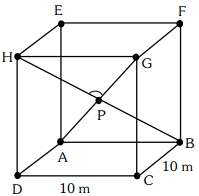
- A \(5\)
- B \(2 \sqrt{10}\)
- C \(5 \sqrt{3}\)
- D \(5 \sqrt{2}\)
Answer & Solution
Correct Answer
(D) \(5 \sqrt{2}\)
Step-by-step Solution
Detailed explanation
\(\mathrm{A}(\hat{\mathrm{j}}) \cdot \mathrm{B}(10 \hat{\mathrm{i}})\) \(H(h\hat{\mathrm{j}}+10 \hat{\mathrm{k}})\) \(G(10 \hat{\mathrm{i}}+\mathrm{h} \hat{\mathrm{j}}+10 \hat{\mathrm{k}})\) \(\overline{\mathrm{AG}}=10 \hat{\mathrm{i}}+\mathrm{hj}+10 \hat{\mathrm{k}}\)…
See the Complete Solution
Get step-by-step explanations for this and 2.5 Lakh+ more JEE, NEET & CET questions.
- Unlock all solutions
- Practice the full chapter
- Track accuracy across PYQs
4.8 rated on Google Play · 14,000+ reviews
More questions from Maths
- If the solution curve \(y=y(x)\) of the differential equation \(\left(1+y^2\right)\left(1+\log _6 x\right) d x+x d y=0, x>0\) passes through the point \((1,1)\) and \(y(\mathrm{e})=\frac{\alpha-\tan \left(\frac{3}{2}\right)}{\beta+\tan \left(\frac{3}{2}\right)}\), then \(\alpha+2 \beta\) is ...........JEE Mains 2024 Medium
- Let \(\mathrm{F}:[3,5] \rightarrow \mathrm{R}\) be a twice differentiable function on \((3,5)\) such that \(\mathrm{F}(\mathrm{x})=\mathrm{e}^{-\mathrm{x}}\) \(\int_{3}^{x}\left(3 t^{2}+2 t+4 F^{\prime}(t)\right) \,d t\) If \(F^{\prime}(4)=\frac{\alpha e^{\beta}-224}{\left(e^{\beta}-4\right)^{2}}\), then \(\alpha+\beta\) is equal to \(....\)JEE Mains 2021 Hard
- The coefficient of \(x^{48}\) in \((1+x)+2(1+x)^{2}+3(1+x)^{3}+....+100(1+x)^{100}\) is equal to:JEE Mains 2026 Medium
- If \(\overrightarrow{ a }=\hat{ i }+2 \hat{ k }, \overrightarrow{ b }=\hat{ i }+\hat{ j }+\hat{ k }, \overrightarrow{ c }=7 \hat{ i }-3 \hat{ k }+4 \hat{ k }\) \(\overrightarrow{ r } \times \overrightarrow{ b }+\overrightarrow{ b } \times \overrightarrow{ c }=\overrightarrow{0}\) and \(\overrightarrow{ r } \cdot \overrightarrow{ a }=0\) then \(\overrightarrow{ r } \cdot \overrightarrow{ c }\) is equal to :JEE Mains 2023 Hard
- If \(a > 0\) and \(z = \frac{{{{\left( {1 + i} \right)}^2}}}{{a - i}}\), has magnitude \(\sqrt {\frac{2}{5}} \), then \(\bar z\) is equal to:JEE Mains 2019 Hard
- For a statistical data \(\mathrm{x}_1, \mathrm{x}_2, \ldots, \mathrm{x}_{10}\) of 10 values, a student obtained the mean as 5.5 and \(\sum_{i=1}^{10} x_i^2=371\). He later found that he had noted two values in the data incorrectly as 4 and 5 , instead of the correct values 6 and 8 , respectively. The variance of the corrected data isJEE Mains 2025 Medium
More PYQs from JEE Mains
- Let \(3, a, b, c\) be in \(A.P.\) and \(3, a-1, b+1, c+9\) be in \(G.P.\) Then, the arithmetic mean of \(a, b\) and \(c\) is :JEE Mains 2024 Hard
- The area of the bounded region enclosed by the curve \(y=3-\left|x-\frac{1}{2}\right|-|x+1|\) and the \(x-\)axis isJEE Mains 2022 Hard
- Let a line \(L\) be perpendicular to both the lines \(L_1: \dfrac{x+1}{3} = \dfrac{y+3}{5} = \dfrac{z+5}{7}\) and \(L_2: \dfrac{x-2}{1} = \dfrac{y-4}{4} = \dfrac{z-6}{7}\). If \(\theta\) is the acute angle between the lines \(L\) and \(L_3: \dfrac{x - \dfrac{8}{7}}{2} = \dfrac{y - \dfrac{4}{7}}{1} = \dfrac{z}{2}\), then \(\tan\theta\) is equal to:JEE Mains 2026 Medium
- Let the set of all \(a \in R\) such that the equation \(\cos 2 x+a \sin x=2 a-7\) has a solution be \([p, q]\) and \(\mathrm{r}=\tan 9^{\circ}-\tan 27^{\circ}-\frac{1}{\cot 63^{\circ}}+\tan 81^{\circ}\), then \(pqr\) is equal to ...........JEE Mains 2024 Hard
- Let three vectors \(\vec{a}, \overrightarrow{\mathrm{b}}\) and \(\vec{c}\) be such that \(\vec{a} \times \overrightarrow{\mathrm{b}}=\vec{c}, \overrightarrow{\mathrm{b}} \times \vec{c}=\vec{a}\) and \(|\vec{a}|=2\) Then which one of the following is not true?JEE Mains 2021 Medium
- If the area (in \(sq. units\)) of the region \(\left\{ {\left( {x,y} \right):{y^2} \le 4x,x + y \le 1,x \ge 0,y \ge 0} \right\}\) is \(a\sqrt 2 + b\), then \(a -b\) is equal toJEE Mains 2019 Hard