


JEE Advanced · Physics · 25. Wave Optics
Young's double slit experiment is carried out by using green, red and blue light, one color at a time. The fringe widths recorded are \(\beta_{G}, \beta_{R}\) and \(\beta_{B}\), respectively. Then,
- A \(\beta_{G}>\beta_{B}>\beta_{R}\)
- B \(\beta_{B}>\beta_{G}>\beta_{R}\)
- C \(\beta_{R}>\beta_{B}>\beta_{G}\)
- D \(\beta_{R}>\beta_{G}>\beta_{B}\)
Answer & Solution
Correct Answer
(D) \(\beta_{R}>\beta_{G}>\beta_{B}\)
Step-by-step Solution
Detailed explanation
We know that fringe width, \(\beta=\frac{\lambda D}{d}\) \(\because \quad \lambda_{R}>\lambda_{\mathrm{G}}>\lambda_{B} \quad \therefore \beta_{R}>\beta_{G}>\beta_{B}\)
See the Complete Solution
Get step-by-step explanations for this and 2.5 Lakh+ more JEE, NEET & CET questions.
- Unlock all solutions
- Practice the full chapter
- Track accuracy across PYQs
4.8 rated on Google Play · 14,000+ reviews
More questions from Physics
- List I describes four systems, each with two particles and in relative motion as shown in figure. List II gives possible magnitudes of their relative velocities (in ) at time .
Which one of the following options is correct?List-I List-II (I) and are moving on a horizontal circle of radius with uniform angular speed . The initial angular positions of and at time are and respectively. 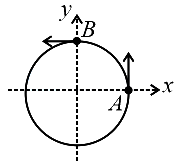
(P) (II) Projectiles and are fired (in the same vertical plane) at and respectively, with the same speed and at from the horizontal plane. The initial separation between and is large enough so that they do not collide, . 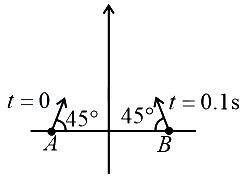
(Q) (III) Two harmonic oscillators and moving in the direction according to and respectively, starting from . Take . 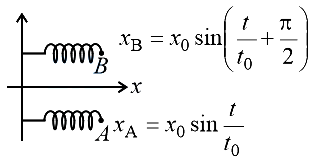
(R) (IV) Particle is rotating in a horizontal circular path of radius on the plane, with constant angular speed . Particle is moving up at a constant speed in the vertical direction as shown in the figure. (Ignore gravity.) 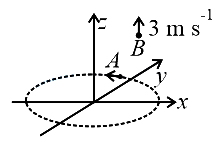
(S) (T) JEE Advanced 2022 Medium - Statement I A cloth covers a table. Some dishes are kept on it. The cloth can be pulled out without dislodging the dishes from the table.
Statement II For every action there is an equal and opposite reaction.JEE Advanced 2007 Medium - For the circuit shown in the figure
 JEE Advanced 2009 Hard
 - The \(\beta\)-decay process, discovered around 1900 , is basically the decay of a neutron \((n)\). In the laboratory, a proton \((p)\) and an electron \(\left(e^{-}\right)\)are observed as the decay products of the neutron. Therefore, considering the decay of a neutron as a two-body decay process, it was predicted theoretically that the kinetic energy of the electron should be a constant. But experimentally, it was observed that the electron kinetic energy has continuous spectrum. Considering a three-body decay process, i.e.
\(n \rightarrow p+e^{-}+\bar{v}_{e}\), around 1930, Pauli explained the observed electron energy spectrum. Assuming the anti-neutrino \(\left(\bar{v}_{e}\right)\) to be massless and possessing negligible energy, and the neutron to be at rest, momentum and energy conservation principles are applied. From this calculation, the maximum kinetic energy of the electron is \(0.8 \times 10^{6} \mathrm{eV}\). The kinetic energy carried by the proton is only the recoil energy.
Question:
What is the maximum energy of the anti-neutrino?JEE Advanced 2012 Medium - A diatomic ideal gas is compressed adiabatically to \(\frac{1}{32}\) of its initial volume. If the initial temperature of the gas is \(T_i\) \(T_i\) (in kelvin) and the final temperature is \(a T_i\), the value of \(a\) isJEE Advanced 2010 Easy
- Paragraph:
Two trains \(A\) and \(B\) are moving with speeds \(20 \mathrm{~m} / \mathrm{s}\) and \(30 \mathrm{~m} / \mathrm{s}\), respectively in the same direction on the same straight track, with \(B\) ahead of \(A\). The engines are at the front ends. The engine of train \(A\) blows a long whistle.
Assume that the sound of the whistle is composed of components varying in frequency from \(f_1=800 \mathrm{~Hz}\) to \(f_2=1120 \mathrm{~Hz}\), as shown in the figure. The spread in the frequency (highest frequency - lowest frequency) is thus \(320 \mathrm{~Hz}\). The speed of sound in still air is \(340 \mathrm{~m} / \mathrm{s}\).
Question:
The spread of frequency as observed by the passengers in train \(B\) isJEE Advanced 2007 Medium
More PYQs from JEE Advanced
- A sample initially contains only U-238 isotope of uranium. With time, some of the U-238 radioactively decays into \(\mathrm{Pb}-206\) while the rest of it remains undisintegrated.
When the age of the sample is \(\mathbf{P} \times 10^8\) years, the ratio of mass of \(\mathrm{Pb}-206\) to that of \(\mathrm{U}-238\) in the sample is found to be 7 . The value of \(\mathbf{P}\) is ______
[Given: Half-life of U-238 is \(4.5 \times 10^9\) years; \(\log _c 2=0.693\) ]JEE Advanced 2024 Hard - Paragraph:
When a metal rod \(M\) is dipped into an aqueous colourless concentrated solution of compound \(\mathrm{N}\), the solution turns light blue. Addition of aqueous \(\mathrm{NaCl}\) to the blue solution gives a white precipitate \(\mathrm{O}\). Addition of aqueous \(\mathrm{NH}_3\) dissolves \(\mathrm{O}\) and gives an intense blue solution.
Question:
The compound \(N\) isJEE Advanced 2011 Hard - The treatment of an aqueous solution of 3.74 g of \(\text{Cu} \left(\text{NO} _3\right)_2\) with excess KI results in a brown solution along with the formation of a precipitate. Passing \(\text{H} _2 \text{S}\) through this brown solution gives another precipitate X . The amount of X (in g ) is _____________ [Given: Atomic mass of \(\text{H} =1, \text{N}=14, \text{O} =16, \text{S}=32, \text{K}=39,\) \(\text{Cu} =63, \text{I} =127]\)JEE Advanced 2022 Easy
- Paragraph I: An organic compound \(\mathrm{P}\) with molecular formula \(\mathrm{C}_5 \mathrm{H}_{18} \mathrm{O}_2\) decolorizes bromine water and also shows positive iodoform test. \(\mathrm{P}\) on ozonolysis followed by treatment with \(\mathrm{H}_2 \mathrm{O}_2\) gives \(\mathrm{Q}\) and \(\mathrm{R}\). While compound \(\mathrm{Q}\) shows positive iodoform test, compound \(\mathrm{R}\) does not give positive iodoform test. \(\mathrm{Q}\) and \(\mathrm{R}\) on oxidation with pyridinium chlorochromate (PCC) followed by heating give \(\mathrm{S}\) and \(\mathrm{T}\), respectively. Both \(\mathrm{S}\) and \(\mathrm{T}\) show positive iodoform test.
Complete copolymerization of 500 moles of \(\mathrm{Q}\) and 500 moles of \(\mathrm{R}\) gives one mole of a single acyclic copolymer \(\mathrm{U}\).
[Given, atomic mass: \(\mathrm{H}=1, \mathrm{C}=12, \mathrm{O}=16\)]
Question: The molecular weight of \(\mathbf{U}\) isJEE Advanced 2024 Medium - Paragraph:
A circle \(C\) of radius 1 is inscribed in an equilateral \(\triangle P Q R\). The points of contact of \(C\) with the sides \(P Q, Q R, R P\) are \(D, E, F\) respectively. The line \(P Q\) is given by the equation
\(\sqrt{3} x+y-6=0\) and the point \(D\) is \(\left(\frac{3 \sqrt{3}}{2}, \frac{3}{2}\right)\). Further, it is given that the origin and the centre of \(C\) are on the same side of the line \(P Q\).Question:
Points \(E\) and \(F\) are given byJEE Advanced 2008 Medium - A sample \((5.6 \mathrm{~g})\) containing iron is completely dissolved in cold dilute \(\mathrm{HCl}\) to prepare a \(250 \mathrm{~mL}\) of solution. Titration of \(25.0 \mathrm{~mL}\) of this solution requires \(12.5 \mathrm{~mL}\) of \(0.03 \mathrm{M} \mathrm{KMnO}_{4}\) solution to reach the end point. Number of moles of \(\mathrm{Fe}^{2+}\) present in \(250 \mathrm{~mL}\) solution is \(\mathbf{x} \times 10^{-2}\) (consider complete dissolution of \(\mathrm{FeCl}_{2}\) ). The amount of iron present in the sample is \(\mathbf{y} \%\) by weight.
(Assume: \(\mathrm{KMnO}_{4}\) reacts only with \(\mathrm{Fe}^{2+}\) in the solution Use: Molar mass of iron as \(56 \mathrm{~g} \mathrm{~mol}^{-1}\) )
The value of is________ .JEE Advanced 2021 Medium