


JEE Advanced · Chemistry · 1. Mole Concept
The treatment of an aqueous solution of 3.74 g of \(\text{Cu} \left(\text{NO} _3\right)_2\) with excess KI results in a brown solution along with the formation of a precipitate. Passing \(\text{H} _2 \text{S}\) through this brown solution gives another precipitate X . The amount of X (in g ) is _____________ [Given: Atomic mass of \(\text{H} =1, \text{N}=14, \text{O} =16, \text{S}=32, \text{K}=39,\) \(\text{Cu} =63, \text{I} =127]\)
- A 0.32
- B 0.33
- C 0.34
- D 0.35
Answer & Solution
Correct Answer
(A) 0.32
Step-by-step Solution
Detailed explanation
Number of moles of
See the Complete Solution
Get step-by-step explanations for this and 2.5 Lakh+ more JEE, NEET & CET questions.
- Unlock all solutions
- Practice the full chapter
- Track accuracy across PYQs
4.8 rated on Google Play · 14,000+ reviews
More questions from Chemistry
- The molar conductivity of a solution of a weak acid HX (0.01 M) is 10 times smaller than the molar conductivity of a solution of a weak acid HY (0.10 M). If , the difference in their values, , is (Consider degree of ionization of both acids to << 1)JEE Advanced 2015 Hard
- For the first order reaction \(2 \mathrm{~N}_2 \mathrm{O}_5(\mathrm{~g}) \longrightarrow 4 \mathrm{NO}_2(g)+\mathrm{O}_2(g)\)JEE Advanced 2011 Easy
- The standard enthalpies of formation of and glucose (s) at are , and , respectively. The standard enthalpy combustion per gram of glucose at isJEE Advanced 2013 Hard
- Paragraph:
An aqueous solution of a mixture of two inorganic salts, when treated with dilute \(H C\) ?, gave a precipitate \((\boldsymbol{P})\) and a filtrate \((\boldsymbol{Q})\). The precipitate \(\boldsymbol{P}\) was found to dissolve in hot water. The filtrate \((\boldsymbol{Q})\) remained unchanged, when treated with \(\mathrm{H}_{2} \mathrm{~S}\) in a dilute mineral acid medium. However, it gave a precipitate \((\boldsymbol{R})\) with \(H_{2} S\) in an ammoniacal medium. The precipitate \(\boldsymbol{R}\) gave a coloured solution \((\boldsymbol{S})\), when treated with \(\mathrm{H}_{2} \mathrm{O}_{2}\) in an aqueous \(\mathrm{NaOH}\) medium.
Question:
The precipitate \(\boldsymbol{P}\) containsJEE Advanced 2013 Medium - A colorless aqueous solution contains nitrates of two metals, and . When it was added to an aqueous solution of , a white precipitate was formed. This precipitate was found to be partly soluble in hot water to give a residue and a solution . The residue was soluble in aq. and also in excess sodium thiosulfate. The hot solution gave a yellow precipitate with . The metals and , respectively, areJEE Advanced 2020 Medium
- Statement I p-hydroxybenzoic acid has a lower boiling point than o-hydroxybenzoic acid.
Statement II o-hydroxybenzoic acid has intramolecular hydrogen bonding.JEE Advanced 2007 Medium
More PYQs from JEE Advanced
- The sum of the spin only magnetic moment values (in B.M.) of \(\left[\mathrm{Mn}(\mathrm{Br})_6\right]^{3-}\) and \(\left[\mathrm{Mn}(\mathrm{CN})_6\right]^{3-}\) is _____.JEE Advanced 2025 Medium
- A mixture of 2 moles of helium gas (atomic mass \(=4 \mathrm{amu}\) ) and 1 mole of argon gas (atomic mass \(=40 \mathrm{amu}\) ) is kept at \(300 \mathrm{~K}\) in a container. The ratio of the rms speeds \(\left(\frac{v_{\mathrm{rms}}(\text { helium })}{v_{\mathrm{rms}}(\operatorname{argon})}\right)\) isJEE Advanced 2012 Easy
- The value of the limit is _________JEE Advanced 2020 Medium
- Consider an elliptically shaped rail PQ in the vertical plane with and . A block of mass 1 kg is pulled along the rail from P to Q with a force of 18 N, which is always parallel to line PQ (see the figure given). Assuming no frictional losses, the kinetic energy of the block when it reaches Q is Joules. The value of n is (take acceleration due to gravity = )
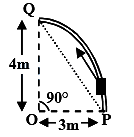 JEE Advanced 2014 Hard
 - The value of isJEE Advanced 2013 Medium
- Consider a branch of the hyperbola \(x^2-2 y^2-2 \sqrt{2} x-4 \sqrt{2} y-6=0\) with vertex at the point \(A\). Let \(B\) be one of the end points of its latus rectum. If \(C\) is the focus of the hyperbola nearest to the point \(A\), then the area of the \(\triangle A B C\) isJEE Advanced 2008 Medium