


JEE Advanced · Mathematics · 9. Straight Lines
Paragraph:
A circle \(C\) of radius 1 is inscribed in an equilateral \(\triangle P Q R\). The points of contact of \(C\) with the sides \(P Q, Q R, R P\) are \(D, E, F\) respectively. The line \(P Q\) is given by the equation
\(\sqrt{3} x+y-6=0\) and the point \(D\) is \(\left(\frac{3 \sqrt{3}}{2}, \frac{3}{2}\right)\). Further, it is given that the origin and the centre of \(C\) are on the same side of the line \(P Q\).Question:
Points \(E\) and \(F\) are given by
- A
\(\left(\frac{\sqrt{3}}{2}, \frac{3}{2}\right),(\sqrt{3}, 0)\)
- B
\(\left(\frac{\sqrt{3}}{2}, \frac{1}{2}\right),(\sqrt{3}, 0)\)
- C
\(\left(\frac{\sqrt{3}}{2}, \frac{3}{2}\right),\left(\frac{\sqrt{3}}{2}, \frac{1}{2}\right)\)
- D
\(\left(\frac{3}{2}, \frac{\sqrt{3}}{2}\right),\left(\frac{\sqrt{3}}{2}, \frac{1}{2}\right)\)
Answer & Solution
Correct Answer
(A)
\(\left(\frac{\sqrt{3}}{2}, \frac{3}{2}\right),(\sqrt{3}, 0)\)
Step-by-step Solution
Detailed explanation
Slope of line joining centre of circle to point \(D\)
\[
=\frac{\frac{3}{2}-1}{\frac{3 \sqrt{3}}{2}-\sqrt{3}}=\frac{1}{\sqrt{3}}
\]
[makes an angle \(30^{\circ}\) with \(X\)-axis]
\(\therefore\) Points \(E\) and \(F\) will make angle \(150^{\circ}\) and \(-90^{\circ}\) with \(X\)-axis.
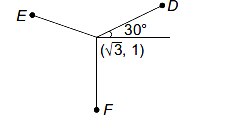
\(\therefore E\) and \(F\) are given by and
\(\therefore\)
\[
\begin{aligned}
\frac{x-\sqrt{3}}{\cos 150^{\circ}} & =\frac{y-1}{\sin 150^{\circ}}=1 \\
\frac{x-\sqrt{3}}{\cos \left(-90^{\circ}\right)} & =\frac{y-1}{\sin \left(-90^{\circ}\right)}=1 \\
E & =\left(\frac{\sqrt{3}}{2}, \frac{3}{2}\right) \\
and
F & =(\sqrt{3}, 0)
\end{aligned}
\]
\[
=\frac{\frac{3}{2}-1}{\frac{3 \sqrt{3}}{2}-\sqrt{3}}=\frac{1}{\sqrt{3}}
\]
[makes an angle \(30^{\circ}\) with \(X\)-axis]
\(\therefore\) Points \(E\) and \(F\) will make angle \(150^{\circ}\) and \(-90^{\circ}\) with \(X\)-axis.
\(\therefore E\) and \(F\) are given by and
\(\therefore\)
\[
\begin{aligned}
\frac{x-\sqrt{3}}{\cos 150^{\circ}} & =\frac{y-1}{\sin 150^{\circ}}=1 \\
\frac{x-\sqrt{3}}{\cos \left(-90^{\circ}\right)} & =\frac{y-1}{\sin \left(-90^{\circ}\right)}=1 \\
E & =\left(\frac{\sqrt{3}}{2}, \frac{3}{2}\right) \\
and
F & =(\sqrt{3}, 0)
\end{aligned}
\]
See the Complete Solution
Get step-by-step explanations for this and 2.5 Lakh+ more JEE, NEET & CET questions.
- Unlock all solutions
- Practice the full chapter
- Track accuracy across PYQs
4.8 rated on Google Play · 14,000+ reviews
More questions from Mathematics
- If is a tangent to the hyperbola , then which of the following CANNOT be sides of a right angled triangle?JEE Advanced 2017 Easy
- For the equation hasJEE Advanced 2014 Medium
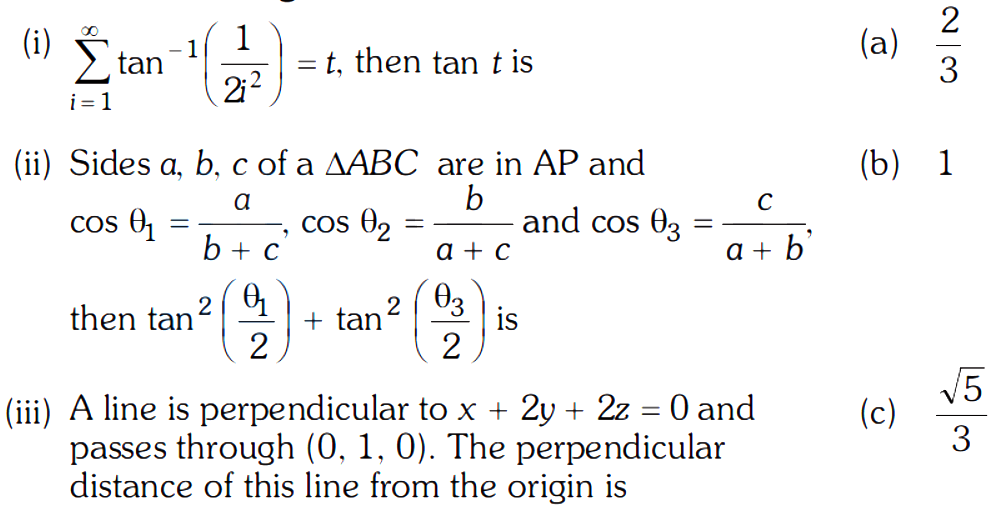
- Match the following.
 JEE Advanced 2006 Medium
 - Paragraph:
Read the following passage and answer the questions.
For every function \(f(x)\) which is twice differentiable, these will be good approximation of \(\int_a^b f(x) d x \cong\left(\frac{b-a}{2}\right)\{f(a)+f(b)\}\). Now, if we take \(c=\frac{a+b}{2}\), then using above again, we get \(\int_a^b f(x) d x=\int_a^c f(x) d x+\int_c^b f(x) d x \cong \frac{b-a}{4}\{f(a)+f(b)+2 f(c)\}\) and so on.
We get approximation for value of \(\int_a^b f(x) d x\).Question:
If \(\lim _{t \rightarrow a} \frac{\int_a^t f(x) d x-\frac{(t-a)}{2}\{f(t)+f(a)\}}{(t-a)^3}=0\), then degree of polynomial function \(f(x)\) at most isJEE Advanced 2006 Hard - Paragraph:
Let \(M=\left\{(x, y) \in \mathbb{R} \times \mathbb{R}: x^{2}+y^{2} \leq r^{2}\right\}\),
where \(r>0 .\) Consider the geometric progression \(a_{n}=\frac{1}{2^{n-1}}, n=1,2,3, \ldots .\) Let \(S_{0}=0\) and, for \(n \geq 1\), let \(S_{n}\) denote the sum of the first \(n\) terms of this progression. For \(n \geq 1\), let \(C_{n}\) denote the circle with center \(\left(S_{n-1}, 0\right)\) and radius \(a_{n}\), and \(D_{n}\) denote the circle with center \(\left(S_{n-1}, S_{n-1}\right)\) and radius \(a_{n}\).
Question:
Consider \(M\) with \(r=\frac{\left(2^{199}-1\right) \sqrt{2}}{2^{198}} .\) The number of all those circles \(D_{n}\) that are inside \(M\) isJEE Advanced 2021 Medium - Let \(f\) be a real-valued function defined on the interval \((0, \infty)\), by \(f(x)=\ln x+\int_0^x \sqrt{1+\sin t} d t\). Then which of the following statement(s) is (are) true ?JEE Advanced 2010 Medium
More PYQs from JEE Advanced
- A small block of mass of \(0.1 \mathrm{~kg}\) lies on a fixed inclined plane PQ which makes an angle \(\theta\) with the horizontal. A horizontal force of \(1 \mathrm{~N}\) acts on the block through its centre of mass as shown in the figure.
The block remains stationary if (take \(g=10 \mathrm{~m} / \mathrm{s}^{2}\) )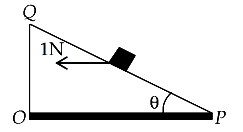 JEE Advanced 2012 Medium
 - Let \(L\) be a normal to the parabola \(y^2=4 x\). If \(L\) passes through the point \((9,6)\), then \(L\) is given byJEE Advanced 2011 Medium
- The number of -digit integers in the closed interval formed by using the digits is ______.JEE Advanced 2022 Hard
- Paragraph :
Two plane harmonic sound waves are expressed by the equations.
\(
\begin{aligned}
& y_1(x, t)=A \cos (0.5 \pi x-100 \pi t) \\
& y_2(x, t)=A \cos (0.46 \pi x-92 \pi t)
\end{aligned}
\)
(All parameters are in MKS)
Question :
What is the speed of the sound?JEE Advanced 2006 Easy - A student uses a simple pendulum of exactly \(1 \mathrm{~m}\) length to determine \(g\), the acceleration due to gravity. He uses a stop watch with the least count of \(1 \mathrm{~s}\) for this and records \(40 \mathrm{~s}\) for 20 oscillations. For this observation, which of the following statement(s) is/are true?JEE Advanced 2010 Easy
- Let be given by thenJEE Advanced 2014 Medium