


JEE Advanced · Physics · 17. Electrostatics
Which of the following statement(s) is/are correct?
- A If the electric field due to a point charge varies as \(r^{-2.5}\) instead of \(r^{-2}\), then the Gauss's law will still be valid
- B The Gauss's law can be used to calculate the field distribution around an electric dipole
- C If the electric field between two point charges is zero somewhere, then the sign of the two charges is the same
- D The work done by the external force in moving a unit positive charge from point \(A\) at potential \(V_A\) to point \(B\) at potential \(V_B\) is \(\left(V_B-V_A\right)\)
Answer & Solution
Correct Answer
(D) The work done by the external force in moving a unit positive charge from point \(A\) at potential \(V_A\) to point \(B\) at potential \(V_B\) is \(\left(V_B-V_A\right)\)
Step-by-step Solution
Detailed explanation
If charges are of opposite signs, then the two fields are along the same direction. So, they cannot be zero. Hence, the charges should be of same sign.
Therefore, option (c) is correct.
Further, work done by external force = change in potential energy
\(
\begin{aligned}
& \therefore \quad W_{A \rightarrow B}=q(\Delta V) \\
& =(+1)\left(V_B-V_A\right) \\
& \text { or } \quad W_{A \rightarrow B}=V_B-V_A\end{aligned}
\)
Therefore, option (d) is also correct.
\(\therefore\) Correct options are (c) and (d).
Analysis of Question
(i) Question is simple.
(ii) \(W=\Delta U\) (by external force)
If charge is just moved, without changing the kinetic energy. If nothing is mentioned in the question regarding the kinetic energy then we take \(W=\Delta U\).
Therefore, option (c) is correct.
Further, work done by external force = change in potential energy
\(
\begin{aligned}
& \therefore \quad W_{A \rightarrow B}=q(\Delta V) \\
& =(+1)\left(V_B-V_A\right) \\
& \text { or } \quad W_{A \rightarrow B}=V_B-V_A\end{aligned}
\)
Therefore, option (d) is also correct.
\(\therefore\) Correct options are (c) and (d).
Analysis of Question
(i) Question is simple.
(ii) \(W=\Delta U\) (by external force)
If charge is just moved, without changing the kinetic energy. If nothing is mentioned in the question regarding the kinetic energy then we take \(W=\Delta U\).
See the Complete Solution
Get step-by-step explanations for this and 2.5 Lakh+ more JEE, NEET & CET questions.
- Unlock all solutions
- Practice the full chapter
- Track accuracy across PYQs
4.8 rated on Google Play · 14,000+ reviews
More questions from Physics
- Paragraph:
The nuclear charge \((\mathrm{Ze})\) is non-uniformly distributed within a nucleus of radius \(R\). The charge density \(\rho(r)\) [charge per unit volume] is dependent only on the radial distance \(r\) from the centre of the nucleus as shown in figure. The electric field is only along the radial direction.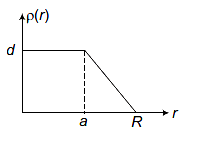
Question:
The electric field within the nucleus is generally observed to be linearly dependent on \(r\). This impliesJEE Advanced 2008 Medium - Two spherical stars and have densities and , respectively. and have the same radius, and their masses and are related by . Due to an interaction process, star loses some of its mass, so that its radius is halved, while its spherical shape is retained, and its density remains . The entire mass lost by is deposited as a thick spherical shell on with the density of the shell being . If and are the escape velocities from and after the interaction process, the ratio . The value of isJEE Advanced 2022 Medium
- For spherical symmetrical charge distribution, variation of electric potential with distance from centre is given in diagram. Given that:
\(V=\frac{q}{4 \pi \varepsilon_0 R_0} \text { for } r \leq R_0\)
and \(V=\frac{q}{4 \pi \varepsilon_0 r}\) for \(r \geq R_0\)
Then which option(s) are correct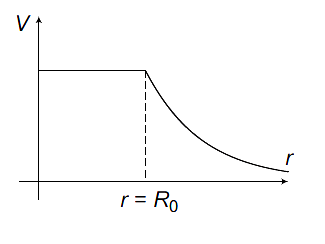 JEE Advanced 2006 Medium
 - A liquid at is poured very slowly into a Calorimeter that is at temperature of The boiling temperature of the liquid is It is found that the first of the liquid completely evaporates. After pouring another of the liquid the equilibrium temperature is found to be The ratio of the Latent heat of the liquid to its specific heat will be ______
[Neglect the heat exchange with surrounding]JEE Advanced 2019 Medium - A field line is shown in the figure. This field cannot represent
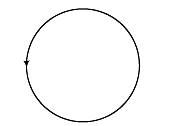 JEE Advanced 2006 Hard
 - One mole of a monatomic ideal gas undergoes four thermodynamic processes as shown schematically in the PV - diagram below. Among these four processes, one is isobaric, one is isochoric, one is isothermal and one is adiabatic. Match the processes mentioned in List-1 with the corresponding statements in List-II.

LIST -I LIST -II A) In process P) Work done by the gas is zero B) In process Q) Temperature of the gas remains unchanged C) In process R) No heat is exchanged between the gas and its surroundings D) In process S) Work done by the gas is JEE Advanced 2018 Medium
More PYQs from JEE Advanced
- Let the function \(g:(-\infty, \infty) \rightarrow\left(-\frac{\pi}{2}, \frac{\pi}{2}\right)\) be given by \(g(u)=2 \tan ^{-1}\left(e^u\right)-\frac{\pi}{2}\). Then, \(g\) isJEE Advanced 2008 Medium
- Let \(f_{1}:(0, \infty) \rightarrow \mathbb{R}\) and \(f_{2}:(0, \infty) \rightarrow \mathbb{R}\) be defined by
\[
f_{1}(x)=\int_{0}^{x} \prod_{j=1}^{21}(t-j)^{j} d t, \quad x>0
\]
and
\(
f_{2}(x)=98(x-1)^{50}-600(x-1)^{49}+2450, \quad x>0
\)
where, for any positive integer \(n\) and real numbers \(a_{1}, a_{2}, \ldots, a_{n}, \prod_{i=1}^{n} a_{i}\) denotes the product of \(a_{1}, a_{2}, \ldots, a_{n} .\) Let \(m_{i}\) and \(n_{i}\), respectively, denote the number of points of local minima and the number of points of local maxima of function \(f_{i}, i=1,2\), in the interval \((0, \infty)\).
The value of is _____.JEE Advanced 2021 Medium - The pair(s) of ions where BOTH the ions are precipitated upon passing gas in presence of dilute HCl, is (are)JEE Advanced 2015 Easy
- Consider the set of eight vectors . Three non-coplanar vectors can be chosen from in ways. Then isJEE Advanced 2013 Medium
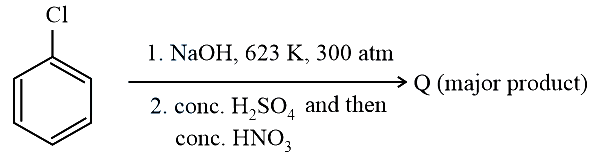
- The weight percentage of hydrogen in , formed in the following reaction sequence, is
[Given: Atomic mass of \(H =1, C =12,\) \(N=14, O =16, S=32, Cl \) \(=35\) ]JEE Advanced 2022 Easy - A hollow pipe of length \(0.8 \mathrm{~m}\) is closed at one end. At its open end a \(0.5 \mathrm{~m}\) long uniform string is vibrating in its second harmonic and it resonates with the fundamental frequency of the pipe. If the tension in the wire is \(50 \mathrm{~N}\) and the speed of sound is \(320 \mathrm{~ms}^{-1}\), the mass of the string isJEE Advanced 2010 Medium