


JEE Advanced · Physics · 13. Thermodynamics
A gas is enclosed in a cylinder with a movable frictionless piston. Its initial thermodynamic state at pressure changes to a final state at in an adiabatic quasi - static process, such that constant. Consider another thermodynamic process that brings the system from the same initial state to the same final state in two steps: an isobaric expansion at followed by an isochoric (isovolumetric) process at volumes . The amount of heat supplied to the system in the two step process is approximately
- A 112 J
- B 294 J
- C 588 J
- D 813 J
Answer & Solution
Correct Answer
(C) 588 J
Step-by-step Solution
Detailed explanation
In adiabatic process
constant
constant
In another process
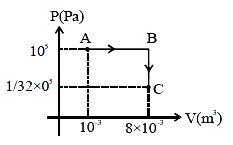
Putting values
constant
constant
In another process
Putting values
See the Complete Solution
Get step-by-step explanations for this and 2.5 Lakh+ more JEE, NEET & CET questions.
- Unlock all solutions
- Practice the full chapter
- Track accuracy across PYQs
4.8 rated on Google Play · 14,000+ reviews
More questions from Physics
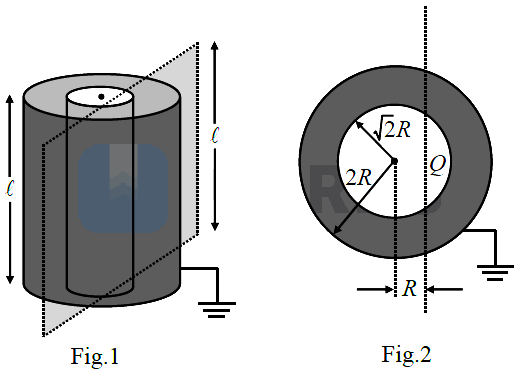
- Two co-axial conducting cylinders of same length \(\ell\) with radii \(\sqrt{2} R\) and \(2 R\) are kept, as shown in Fig. 1. The charge on the inner cylinder is \(Q\) and the outer cylinder is grounded. The annular region between the cylinders is filled with a material of dielectric constant \(\kappa=5\). Consider an imaginary plane of the same length \(\ell\) at a distance R from the common axis of the cylinders. This plane is parallel to the axis of the cylinders. The cross-sectional view of this arrangement is shown in Fig. 2. Ignoring edge effects, the flux of the electric field through the plane is ( \(\epsilon_0\) is the permittivity of free space):
 JEE Advanced 2025 Hard
 - Two loudspeakers M and N are located 20m apart and emit sound at frequencies 118 Hz and 121 Hz, respectively. A car is initially at a point P, 1800 m away from the midpoint Q of the line MN and moves towards Q constantly at 60 km/hr along the perpendicular bisector of MN. It crosses Q and eventually reaches a point R, 1800 m away from Q. Let represent the beat frequency measured by a person sitting in the car at time t. Let be the beat frequencies measured at locations P, Q and R, respectively. The speed of sound in air is Which of the following statement(s) is(are) true regarding the sound heard by the person ?JEE Advanced 2016 Hard
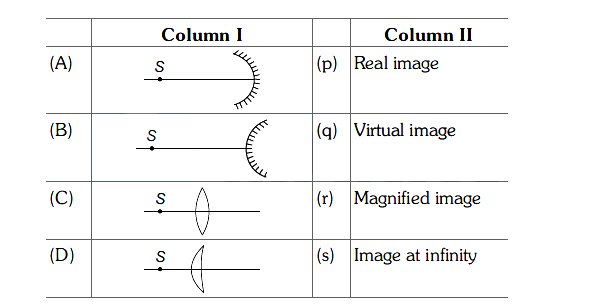
- An optical component and an object \(S\) placed along its optic axis are given in Column I. The distance between the object and the component can be varied. The properties of images are given in Column II. Match all the properties of images from Column II with the appropriate components given in Column I. Indicate your answer by darkening the appropriate bubble of the \(4 \times 4\) matrix given in the ORS.
 JEE Advanced 2008 Easy
 - A particle of mass moves in circular orbits with potential energy , where is a positive constant and is its distance from the origin. Its energies are calculated using the Bohr model. If the radius of the particle's orbit is denoted by and its speed and energy are denoted by and respectively, then for the orbit (here is the Planck's constant)JEE Advanced 2020 Medium
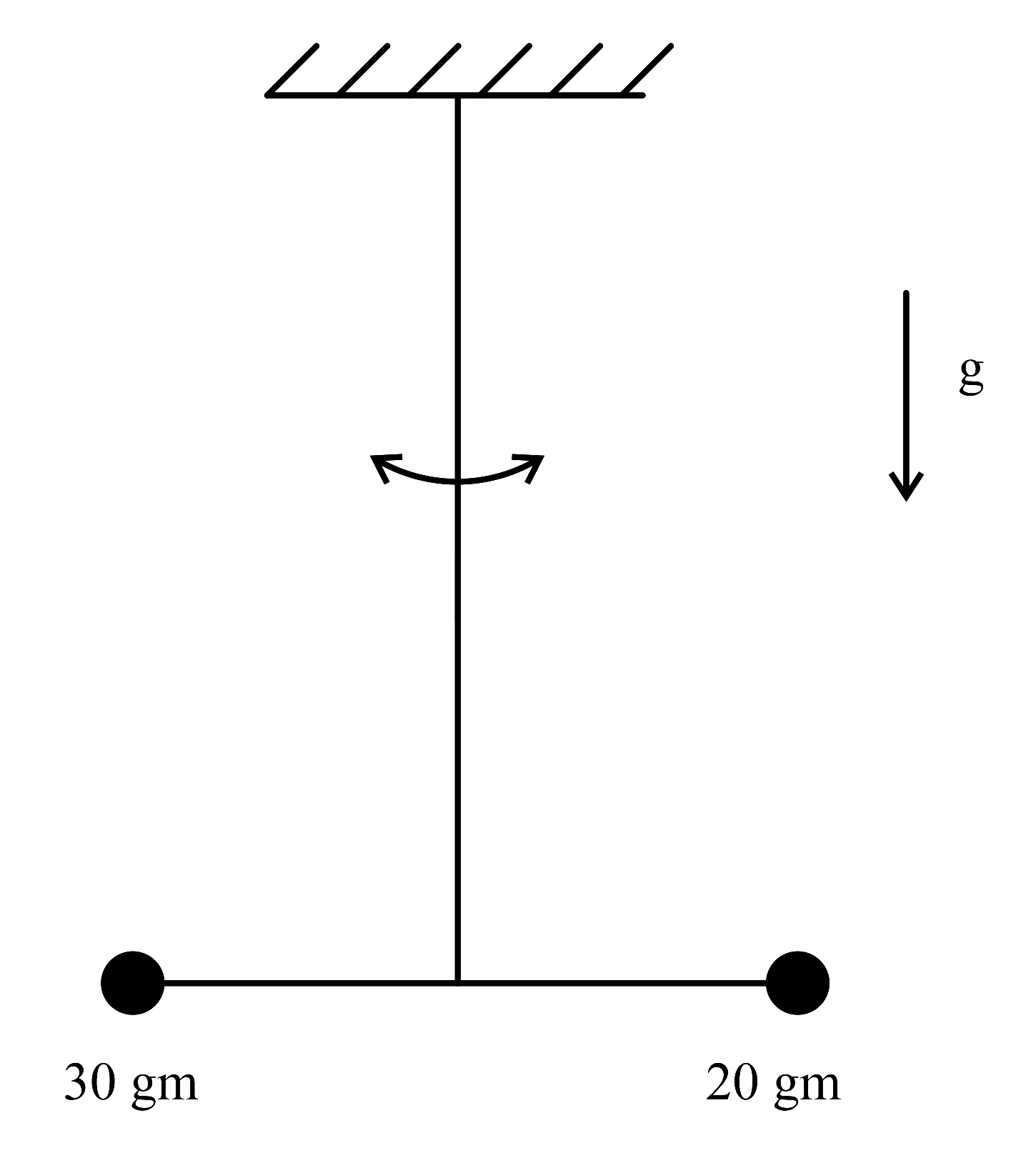
- Two point-like objects of masses and are fixed at the two ends of a rigid massless rod of length . This system is suspended vertically from a rigid ceiling using a thin wire attached to its center of mass, as shown in the figure. The resulting torsional pendulum undergoes small oscillations. The torsional constant of the wire is . The angular frequency of the oscillations in . The value of is _____.
 JEE Advanced 2023 Easy
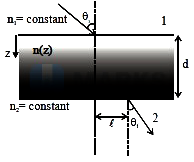
 - A transparent slab of thickness d has a refractive index n (z) that increases with z. Here z is the vertical distance inside the slab, measured from the top. The slab is placed between two media with uniform refractive indices as shown in the figure. A ray of light is incident with angle from medium 1 and emerges in medium 2 with refraction angle with a lateral displacement . Which of the following statement(s) is (are) true?
 JEE Advanced 2016 Medium
More PYQs from JEE Advanced
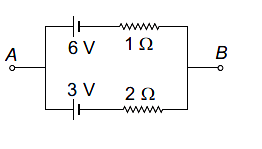
- Two batteries of different emfs and different internal resistances are connected as shown. The voltage across \(A B\) in volt is
 JEE Advanced 2011 Easy
 - The structure of a peptide is given below.
If the absolute values of the net charge of the peptide at and are and respectively, then what is ?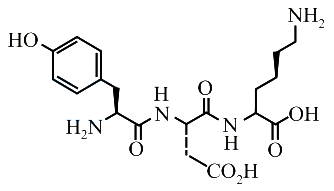 JEE Advanced 2020 Medium
 - Let the straight line \(x=b\) divide the area enclosed by \(y=(1-x)^2, y=0\) and \(x=0\) into two parts \(R_1(0 \leq x \leq b)\) and \(R_2(b \leq x \leq 1)\) such that \(R_1-R_2=\frac{1}{4}\). Then, \(b\) equals toJEE Advanced 2011 Medium
- Paragraph:
A thermal power plant produces electric power of \(600 \mathrm{~kW}\) at \(4000 \mathrm{~V}\), which is to be transported to a place \(20 \mathrm{~km}\) away from the power plant for consumers' usage. It can be transported either directly with a cable of large current carrying capacity or by using a combination of step-up and step-down transformers at the two ends. The drawback of the direct transmission is the large energy dissipation. In the method using transformers, the dissipation is much smaller. In this method, a step-up transformer is used at the plant side so that the current is reduced to a smaller value. At the consumers' end, a step-down transformer is used to supply power to the consumers at the specified lower voltage. It is reasonable to assume that the power cable is purely resistive and the transformers are ideal with a power factor unity. All the currents and voltages mentioned are rms values.
Question:
If the direct transmission method with a cable of resistance \(0.4 \Omega \mathrm{km}^{-1}\) is used, the power dissipation (in %) during transmission isJEE Advanced 2013 Medium - For any , let and . Then the sum of all the solutions of the equation for , is equal toJEE Advanced 2023 Medium
- Paragraph :
A special metal \(S\) conducts electricity without any resistance. A closed wire loop, made of \(S\), does not allow any change in flux through itself by inducing a suitable current to generate a compensating flux. The induced current in the loop cannot decay due to its zero resistance. This current gives rise to a magnetic moment which in turn repels the source of magnetic field or flux. Consider such a loop, of radius \(a\), with its center at the origin. A magnetic dipole of moment \(m\) is brought along the axis of this loop from infinity to a point at distance \(r(\gg a)\) from the center of the loop with its north pole always facing the loop, as shown in the figure below.
The magnitude of magnetic field of a dipole \(m\), at a point on its axis at distance \(r\), is \(\frac{\mu_{0}}{2 \pi} \frac{m}{r^{3}}\), where \(\mu_{0}\) is the permeability of free space. The magnitude of the force between two magnetic dipoles with moments, \(m_{1}\) and \(m_{2}\), separated by a distance \(r\) on the common axis, with their north poles facing each other, is \(\frac{k m_{1} m_{2}}{r^{4}}\), where \(k\) is a constant of appropriate dimensions. The direction of this force is along the line joining the two dipoles.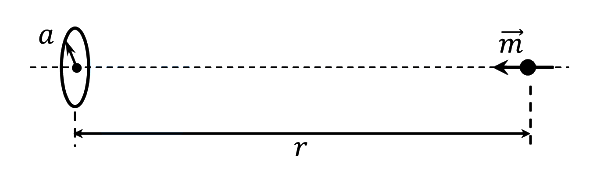
Question :
When the dipole m is placed at a distance r from the centre of the loop (as shown in the figure), the current induced in the loop will be proportional to:JEE Advanced 2021 Medium