


JEE Advanced · Physics · 9. Gravitation
Statement 1 An astronaut in an orbiting space station above the earth experiences weightlessness.
and Statement 2 An object moving around the earth under the influence of earth's gravitational force is in state of 'free fall'.
- A Statement 1 is true, Statement 2 is true, Statement 2 is a correct explanation for Statement 1.
- B Statement 1 is true, Statement 2 is true, Statement 2 is not a correct explanation for Statement 1.
- C Statement 1 is true, Statement 2 is false.
- D Statement 1 is false, Statement 2 is true
Answer & Solution
Correct Answer
(A) Statement 1 is true, Statement 2 is true, Statement 2 is a correct explanation for Statement 1.
Step-by-step Solution
Detailed explanation
Force acting on astronaut is utilised in providing necessary centripetal force; thus he feels weightlessness or he is in a state of free fall.
\(
\therefore \text { correct option is (a) }
\)
\(
\therefore \text { correct option is (a) }
\)
See the Complete Solution
Get step-by-step explanations for this and 2.5 Lakh+ more JEE, NEET & CET questions.
- Unlock all solutions
- Practice the full chapter
- Track accuracy across PYQs
4.8 rated on Google Play · 14,000+ reviews
More questions from Physics
- Paragraph :
When a particle of mass \(m\) moves on the \(x\)-axis in a potential of the form \(V(x)=k x^2\), it performs simple harmonic motion.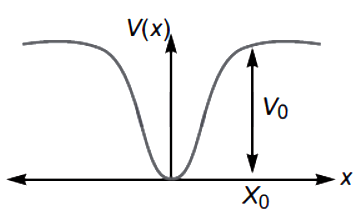
The corresponding time period is proportional to \(\sqrt{\frac{m}{k}}\), as can be seen easily using dimensional analysis. However, the motion of a particle can be periodic even when its potential energy increases on both sides of \(x=0\) in a way different from \(k x^2\) and its total energy is such that the particle does not escape to infinity. Consider a particle of mass \(\mathrm{m}\) moving on the \(x\)-axis. Its potential energy is \(V(x)=\alpha x^4(\alpha>0)\) for \(|x|\) near the origin and becomes a constant equal to \(V_0\) for \(|x| \geq X_0\) (see figure).
Question :
The acceleration of this particle for \(|x|>X_0\) isJEE Advanced 2010 Easy - Consider a spherical gaseous cloud of mass density in free space where is the radial distance from its center. The gaseous cloud is made of particles of equal mass m moving in circular orbits about the common center with the same kinetic energy . The force acting on the particles is their mutual gravitational force. If is constant in time, the particle number density is: [ is universal gravitational constant]JEE Advanced 2019 Hard
- Two spherical stars and emit blackbody radiation. The radius of is 400 times that of and emits times the power emitted from . The ratio of their wavelengths and at which the peaks occur in their respective radiation curves isJEE Advanced 2015 Easy
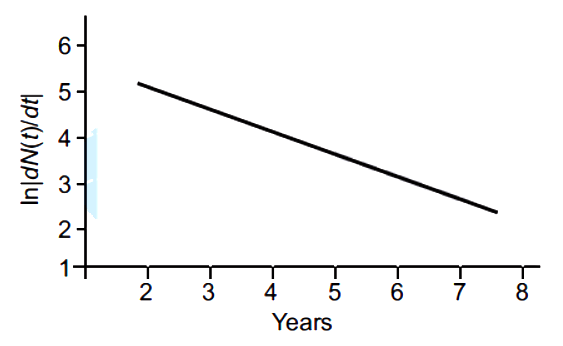
- To determine the half-life of a radioactive element, a student plots a graph of \(\ln \left|\frac{d N(t)}{d t}\right|\) versust. Here \(\frac{d N(t)}{d t}\) is the rate of radioactive decay at time \(t\). If the number of radioactive nuclei of this element decreases by a factor of \(p\) after \(4.16 \mathrm{yr}\), the value of \(p\) is
 JEE Advanced 2010 Hard
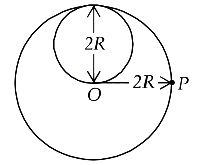
 - A lamina is made by removing a small disc of diameter \(2 R\) from a bigger disc of uniform mass density and radius \(2 R\), as shown in the figure. The moment of inertia of this lamina about axes passing though \(O\) and \(P\) is \(I_{O}\) and \(I_{P}\) respectively. Both these axes are perpendicular to the plane of the lamina. The ratio \(I_{P} / I_{O}\) to the nearest integer is
 JEE Advanced 2012 Medium
 - A ray of light travelling in water is incident on its surface open to air. The angle of incidence is \(\theta\), which is less than the critical angle. Then there will beJEE Advanced 2007 Medium
More PYQs from JEE Advanced
- Let \(S=\{a+b \sqrt{2}: a, b \in \mathbb{Z}\}, T_1=\)\(\left\{(-1+\sqrt{2})^n: n \in \mathbb{N}\right\}\), and \(T_2=\left\{(1+\sqrt{2})^n: n \in \mathbb{N}\right\}\). Then which of the following statements is (are) TRUE?JEE Advanced 2024 Medium
- Paragraph:
Tangents are drawn from the point \(P(3,4)\) to the ellipse \(\frac{x^2}{9}+\frac{y^2}{4}=1\) touching the ellipse at points \(A\) and \(B\).Question:
The coordinates of \(A\) and \(B\) areJEE Advanced 2010 Medium - Paragraph:
If a continuous \(f\) defined on the real line \(R\), assume positive and negative values in \(R\), then the equation \(f(x)=0\) has a root in \(R\). For example, if it is known that a continuous function \(f\) on \(R\) is positive at some point and its minimum values is negative, then the equation \(f(x)=0\) has a root in \(R\).
Consider \(f(x)=k e^x-x\) for all real \(x\), where \(k\) is real constant.Question:
For \(k>0\), the set of all values of \(k\) for which \(k e^x-x=0\) has two distinct roots, isJEE Advanced 2007 Medium - As per IUPAC nomenclature, the name of the complex \(\left[\mathrm{Co}\left(\mathrm{H}_{2} \mathrm{O}\right)_{4}\left(\mathrm{NH}_{3}\right)_{2}\right] \mathrm{Cl}_{3}\) is :JEE Advanced 2012 Easy
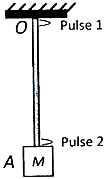
- A block hangs vertically at the bottom end of a uniform rope of constant mass per unit length. The top end of the rope is attached to a fixed rigid support at O. A transverse wave pulse (Pulse 1) of wavelength is produced at point O on the rope. The pulse takes time to reach point A. If the wave pulse of wavelength is produced at point A (Pulse 2) without disturbing the position of M it takes time to reach point O. Which of the following options is/are correct?
 JEE Advanced 2017 Medium
 - A hydrogen atom, initially at rest in its ground state, absorbs a photon of frequency \(v_1\) and ejects the electron with a kinetic energy of 10 eV . The electron then combines with a positron at rest to form a positronium atom in its ground state and simultaneously emits a photon of frequency \(v_2\). The center of mass of the resulting positronium atom moves with a kinetic energy of 5 eV . It is given that positron has the same mass as that of electron and the positronium atom can be considered as a Bohr atom, in which the electron and the positron orbit around their center of mass. Considering no other energy loss during the whole process, the difference between the two photon energies (in eV ) is \(\qquad\)JEE Advanced 2025 Hard