


JEE Advanced · Chemistry · 23. Coordination Compounds
As per IUPAC nomenclature, the name of the complex \(\left[\mathrm{Co}\left(\mathrm{H}_{2} \mathrm{O}\right)_{4}\left(\mathrm{NH}_{3}\right)_{2}\right] \mathrm{Cl}_{3}\) is :
- A Tetraaquadiaminecobalt (III) chloride
- B Tetraaquadiamminecobalt (III) chloride
- C Diaminetetraaquacoblat (II) chloride
- D Diamminetetraaquacobalt (III) chloride
Answer & Solution
Correct Answer
(D) Diamminetetraaquacobalt (III) chloride
Step-by-step Solution
Detailed explanation
(achiral)
\(\left[\mathrm{Co}\left(\mathrm{H}_{2} \mathrm{O}\right)_{4}\left(\mathrm{NH}_{3}\right)_{2}\right] \mathrm{Cl}_{3}\)
Diamminetetraaquacobalt (III) chloride.
\(\left[\mathrm{Co}\left(\mathrm{H}_{2} \mathrm{O}\right)_{4}\left(\mathrm{NH}_{3}\right)_{2}\right] \mathrm{Cl}_{3}\)
Diamminetetraaquacobalt (III) chloride.
See the Complete Solution
Get step-by-step explanations for this and 2.5 Lakh+ more JEE, NEET & CET questions.
- Unlock all solutions
- Practice the full chapter
- Track accuracy across PYQs
4.8 rated on Google Play · 14,000+ reviews
More questions from Chemistry
- The wave function, \(\psi_{ n , 1, m_{ l }}\) is a mathematical function whose value depends upon spherical polar coordinates \(( r , \theta, \phi)\) of the electron and characterized by the quantum numbers \(n , 1\) and \(m _{ l }\). Here \(r\) is the distance from the nucleus, \(\theta\) is colatitude and \(\phi\) is azimuth. In the mathematical functions given in the Table, Z is the atomic number and \(a_0\) is Bohr radius
For \(\text{He} ^{+}\)ion, the only incorrect combinationColumn 1 Column 2 Column 3 (I) 1s orbital \(\text {(i) } \psi_{ n , 1, m_1}\)
\(\propto\left(\frac{ Z }{ a _{ o }}\right)^{\frac{3}{2}} e ^{-\left(\frac{ Zr }{ e _{ o }}\right)}\)(P) 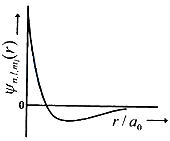
(II) 2s orbital (ii) One radial node (Q) Probability density at the nucleus \(\propto \frac{1}{ a _{ o }^3}\). (III) \(2 p _{ z }\) orbital \(\text {(iii) } \psi_{ n }, 1, m_{ l }\)
\(\propto\left(\frac{ Z }{ a _{ o }}\right)^{\frac{5}{2}} re ^{-\left(\frac{ Zr }{2 a _{ o }}\right)} \cos \theta\)(R) Probability density is maximum at the nucleus. (IV) \(3 d_{ z }^2\) orbital (iv) \(x y\)-plane is a nodal plane (S) Energy needed to excite an electron from \(n =2\) state to \(n =4\) state is \(\frac{27}{32}\) times the energy needed to excite are electron from \(n =2\) state to \(n =6\) state. JEE Advanced 2017 Hard - Consider the following reversible reaction:
The activation energy of the backward reaction exceeds that of the forward reaction by (in ). If the pre-exponential factor of the forward reaction is times that of the reverse reaction, the absolute value of for the reaction at is ____.
(Given; and is the Gibbs energy)JEE Advanced 2018 Medium - The Fischer projection of -erythrose is shown below.
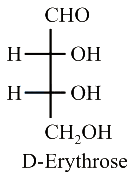
-Erythrose and its isomers are listed as and in Column I. Choose the correct relationship of and with -erythrose from Column II.Column - I Column -II P. 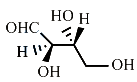
1. Diastereomer Q. 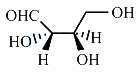
2. Identical R. 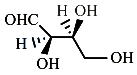
3. Enantiomer S. 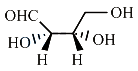 JEE Advanced 2020 Medium
 - The reversible expansion of an ideal gas under adiabatic and isothermal conditions is shown in the figure. Which of the following statement(s) is (are) correct?
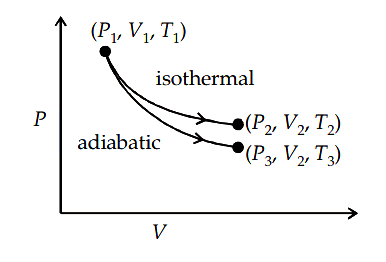 JEE Advanced 2012 Medium
 - Tin is obtained from cassiterite by reduction with coke. Use the data given below to determine the minimum temperature (in K ) at which the reduction of cassiterite by coke would take place.
\(298 K: \Delta_{ f } H ^0\left( SnO _2(s)\right)=-581.0 kJ mol ^{-1}\), \(\Delta_{ f } H ^0\left( CO _2(g)\right)=-394.0 kJ mol ^{-1}\)
\(S ^0\left( SnO _2(s)\right)=56.0 JK ^{-1} mol^{-1}, S^0( Sn ( s ))\) \(=52.0 JK ^{-1} mol^{-1}\)
\(S ^0( C ( s ))=6.0 JK ^{-1} mol^{-1}, S^0\left( CO _2(g)\right)\) \(=210.0 JK ^{-1} mol^{-1}\)
Assume that the enthalpies and the entropies are temperature independent.JEE Advanced 2020 Medium - Match the conversions in Column I with the type(s) given in Column II. Indicate your answer by darkening the appropriate bubbles of the \(4 \times 4\) matrix given in the ORS.
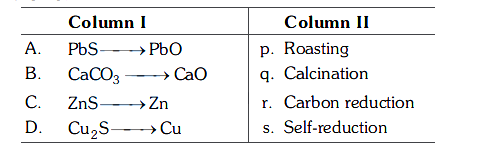 JEE Advanced 2008 Medium
More PYQs from JEE Advanced
- Paragraph:
There are some deposits of nitrates and phosphates in earth's crust. Nitrates are more soluble in water. Nitrates are difficult to reduce under the laboratory conditions but microbes do it easily. Ammonia forms large number of complexes with transition metal ions. Hybridisation easily explains the ease of sigma donation capability of \(\mathrm{NH}_3\) and \(\mathrm{PH}_3\). Phosphine is a flammable gas and is prepared from white phosphorus.
Question:
Among the following, the correct statement isJEE Advanced 2008 Medium - Consider a reaction \(a G+b H \rightarrow\) products. When concentration of both the reactants \(G\) and \(H\) is doubled, the rate increases by eight times. However, when concentration of \(G\) is doubled keeping the concentration of \(H\) fixed, the rate is doubled. The overall order of the reaction isJEE Advanced 2007 Easy
- In the following carbocation, \(\mathrm{H} / \mathrm{CH}_3\) that is most likely to migrate to the positively charged carbon is
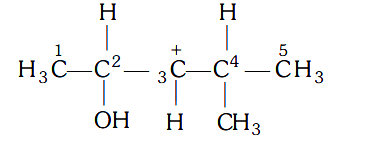 JEE Advanced 2009 Hard
 - Consider the lines given by
\[
L_1: x+3 y-5=0, L_2: 3 x-k y-1=0, L_3: 5 x+2 y-12=0
\]
Match the Statements/Expressions in Column I with the Statements/Expressions in Column II.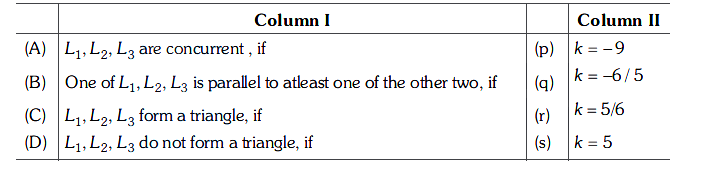 JEE Advanced 2008 Medium
 - Paragraph:
Let \(S=S_{1} \cap S_{2} \cap S_{3}\), where
\(S_{1}=\{z \in \mathbb{C}:|z|<4\}, \quad S_{2}=\left\{z \in \mathbb{C}: \operatorname{Im}\left[\frac{z-1+\sqrt{3} i}{1-\sqrt{3} i}\right]>0\right\}\) and \(S_{3}=\{z \in \mathbb{C}: \operatorname{Re} z>0\}\).
Question:
Area of \(S=\)JEE Advanced 2013 Medium - A soft plastic bottle, filled with water of density \(1 \mathrm{gm} / \mathrm{cc}\), carries an inverted glass test-tube with some air (ideal gas) trapped as shown in the figure. The test-tube has a mass of \(5 \mathrm{gm}\), and it is made of a thick glass of density \(2.5 \mathrm{gm} / \mathrm{cc}\). Initially the bottle is sealed at atmospheric pressure \(p_{0}=10^{5} \mathrm{~Pa}\) so that the volume of the trapped air is \(v_{0}=3.3 \mathrm{cc}\). When the bottle is squeezed from outside at constant temperature, the pressure inside rises and the volume of the trapped air reduces. It is found that the test tube begins to sink at pressure \(p_{0}+\Delta p\) without changing its orientation. At this pressure, the volume of the trapped air is \(v_{0}-\Delta v\).
Let \(\Delta v=X\) cc and \(\Delta p=Y \times 10^{3} \mathrm{~Pa}\).
The value of is _____.JEE Advanced 2021 Hard