


JEE Advanced · Physics · 5. Laws of Motion
Paragraph :
A frame of reference that is accelerated with respect to an inertial frame of reference is called a non-inertial frame of reference. A coordinate system fixed on a circular disc rotating about a fixed axis with a constant angular velocity \(\omega\) is an example of a non-inertial frame of reference.
The relationship between the force \(\vec{F}_{\text {rot }}\) experienced by a particle of mass \(m\) moving on the rotating disc and the force \(\vec{F}_{\text {in }}\) experienced by the particle in an inertial frame of reference is
\(\vec{F}_{\mathrm{rot}}=\vec{F}_{\mathrm{in}}+2 m\left(\vec{v}_{\mathrm{rot}} \times \vec{\omega}\right)+m(\vec{\omega} \times \vec{r}) \times \vec{\omega}\),
where \(\vec{v}_{\text {rot }}\) is the velocity of the particle in the rotating frame of reference and \(\vec{r}\) is the position vector of the particle with respect to the centre of the disc.
Now consider a smooth slot along a diameter of a disc of radius \(R\) rotating counter-clockwise with a constant angular speed \(\omega\) about its vertical axis through its center. We assign a coordinate system with the origin at the center of the disc, the \(x\)-axis along the slot, the \(y\)-axis perpendicular to the slot and the \(z\)-axis along the rotation axis \((\vec{\omega}=\omega \hat{k}) .\) A small block of mass \(m\) is gently placed in the slot at \(\vec{r}=(R / 2) \hat{i}\) at \(t=0\) and is constrained to move only along the slot.
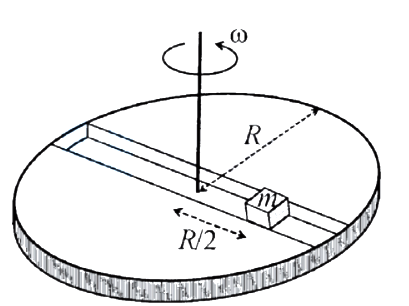
Question :
The net reaction of the disc on the block is
- A
- B
- C
- D
Answer & Solution
Correct Answer
(C)
Step-by-step Solution
Detailed explanation
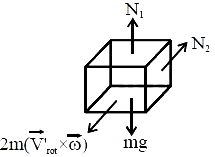
Total reaction on block
See the Complete Solution
Get step-by-step explanations for this and 2.5 Lakh+ more JEE, NEET & CET questions.
- Unlock all solutions
- Practice the full chapter
- Track accuracy across PYQs
4.8 rated on Google Play · 14,000+ reviews
More questions from Physics
- A double slit setup is shown in the figure. One of the slits is in medium of refractive index . The other slit is at the interface of this medium with another medium of refractive index . The line joining the slits is perpendicular to the interface and the distance between the slits is . The slit widths are much smaller than . A monochromatic parallel beam of light is incident on the slits from medium . A detector is placed in medium at a large distance from the slits, and at an angle from the line joining them, so that equals the angle of refraction of the beam. Consider two approximately parallel rays from the slits received by the detector.
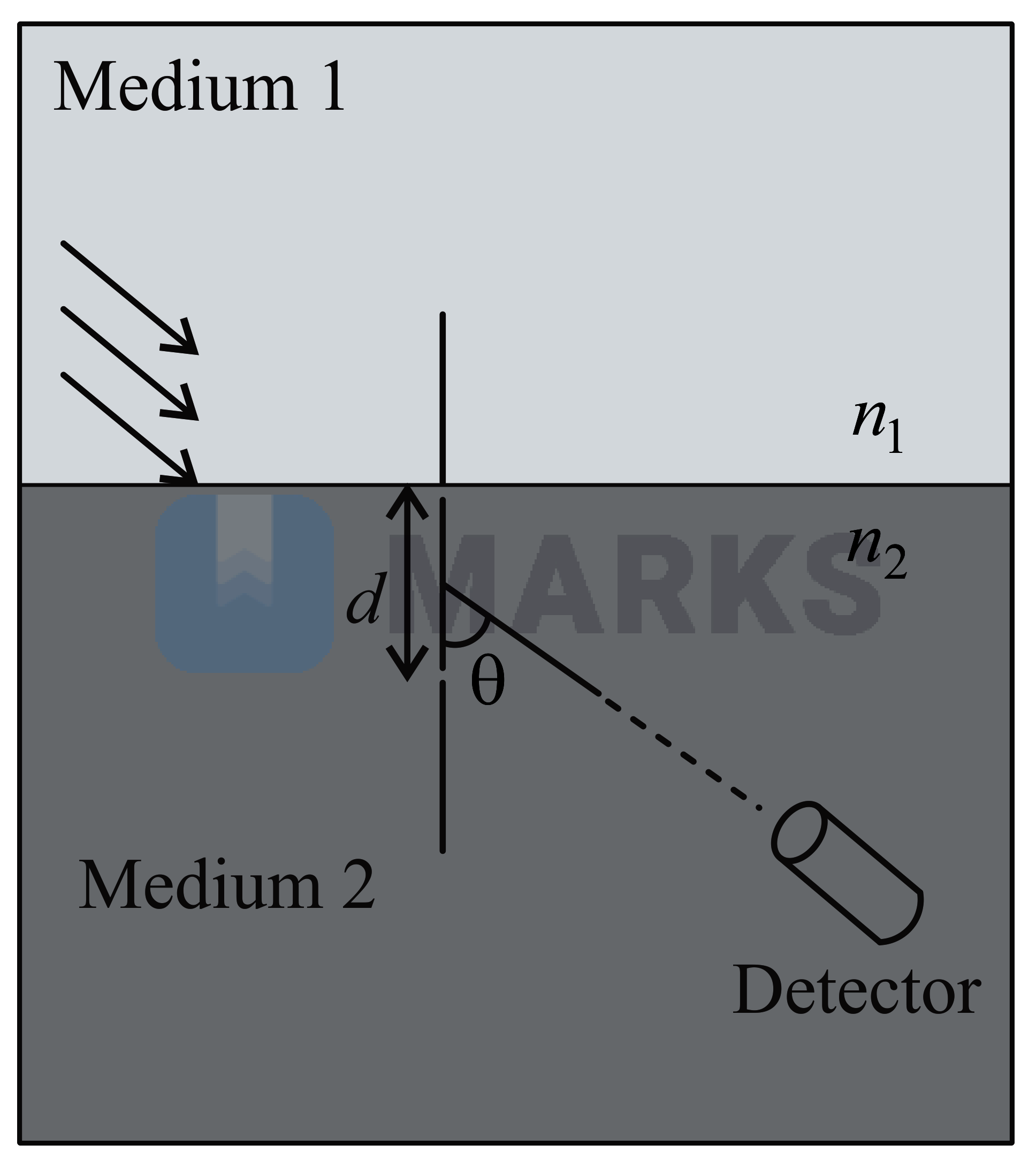
Which of the following statement(s) is(are) correct?JEE Advanced 2022 Easy - Paragraph :
When a particle of mass \(m\) moves on the \(x\)-axis in a potential of the form \(V(x)=k x^2\), it performs simple harmonic motion.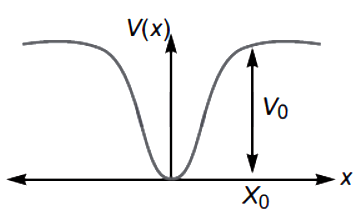
The corresponding time period is proportional to \(\sqrt{\frac{m}{k}}\), as can be seen easily using dimensional analysis. However, the motion of a particle can be periodic even when its potential energy increases on both sides of \(x=0\) in a way different from \(k x^2\) and its total energy is such that the particle does not escape to infinity. Consider a particle of mass \(\mathrm{m}\) moving on the \(x\)-axis. Its potential energy is \(V(x)=\alpha x^4(\alpha>0)\) for \(|x|\) near the origin and becomes a constant equal to \(V_0\) for \(|x| \geq X_0\) (see figure).
Question :
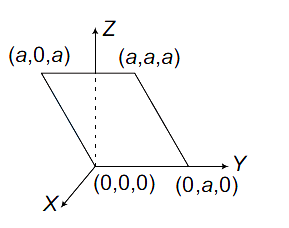
If the total energy of the particle is \(E\), it will perform periodic motion only ifJEE Advanced 2010 Medium - Consider an electric field \(\mathbf{E}=E_0 \hat{\mathbf{x}}\) where \(\bar{E}_0\) is a constant. The flux through the shaded area ( as shown in the figure) due to this field is
 JEE Advanced 2011 Medium
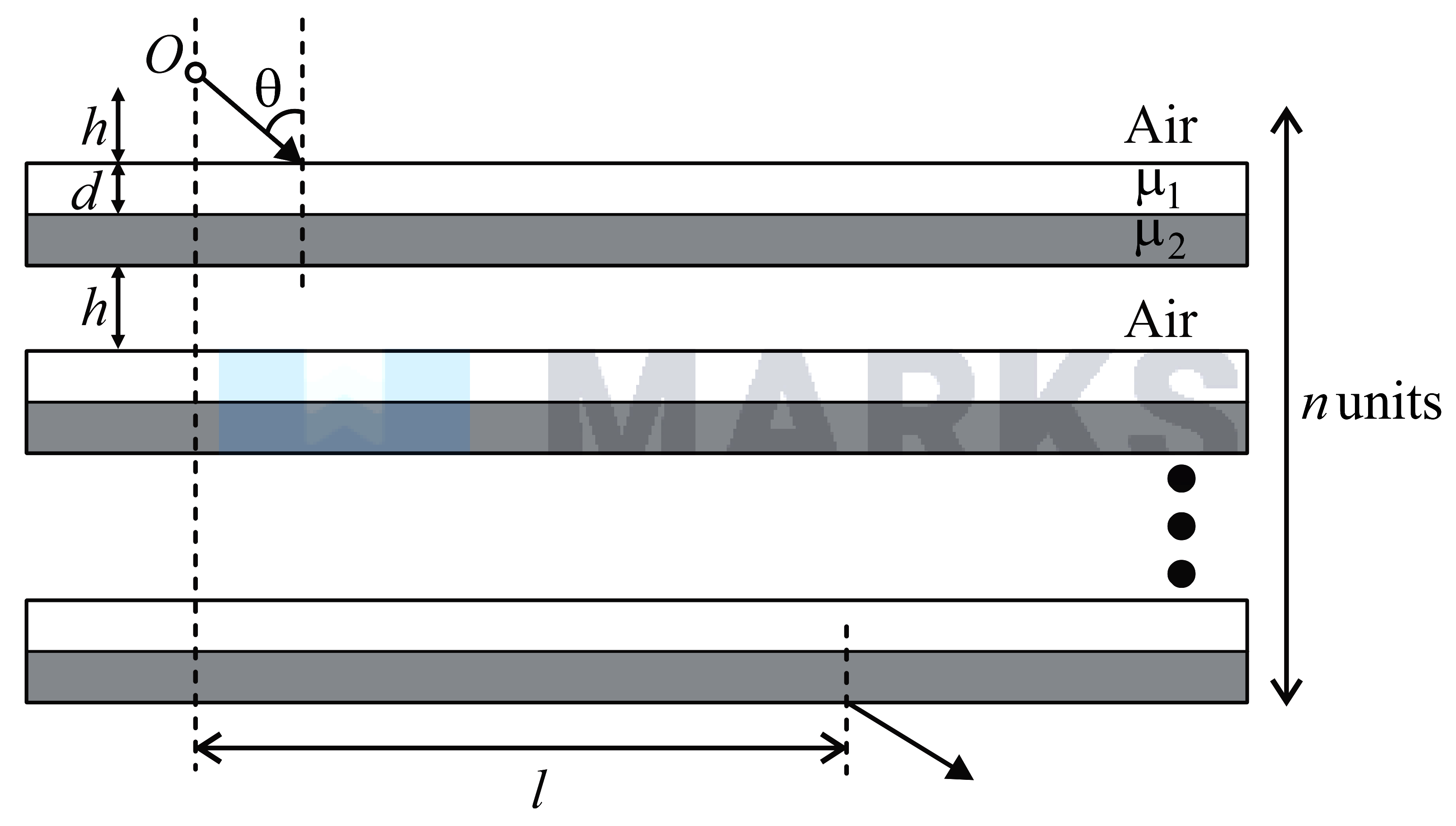
 - Consider a configuration of identical units, each consisting of three layers. The first layer is a column of air of height , and the second and third layers are of equal thickness , and refractive indices and , respectively. A light source is placed on the top of the first unit, as shown in the figure. A ray of light from is incident on the second layer of the first unit at an angle of to the normal. For a specific value of , the ray of light emerges from the bottom of the configuration at a distance , as shown in the figure. The value of is _______.
 JEE Advanced 2022 Hard
 - A ray of light travelling in water is incident on its surface open to air. The angle of incidence is \(\theta\), which is less than the critical angle. Then there will beJEE Advanced 2007 Medium
- A fission reaction is given by , where and are two particles. Considering to be at rest, the kinetic energies of the products are denoted by and , respectively. Let the binding energies per nucleon of and be 7.5 MeV, 8.5 MeV, and 8.5 MeV respectively. Considering different conservation laws, the correct option(s) is (are)JEE Advanced 2015 Medium
More PYQs from JEE Advanced
- A closed vessel with rigid walls contains 1 mol of and 1 mol of air at 298 K. Considering complete decay of to , the ratio of the final pressure to the initial pressure of the system at 298 K isJEE Advanced 2015 Hard
- In terms of potential difference , electic current , permittivity , permeability and speed of light , the dimensionally correct equation(s) is (are)JEE Advanced 2015 Easy
- Let . Let be the function defined by . Then, which of the following statements is/are TRUE?JEE Advanced 2022 Hard
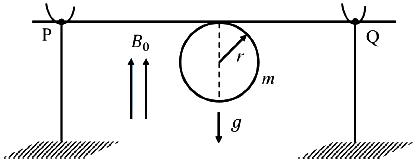
- A thin stiff insulated metal wire is bent into a circular loop with its two ends extending tangentially from the same point of the loop. The wire loop has mass \(m\) and radius \(r\) and it is in a uniform vertical magnetic field \(B_0\), as shown in the figure. Initially, it hangs vertically downwards, because of acceleration due to gravity \(g\), on two conducting supports at \(\mathrm{P}\) and \(\mathrm{Q}\). When a current \(I\) is passed through the loop, the loop turns about the line \(\mathrm{PQ}\) by an angle \(\theta\) given by
 JEE Advanced 2024 Medium
 - Dissolving \(120 \mathrm{~g}\) of urea (molecular weight 60) in \(1000 \mathrm{~g}\) of water gave a solution of density \(1.15 \mathrm{~g} / \mathrm{mL}\). The molarity of the solution isJEE Advanced 2011 Easy
- Under the same reaction conditions, initial concentration of \(1.386 \mathrm{~mol} \mathrm{dm}^{-3}\) of a substance becomes half in 40 s and 20 s through first-order and zero-order kinetics, respectively. Ratio \(\left(\frac{k_1}{k_0}\right)\) of the rate constants for first order \(\left(k_1\right)\) and zero \(\operatorname{order}\left(k_0\right)\) of the reaction isJEE Advanced 2008 Easy