


JEE Advanced · Physics · 15. Oscillations
Paragraph :
When a particle of mass \(m\) moves on the \(x\)-axis in a potential of the form \(V(x)=k x^2\), it performs simple harmonic motion.
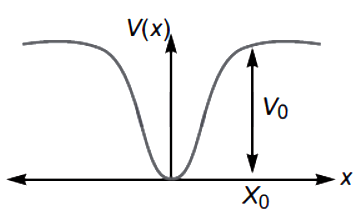
The corresponding time period is proportional to \(\sqrt{\frac{m}{k}}\), as can be seen easily using dimensional analysis. However, the motion of a particle can be periodic even when its potential energy increases on both sides of \(x=0\) in a way different from \(k x^2\) and its total energy is such that the particle does not escape to infinity. Consider a particle of mass \(\mathrm{m}\) moving on the \(x\)-axis. Its potential energy is \(V(x)=\alpha x^4(\alpha>0)\) for \(|x|\) near the origin and becomes a constant equal to \(V_0\) for \(|x| \geq X_0\) (see figure).
Question :
If the total energy of the particle is \(E\), it will perform periodic motion only if
- A \(E < 0\)
- B \(E>0\)
- C \(V_0>E>0\)
- D \(E>V_0\)
Answer & Solution
Correct Answer
(C) \(V_0>E>0\)
Step-by-step Solution
Detailed explanation
If \(E>V_0\), particle will escape. But simultaneously for oscillations, \(E>0\). Hence, the correct answer is \(V_0>E>0\) or the correct option is (c).
See the Complete Solution
Get step-by-step explanations for this and 2.5 Lakh+ more JEE, NEET & CET questions.
- Unlock all solutions
- Practice the full chapter
- Track accuracy across PYQs
4.8 rated on Google Play · 14,000+ reviews
More questions from Physics
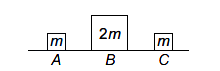
- Three objects \(A, B\) and \(C\) are kept in a straight line on a frictionless horizontal surface. These have masses \(m, 2 m\) and \(m\), respectively. The object \(A\) moves towards \(B\) with a speed \(9 \mathrm{~ms}^{-1}\) and makes an elastic collision with it. Thereafter, \(B\) makes completely inelastic collision with \(C\). All motions occur on the same straight line. Find the final speed (in \(\mathrm{ms}^{-1}\) ) of the object \(C\).
 JEE Advanced 2009 Medium
 - List-I shows various functional dependencies of energy \((E)\) on the atomic number \((Z)\). Energies associated with certain phenomena are given in List-II. Choose the option that describes the correct match between the entries in List-I to those in List-II.
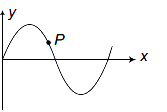
List - I List - II (P) \(E\text { propto } Z^2\) (1) energy of characteristic x-rays (Q) \(E\text { propto } (Z-1)^2\) (2) electrostatic part of the nuclear binding energy for stable nuclei with mass numbers in the range 30 to 170 (R) \(E \text { propto } Z(Z-1)\) (3) energy of continuous x-rays (S) E is practically independent of Z (4) average nuclear binding energy per nucleon for stable nuclei with mass number in the range 30 to 170 (5) energy of radiation due to electronic transitions from hydrogen-like atoms JEE Advanced 2025 Hard - A transverse sinusoidal wave moves along a string in the positive \(x\)-direction at a speed of \(10 \mathrm{~cm} / \mathrm{s}\). The wavelength of the wave is \(0.5 \mathrm{~m}\) and its amplitude is \(10 \mathrm{~cm}\). At a particular time \(t\), the snap-shot of the wave is shown in figure. The velocity of point \(P\) when its displacement is \(5 \mathrm{~cm}\) is
 JEE Advanced 2008 Easy
 - Statement 1 The sensitivity of a moving coil galvanometer is increased by placing a suitable magnetic material as a core inside the coil.
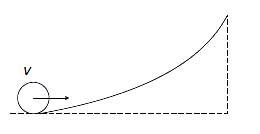
and Statement 2 Soft iron has a high magnetic permeability and cannot be easily magnetized or demagnetized.JEE Advanced 2008 Easy - A small object of uniform density rolls up a curved surface with an initial velocity \(v\). It reaches up to a maximum height of \(\frac{3 v^2}{4 g}\) with respect to the initial\(
\text { position. The object is }
\) JEE Advanced 2007 Medium
 - Consider an circuit, with inductance and capacitance , kept on a plane. The area of the circuit is . It is placed in a constant magnetic field of strength which is perpendicular to the plane of the circuit. At time , the magnetic field strength starts increasing linearly as with . The maximum magnitude of the current in the circuit is____.JEE Advanced 2022 Medium
More PYQs from JEE Advanced
- Aqueous solution of \(\text{Na} _2\text S_2\text O _3\) on reaction with \(\text{Cl} _2\) givesJEE Advanced 2008 Medium
- The term that corrects for the attractive forces present in a real gas in the van der Waals' equation isJEE Advanced 2009 Easy
- For a first order reaction, \(A \rightarrow P\), the temperature \((T)\) dependent rate constant \((k)\) was found to follow the equation, \(\log k=-(2000) / T+6.0\)
The pre-exponential factor \(A\) and the activation energy \(\left(E_a\right)\), respectively, areJEE Advanced 2009 Easy - Calamine, malachite, magnetite and cryolite, respectively are:JEE Advanced 2019 Easy
- If is the solution of the differential equation for , and the slope of the curve is never zero, then the value of is _____ .JEE Advanced 2022 Easy
- An electron and a proton are moving on straight parallel paths with same velocity. They enter a semi-infinite region of uniform magnetic field perpendicular to the velocity. Which of the following statement(s) is/are true?JEE Advanced 2011 Easy