


JEE Advanced · Physics · 13. Thermodynamics
One mole of a monoatomic ideal gas goes through a thermodynamic cycle, as shown in the volume versus temperature diagram. The correct statement(s) is/are:
[ is the gas constant]
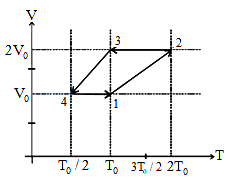
- A The ratio of heat transfer during processes and is
- B The ratio of heat transfer during processes and is
- C The above thermodynamic cycle exhibits only isochoric and adiabatic processes.
- D Work done in this thermodynamic cycle is
Answer & Solution
Correct Answer
(D) Work done in this thermodynamic cycle is
Step-by-step Solution
Detailed explanation
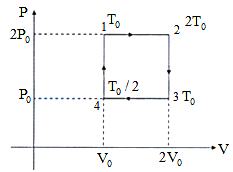
correct
Incorrect
No adiabatic process is involved incorrect
Work done area inside diagram [at point in diagram] correct.
isobaric at pressure
isobaric at volume
isobaric at pressure
isobaric at volume
Given, number of moles,
and (for mono atomic gas)
Now,
See the Complete Solution
Get step-by-step explanations for this and 2.5 Lakh+ more JEE, NEET & CET questions.
- Unlock all solutions
- Practice the full chapter
- Track accuracy across PYQs
4.8 rated on Google Play · 14,000+ reviews
More questions from Physics
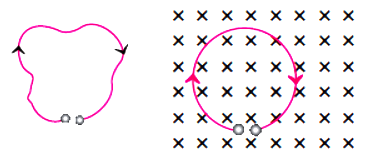
- A thin flexible wire of length \(L\) is connected to two adjacent fixed points and carries a current \(I\) in the clockwise direction, as shown in the figure. When the system is put in a uniform magnetic field of strength \(B\) going into the plane of the paper, the wire takes the shape of a circle. The tension in the wire is
 JEE Advanced 2010 Medium
 - \(5.6 \mathrm{~L}\) of helium gas at STP is adiabatically compressed to \(0.7 \mathrm{~L}\). Taking the initial temperature to be \(T_1\), the work done in the process isJEE Advanced 2011 Hard
- List I contains four combinations of two lenses ( 1 and 2 ) whose focal lengths (in cm ) are indicated in the figures. In all cases, the object is placed 20 cm from the first lens on the left, and the distance between the two lenses is 5 cm . List II contains the positions of the final images.
Which one of the following options is correct?List - I List - II (I) 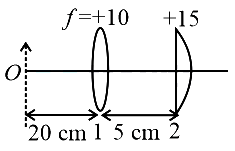
(P) Final image is formed at 7.5 cm on the right side of lens 2. (II) 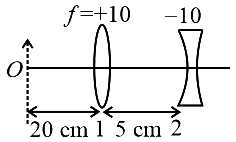
(Q) Final image is formed at 60.0 cm on the right side of lens 2. (III) 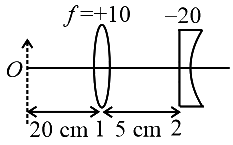
(R) Final image is formed at 30.0 cm on the left side of lens 2. (IV) 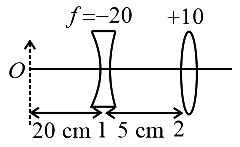
(S) Final image is formed at
6.0 cm on the right side of lens 2.(T) Final image is formed at 30.0 cm on the right side of lens 2. JEE Advanced 2022 Hard - A temperature difference can generate e.m.f. in some materials. Let \(S\) be the e.m.f. produced per unit temperature difference between the ends of a wire, \(\sigma\) the electrical conductivity and \(\kappa\) the thermal conductivity of the material of the wire. Taking \(M, L, T, I\) and \(K\) as dimensions of mass, length, time, current and temperature, respectively, the dimensional formula of the quantity \(Z=\frac{S^2 \sigma}{\kappa}\) is :-JEE Advanced 2025 Easy
- System shown in figure is in equilibrium and at rest. The spring and string are massless, now the string is cut. The acceleration of mass \(2 m\) and \(m\) just after the string is cut will be
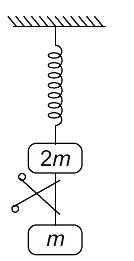 JEE Advanced 2006 Medium
 - Paragraph :
A frame of reference that is accelerated with respect to an inertial frame of reference is called a non-inertial frame of reference. A coordinate system fixed on a circular disc rotating about a fixed axis with a constant angular velocity \(\omega\) is an example of a non-inertial frame of reference.
The relationship between the force \(\vec{F}_{\text {rot }}\) experienced by a particle of mass \(m\) moving on the rotating disc and the force \(\vec{F}_{\text {in }}\) experienced by the particle in an inertial frame of reference is
\(\vec{F}_{\mathrm{rot}}=\vec{F}_{\mathrm{in}}+2 m\left(\vec{v}_{\mathrm{rot}} \times \vec{\omega}\right)+m(\vec{\omega} \times \vec{r}) \times \vec{\omega}\),
where \(\vec{v}_{\text {rot }}\) is the velocity of the particle in the rotating frame of reference and \(\vec{r}\) is the position vector of the particle with respect to the centre of the disc.
Now consider a smooth slot along a diameter of a disc of radius \(R\) rotating counter-clockwise with a constant angular speed \(\omega\) about its vertical axis through its center. We assign a coordinate system with the origin at the center of the disc, the \(x\)-axis along the slot, the \(y\)-axis perpendicular to the slot and the \(z\)-axis along the rotation axis \((\vec{\omega}=\omega \hat{k}) .\) A small block of mass \(m\) is gently placed in the slot at \(\vec{r}=(R / 2) \hat{i}\) at \(t=0\) and is constrained to move only along the slot.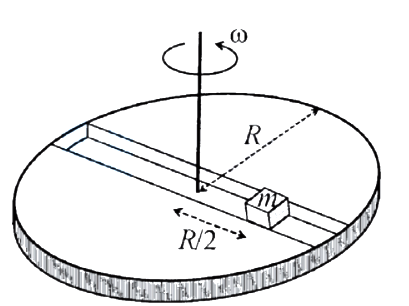
Question :
The net reaction of the disc on the block isJEE Advanced 2016 Medium
More PYQs from JEE Advanced
- Consider the strong electrolytes and . Limiting molar conductivity of and are and , respectively. The value of is Given:
is the limiting molar conductivity of ions The plot of molar conductivity of vs is given below.Ion \(Z ^{ n +}\) \(U ^{ p +}\) \(V ^{ n +}\) \(X ^{ m }\) \(Y ^{ m -}\) \(\lambda^0(\text{S cm} ^2\) \(\text{mol}^{-1})\) 50.0 25.0 100.0 80.0 100.0 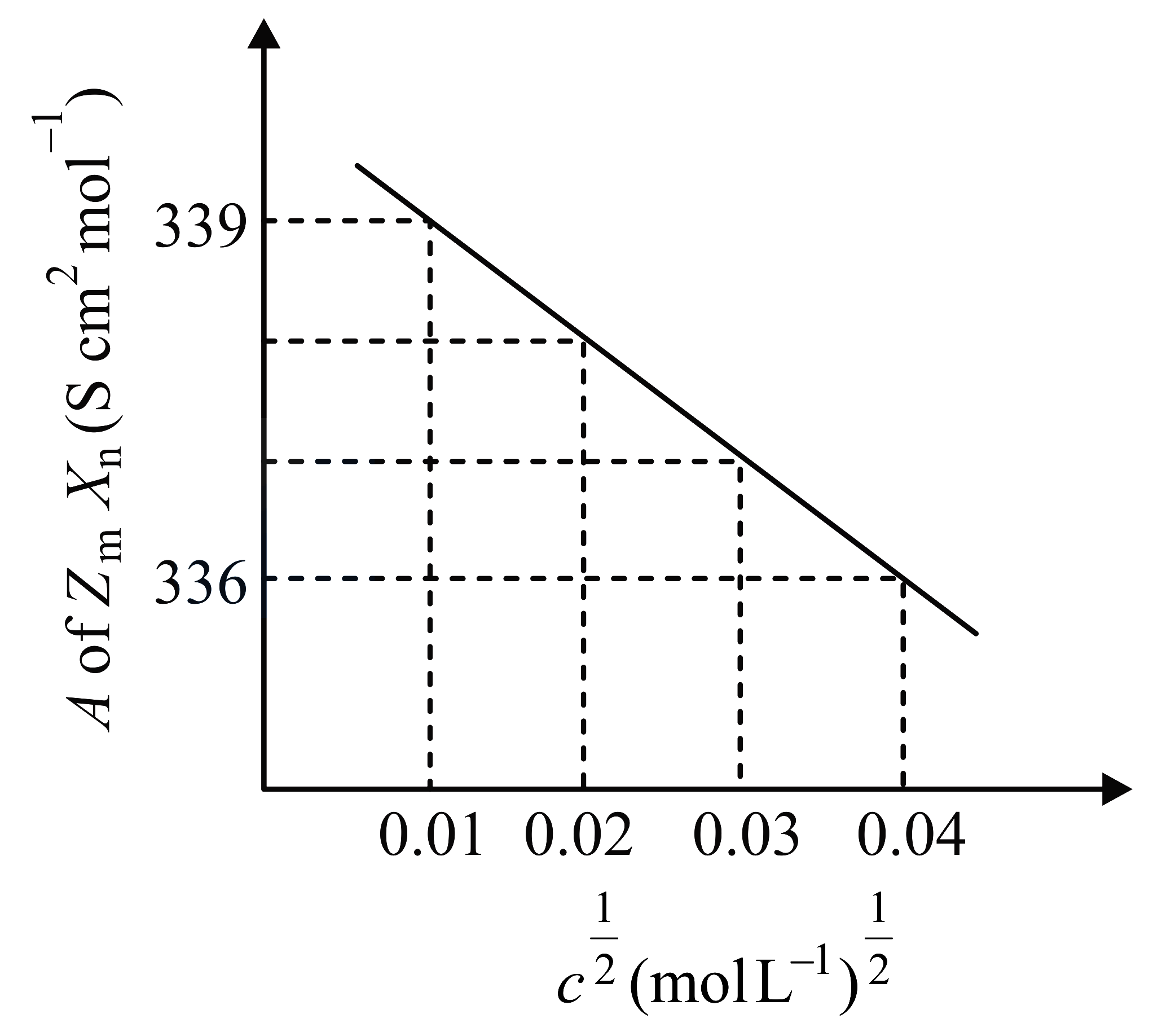 If the numerical value has more than two decimal places, truncate/round-off the value to TWO decimal places.JEE Advanced 2022 Medium
 - Paragraph:
p-amino-N, N-dimethylaniline is added to a strongly acidic solution of \(X\). The resulting solution is treated with a few drops of aqueous solution of \(Y\) to yield blue colouration due to the formation of methylene blue. Treatment of the aqueous solution of \(Y\) with the reagent potassium hexacyanoferrate(II) leads to the formation of an intense blue precipitate. The precipitate dissolves an excess addition of the reagent. Similarly, treatment of the solution of \(Y\) with the solution of potassium hexacyanoferrate(III) leads to a brown colouration due to the formation of \(Z\).
Question:
The compound \(Z\), isJEE Advanced 2009 Hard - Let and be real numbers such that . If and , then the greatest integer less than or equal to isJEE Advanced 2022 Medium
- If , then which of the following matrices is equal to ?JEE Advanced 2022 Easy
- Let and let and
Then which of the following options is/are correct?JEE Advanced 2019 Hard - The diffusion coefficient of an ideal gas is proportional to its mean free path and mean speed. The absolute temperature of an ideal gas is increased times and its pressure times. As a result, the diffusion coefficient of this gas increases times. The value of is:JEE Advanced 2016 Hard