


JEE Advanced · Physics · 28. Nuclear Physics
Match the following columns
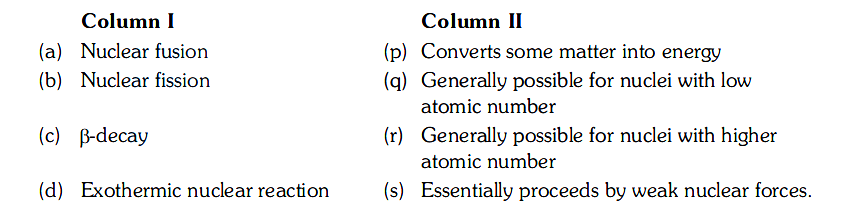
- A (a) p,q, (b) p, (c) p, (d) p,q
- B (a) p,q,r, (b) p, s, (c) p,r, (d) p,q,r
- C (a) p,q, (b) p, r, (c) p,s, (d) p,q,r
- D (a) p,s, (b) p, s, (c) p, (d) p,q
Answer & Solution
Correct Answer
(C) (a) p,q, (b) p, r, (c) p,s, (d) p,q,r
Step-by-step Solution
Detailed explanation
(a) \(\rightarrow\) p, q
(b) \(\rightarrow \mathrm{p}, \mathrm{r}\)
(c) \(\rightarrow\) p, \(s\)
(d) \(\rightarrow\) p, q, r
(b) \(\rightarrow \mathrm{p}, \mathrm{r}\)
(c) \(\rightarrow\) p, \(s\)
(d) \(\rightarrow\) p, q, r
See the Complete Solution
Get step-by-step explanations for this and 2.5 Lakh+ more JEE, NEET & CET questions.
- Unlock all solutions
- Practice the full chapter
- Track accuracy across PYQs
4.8 rated on Google Play · 14,000+ reviews
More questions from Physics
- A perfectly reflecting mirror of mass mounted on a spring constitutes a spring-mass system of angular frequency such that with as Planck's constant. photons of wavelength strike the mirror simultaneously at normal incidence such that the mirror gets displaced by If the value of is then the value of is________.
[Consider the spring as massless]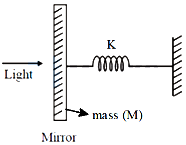 JEE Advanced 2019 Medium
 - Parallel rays of light of intensity are incident on a spherical black body kept in surroundings of temperature 300 K. Take Stefan-Boltzmann constant and assume that the energy exchange with the surroundings is only through radiation. The final steady state temperature of the black body is close toJEE Advanced 2014 Medium
- You are given many resistances, capacitors and inductors. These are connected to a variable DC voltage source (the first two circuits) or an AC voltage source of \(50 \mathrm{~Hz}\) frequency (the next three circuits) in different ways as shown in Column II. When a current \(I\) (steady state for DC or rms for \(A C\) ) flows through the circuit, the corresponding voltage \(V_1\) and \(V_2\) (indicated in circuits) are related as shown in Column I. Match the two
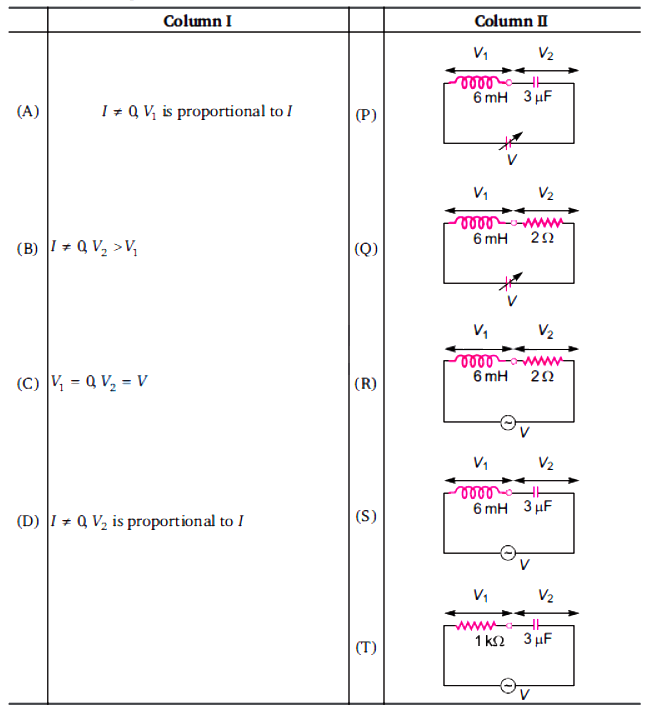 JEE Advanced 2010 Hard
 - Paragraph :
A thermal power plant produces electric power of \(600 \mathrm{~kW}\) at \(4000 \mathrm{~V}\), which is to be transported to a place \(20 \mathrm{~km}\) away from the power plant for consumers' usage. It can be transported either directly with a cable of large current carrying capacity or by using a combination of step-up and step-down transformers at the two ends. The drawback of the direct transmission is the large energy dissipation. In the method using transformers, the dissipation is much smaller. In this method, a step-up transformer is used at the plant side so that the current is reduced to a smaller value. At the consumers' end, a step-down transformer is used to supply power to the consumers at the specified lower voltage. It is reasonable to assume that the power cable is purely resistive and the transformers are ideal with a power factor unity. All the currents and voltages mentioned are rms values.
Question :
In the method using the transformers, assume that the ratio of the number of turns in the primary to that in the secondary in the step-up transformer is \(1: 10\). If the power to the consumers has to be supplied at \(200 \mathrm{~V}\), the ratio of the number of turns in the primary to that in the secondary in the step-down transformer isJEE Advanced 2013 Medium - Light of wavelength falls on a cathode plate inside a vacuum tube as shown in the figure. The work function of the cathode surface is and the anode is a wire mesh of conducting material kept at a distance d from the cathode. A potential difference V is maintained between the electrodes. If the minimum de Broglie wavelength of the electrons passing through the anode is which of the following statement(s) is(are) true ?
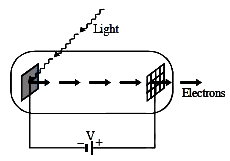 JEE Advanced 2016 Medium
 - A metal target with atomic number \(Z=46\) is bombarded with a high energy electron beam. The emission of X-rays from the target is analyzed. The ratio \(r\) of the wavelengths of the \(K_\alpha\)-line and the cut-off is found to be \(r=2\). If the same electron beam bombards another metal target with \(Z=41\), the value of \(r\) will beJEE Advanced 2024 Medium
More PYQs from JEE Advanced
- In the following reactions, P, Q, R and S are the major products.
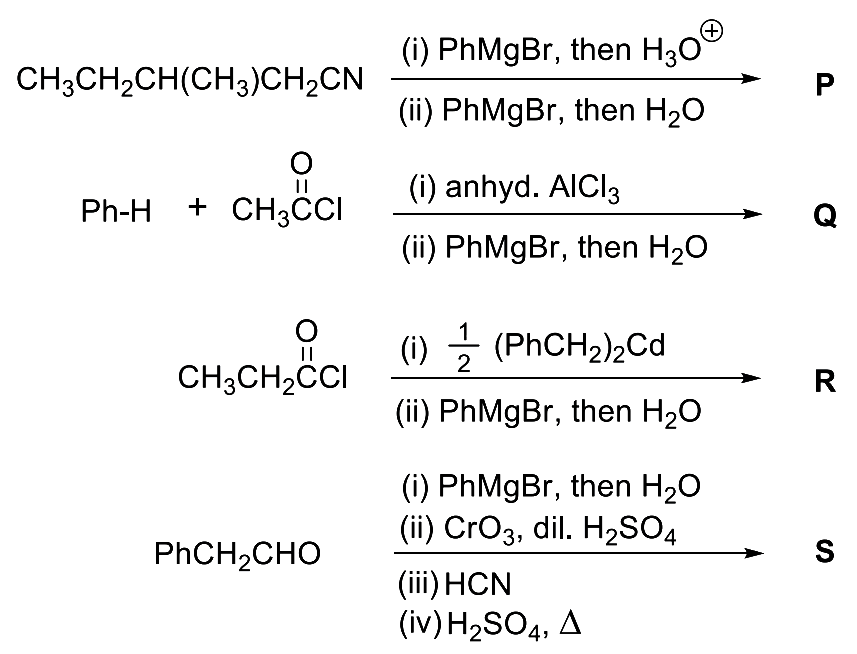
The correct statement(s) about P, Q, R and S is(are)JEE Advanced 2023 Hard - Match the statements in Column I with the properties Column II.
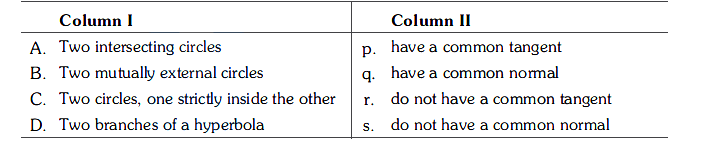 JEE Advanced 2007 Easy
 - Two satellites and are moving in different circular orbits around the Earth(radius ). The heights of and from the Earth surface are and , respectively, where . The accelerations of and due to Earth’s gravity are and , respectively. If , what is the value of ?JEE Advanced 2023 Easy
- Paragraph : In electromagnetic theory, the electric and magnetic phenomena are related to each other. Therefore, the dimensions of electric and magnetic quantities must also be related to each other. In the questions below, stand for dimensions of electric and magnetic fields respectively, while and stand for dimensions of the permittivity and permeability of free space respectively. are dimensions of length and time respectively. All the quantities are given in units
Question : The relation between isJEE Advanced 2018 Easy - Four persons independently solve a certain problem correctly with probabilities . Then the probability that the problem is solved correctly by at least one of them isJEE Advanced 2013 Medium
- Paragraph:
Properties such as boiling point, freezing point and vapour pressure of a pure solvent change when solute molecules are added to get homogeneous solution. These are called colligative properties. Applications of colligative properties are very useful in day-to-day life. One of its examples is the use of ethylene glycol and water mixture as anti-freezing liquid in the radiator automobiles.
A solution \(M\) is prepared by mixing ethanol and water. The mole fraction of ethanol in the mixtrue is \(0.9\)
Given Freezing point depression constant of water \(\left(k^{\text {water }}\right)=1.86 \mathrm{~K} \mathrm{~kg} \mathrm{~mol}^{-1}\)
Freezing point depression constant of ethanol \(\left(k_f^{\text {ethanol }}\right)=2.0 \mathrm{Kkg} \mathrm{mol}^{-1}\)
Boiling point elevation constant of water \(\left(k_b^{\text {water }}\right)=0.52 \mathrm{Kkg} \mathrm{mol}^{-1}\)
Boiling point elevation constant of ethanol \(\left(k_b^{\text {ethanol }}\right)=1.2 \mathrm{Kkg} \mathrm{mol}^{-1}\)
Standard freezing point of water \(=273 \mathrm{~K}\)
Standard freezing point of ethanol \(=155.7 \mathrm{~K}\)
Standard boiling point of water \(=373 \mathrm{~K}\)
Standard boiling point of ethanol \(=351.5 \mathrm{~K}\)
Vapour pressure of pure water \(=328 \mathrm{~mm}\) of \(\mathrm{Hg}\)
Vapour pressure of pure ethanol \(=40 \mathrm{~mm}\) of \(\mathrm{Hg}\)
Molecular weight of water \(=18 \mathrm{~g} \mathrm{~mol}^{-1}\)
Molecular weight of ethanol \(=46 \mathrm{~g} \mathrm{~mol}^{-1}\)
In answering the following questions, consider the solutions to be ideal dilute solutions and solutes to be non-volatile and non-dissociative.
Question:
Water is added to the solution \(M\) such that the mole fraction of water in the solution becomes \(0.9\) The boiling point of this solutions isJEE Advanced 2008 Medium