


JEE Advanced · Physics · 28. Nuclear Physics
Match List I of the nuclear processes with List II containing parent nucleus and one of the end products of each process and then select the correct answer using the codes given below the lists :
| List - i | List - II |
| A. Alpha decay | P. \({ }_8^{15} O \rightarrow{ }_7^{15} N+\ldots \ldots \ldots\). |
| B. \(\beta^{+}\)decay | Q. \({ }_{92}^{238} U \rightarrow{ }_{90}^{234} Th +\ldots \ldots \ldots\). |
| C. Fission | R. \({ }_{83}^{185} Bi \rightarrow{ }_{82}^{184} Pb+\ldots \ldots \ldots\). |
| D. Proton emission | S. \({ }_{94}^{239} Pu \rightarrow{ }_{57}^{140} La +\ldots \ldots \ldots\). |
- A a-q;b-p;c-s;d-r;
- B a-q;b-s;c-p;d-r;
- C a-q;b-r;c-s;d-p;
- D a-q;b-r;c-s;d-p;
Answer & Solution
Correct Answer
(A) a-q;b-p;c-s;d-r;
Step-by-step Solution
Detailed explanation
(p) ln decay, the mass number decreases by and atomic number decreases by .
(q) ln decay, mass number remains unchanged while atomic number decreases by .
(r) ln fission, parent nucleus breaks into almost two equal fragments.
(s) ln proton emission, both mass number and atomic number decreases by .
(q) ln decay, mass number remains unchanged while atomic number decreases by .
(r) ln fission, parent nucleus breaks into almost two equal fragments.
(s) ln proton emission, both mass number and atomic number decreases by .
See the Complete Solution
Get step-by-step explanations for this and 2.5 Lakh+ more JEE, NEET & CET questions.
- Unlock all solutions
- Practice the full chapter
- Track accuracy across PYQs
4.8 rated on Google Play · 14,000+ reviews
More questions from Physics
- A point object is placed at distance of \(20 \mathrm{~cm}\) from a thin planoconvex lens of focal length \(15 \mathrm{~cm}\). The plane surface of the lens is now silvered. The image created by the system is at
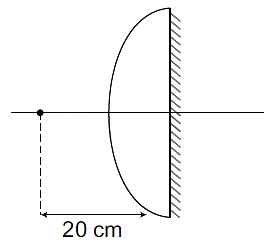 JEE Advanced 2006 Medium
 - Two thin circular discs of mass m and 4m, having radii of a and 2a, respectively, are rigidly fixed by a massless, right rod of length through their center. This assembly is laid on a firm and flat surface, and set rolling without slipping on the surface so that the angular speed about the axis of the rod is . The angular momentum of the entire assembly about the point 'O' is (see the figure). Which of the following statement(s) is(are) true?
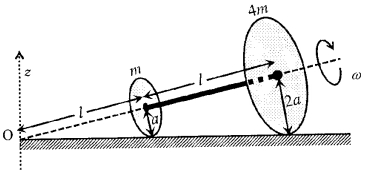 JEE Advanced 2016 Hard
 - Paragraph:
The nuclear charge \((\mathrm{Ze})\) is non-uniformly distributed within a nucleus of radius \(R\). The charge density \(\rho(r)\) [charge per unit volume] is dependent only on the radial distance \(r\) from the centre of the nucleus as shown in figure. The electric field is only along the radial direction.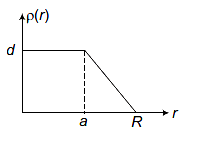
Question:
The electric field within the nucleus is generally observed to be linearly dependent on \(r\). This impliesJEE Advanced 2008 Medium - In an -ray tube, electrons emitted from a filament (cathode) carrying current hit a target (anode) at a distance from the cathode. The target is kept at a potential higher than the cathode resulting in emission of continuous and characteristic X-rays. If the filament current is decreased to the potential difference is increased to and the separation distance is reduced to thenJEE Advanced 2020 Medium
- In a Young's double slit experiment, the separation between the two slits is \(d\) and the wavelength of the light is \(\lambda\). The intensity of light falling on slit 1 is four times the intensity of light falling on slit 2 . Choose the correct choice(s),JEE Advanced 2008 Medium
- In a circuit, a metal filament lamp is connected in series with a capacitor of capacitance \(\mathrm{C} \mu F\) across a \(200 \mathrm{~V}, 50 \mathrm{~Hz}\) supply. The power consumed by the lamp is \(500 \mathrm{~W}\) while the voltage drop across it is \(100 \mathrm{~V}\). Assume that there is no inductive load in the circuit. Take \(r m s\) values of the voltages. The magnitude of the phaseangle (in degrees) between the current and the supply voltage is \(\varphi\). Assume, \(\pi \sqrt{3} \approx 5\).
The value of is _____.JEE Advanced 2021 Medium
More PYQs from JEE Advanced
- The function \(f:[0,3] \rightarrow[1,29]\), defined by \(f(x)=2 x^{3}-15 x^{2}+36 x+1\), isJEE Advanced 2012 Easy
- Let for all be a continuous function. For if is the area of the region bounded by then isJEE Advanced 2015 Medium
- The figure below is the plot of potential energy versus internuclear distance of molecule in the electronic ground state. What is the value of the net potential energy (as indicated in the figure) in for at which the electron-electron repulsion and the nucleus-nucleus repulsion energies are absent? As reference, the potential energy of atom is taken as zero when its electron and the nucleus are infinitely far apart.
Use Avogadro constant as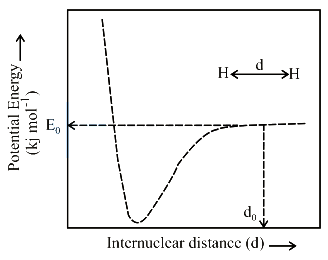
Mark total potential energy for 2 H-atom (per mole) as answer.JEE Advanced 2020 Medium - \(2.5 \mathrm{~mL}\) of \(\frac{2}{5} \mathrm{M}\) weak monoacidic base \(\left(K_b=1 \times 10^{-12}\right.\) at \(\left.25^{\circ} \mathrm{C}\right)\) is titrated with \(\frac{2}{15}\) \(\mathrm{M} \mathrm{HCl}\) in water at \(25^{\circ} \mathrm{C}\). The concentration of \(\mathrm{H}^{+}\)at equivalence point is \(\left(K_w=1 \times 10^{-14}\right.\) at \(\left.25^{\circ} \mathrm{C}\right)\)JEE Advanced 2008 Hard
- Let
Column 1 contains information about zeros of , and
Column 2 contains information about the limiting behaviour of , and at infinity.
Column 3 contains information about increasing-decreasing nature of andColumn 1 Column 2 Column 3 (I) for some (i) (P) is increasing in (II) for some (ii) (Q) is decreasing in (III) for some (iii) (R) is increasing in (IV) for some (iv) (S) is decreasing in JEE Advanced 2017 Hard - A table tennis ball has radius \((3 / 2) \times 10^{-2} \mathrm{~m}\) and mass \((22 / 7) \times 10^{-3} \mathrm{~kg}\). It is slowly pushed down into a swimming pool to a depth of \(d=0.7 \mathrm{~m}\) below the water surface and then released from rest. It emerges from the water surface at speed \(v\), without getting wet, and rises up to a height \(H\). Which of the following option(s) is(are) correct?
[Given: \(\pi=22 / 7, g=10 \mathrm{~m} \mathrm{~s}^{-2}\), density of water \(=1 \times 10^3 \mathrm{~kg} \mathrm{~m}^{-3}\), viscosity of water \(=1 \times 10^{-3} \mathrm{~Pa}\)-s.]JEE Advanced 2024 Hard