


JEE Advanced · Physics · 22. AC Circuits
In the circuit shown, initially there is no charge on capacitors and keys and are open. The values of the capacitors are and
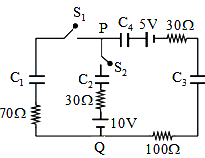
Which of the statement(s) is/are correct?
- A If key is kept closed for long time such that capacitors are fully charged, the voltage difference between points and will be
- B The keys is kept closed for long time such that capacitors are fully charged. Now key is closed, at this time, the instantaneous current across resistor (between points and ) will be (round off to decimal place).
- C At time the key is closed, the instantaneous current in the closed circuit will be
- D If key is kept closed for long time such that capacitors are fully charged, the voltage across the capacitors will be
Answer & Solution
Correct Answer
(D) If key is kept closed for long time such that capacitors are fully charged, the voltage across the capacitors will be
Step-by-step Solution
Detailed explanation
For option , refer circuit diagram below
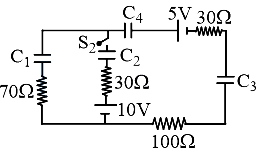
Just after closing of switch charge on all the capacitors
Replace all capacitors with wire, then circuit will get reduced as shown below.
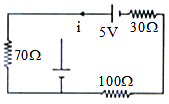
is correct
Now is kept closed for long time circuit is in steady state
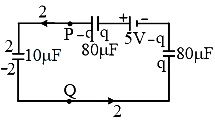
Apply KVL in loop, start from battery
Potential difference across
is correct.
For option Now just after closing of charge on each capacitor remain same,
Refer circuit below -
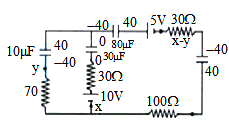
KVL in left loop, starting from battery of volts,
...(i)
Now, apply KVL in right loop starting from capacitor
\(\Rightarrow-\frac{40}{80}+5+(x-y) 30-\frac{40}{80}+(x-y) \times 100\) \(-10+x \times 30=0 \)
\( \Rightarrow 160 x-130 y-6=0 \ldots(\text{ii})\)
Now, solving equation (i) and (ii) we get,
and is incorrect.
Just after closing of switch charge on all the capacitors
Replace all capacitors with wire, then circuit will get reduced as shown below.
is correct
Now is kept closed for long time circuit is in steady state
Apply KVL in loop, start from battery
Potential difference across
is correct.
For option Now just after closing of charge on each capacitor remain same,
Refer circuit below -
KVL in left loop, starting from battery of volts,
...(i)
Now, apply KVL in right loop starting from capacitor
\(\Rightarrow-\frac{40}{80}+5+(x-y) 30-\frac{40}{80}+(x-y) \times 100\) \(-10+x \times 30=0 \)
\( \Rightarrow 160 x-130 y-6=0 \ldots(\text{ii})\)
Now, solving equation (i) and (ii) we get,
and is incorrect.
See the Complete Solution
Get step-by-step explanations for this and 2.5 Lakh+ more JEE, NEET & CET questions.
- Unlock all solutions
- Practice the full chapter
- Track accuracy across PYQs
4.8 rated on Google Play · 14,000+ reviews
More questions from Physics
- Paragraph:
When a particle is restricted to move along \(x\)-axis between \(x=0\) and \(x=a\), where \(a\) is of nanometer dimension, its energy can take only certain specific values. The allowed energies of the particle moving in such a restricted region, correspond to the formation of standing waves with nodes at its ends \(x=0\) and \(x=a\). The wavelength of this standing wave is related to the liner momentum \(p\) of the particle according to the de Broglie relation. The energy of the particle of mass \(m\) is related to its linear momentum as \(E=\frac{p^2}{2 m}\). Thus, the energy of the particle can be denoted by a quantum number \(n\) taking values \(1,2,3, \ldots(n=1\), called the ground state) corresponding to the number of loops in the standing wave.
Use the model described above to answer the following three questions for a particle moving in the line \(x=0\) to \(x=a\) [Take \(h=6.6 \times 10^{-34} \mathrm{Js}\) and \(e=1.6 \times 10^{-19} \mathrm{C}\) ]
Question:
The allowed energy for the particle for a particular value of \(n\) is proportional toJEE Advanced 2009 Medium - In a radioactive decay process, the activity is defined as , where is the number of radioactive nuclei at time . Two radioactive sources, and have same activity at time . At a later time, the activities of and are and , respectively. When and have just completed their and half-lives, respectively, the ratio is _____.JEE Advanced 2023 Medium
- A steady current \(I\) goes through a wire loop \(P Q R\) having shape of a right angle triangle with \(P Q=3 x, P R=4 x\) and \(Q R=5 x\). If the magnitude of the magnetic field at \(P\) due to this loop is \(k\left(\frac{\mu_0 I}{48 \pi x}\right)\), find the value of \(k\).JEE Advanced 2009 Easy
- A train is moving along a straight line with a constant acceleration a. A boy standing in the train throws a ball forward with a speed of \(10 \mathrm{~m} / \mathrm{s}\), at an angle of \(60^{\circ}\) to the horizontal. The boy has to move forward by \(1.15 \mathrm{~m}\) inside the train to catch the ball back at the initial height. The acceleration of the train in \(\mathrm{m} / \mathrm{s}^2\), isJEE Advanced 2011 Medium
- Find the time constant for the given R C circuits in correct order.
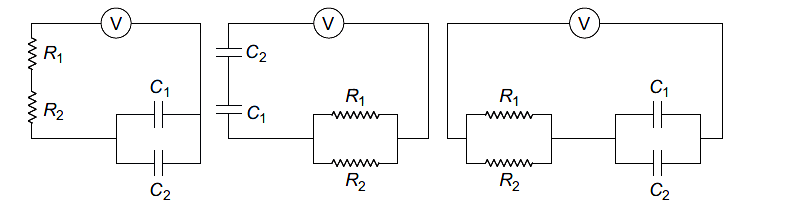
\(R_1=1 \Omega, R_2=2 \Omega, C_1=4 \mu \mathrm{F}, C_2=2 \mu \mathrm{F}\)JEE Advanced 2006 Easy - Three concentric metallic spherical shells of radii \(R, 2 R, 3 R\) are given charges \(Q_1, Q_2, Q_3\), respectively. It is found that the surface charge densities on the outer surfaces of the shells are equal. Then, the ratio of the charges given to the shells, \(Q_1: Q_2: Q_3\), isJEE Advanced 2009 Easy
More PYQs from JEE Advanced
- Which of the following inequalities is/are TRUE?JEE Advanced 2020 Hard
- The reagent(s) for the following conversion,

is/areJEE Advanced 2007 Easy - At time , a disk of radius starts to roll without slipping on a horizontal plane with an angular acceleration of . A small stone is stuck to the disk. At , it is at the contact point of the disk and the plane. Later, at time , the stone detaches itself and flies off tangentially from the disk. The maximum height (in ) reached by the stone measured from the plane is . The value of is [Take .] If the numerical value has more than two decimal places, truncate/round-off the value to TWO decimal places.JEE Advanced 2022 Hard
- Consider an obtuse angled triangle in which the difference between the largest and the smallest angle is and whose sides are in arithmetic progression. Suppose that the vertices of this triangle lie on a circle of radius .
(There are two questions based on , the question given below is one of them)
Let be the area of the triangle . Then the value of isJEE Advanced 2023 Easy - An extended object is placed at point , in front of a convex lens and a concave lens is placed behind it, as shown in the figure. The radii of curvature of all the curved surfaces in both the lenses are . The refractive index of both the lenses is . The total magnification of this lens system is:
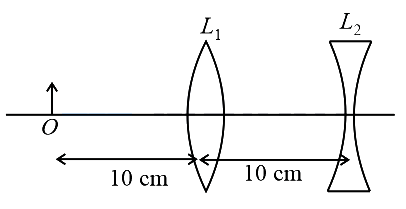 JEE Advanced 2021 Medium
 - Paragraph: Let \(f:\left[0, \frac{\pi}{2}\right] \rightarrow[0,1]\) be the function defined by \(f(x)=\sin ^2 x\) and let \(g:\left[0, \frac{\pi}{2}\right] \rightarrow[0, \infty)\) be the function defined by \(g(x)=\sqrt{\frac{\pi x}{2}-x^2}\).
Question: The value of \(2 \int_0^{\frac{\pi}{2}} f(x) g(x) d x-\int_0^{\frac{\pi}{2}} g(x) d x\) isJEE Advanced 2024 Medium