


JEE Advanced · Physics · 27. Atomic Physics
A particle of mass \(m\) is moving in a circular orbit under the influence of the central force \(F(r)=-k r\), corresponding to the potential energy \(V(r)=k r^2 / 2\), where \(k\) is a positive force constant and \(r\) is the radial distance from the origin. According to the Bohr's quantization rule, the angular momentum of the particle is given by \(L=n \hbar\), where \(\hbar=h /(2 \pi), h\) is the Planck's constant, and \(n\) a positive integer. If \(v\) and \(E\) are the speed and total energy of the particle, respectively, then which of the following expression(s) is(are) correct?
- A \(r^2=n \hbar \sqrt{\frac{1}{m k}}\)
- B \(v^2=n \hbar \sqrt{\frac{k}{m^3}}\)
- C \(\frac{L}{m r^2}=\sqrt{\frac{k}{m}}\)
- D \(E=\frac{n \hbar}{2} \sqrt{\frac{k}{m}}\)
Answer & Solution
Correct Answer
(A) \(r^2=n \hbar \sqrt{\frac{1}{m k}}\)
Step-by-step Solution
Detailed explanation
The central force will provide necessary centripetal force
\(\Rightarrow \mathrm{kr}=\frac{\mathrm{mv}^2}{\mathrm{r}}\)
or, \(\mathrm{kr}^2=\mathrm{mv}^2\) ...(1)
By quantisation rule
\(\mathrm{n} \hbar=\mathrm{mvr}\)
or, \(\frac{\mathrm{n} \hbar}{\mathrm{r}}=\mathrm{mv}\) ...(2)
\(\begin{aligned} & \frac{(1)}{(2)^2} \Rightarrow \frac{\mathrm{kr}^2}{\frac{\mathrm{n}^2 \hbar^2}{\mathrm{r}^2}}=\frac{\mathrm{mv}^2}{\mathrm{~m}^2 \mathrm{v}^2} \\ & \Rightarrow \frac{\mathrm{k}}{\mathrm{n}^2 \hbar^2} \mathrm{r}^4=\frac{1}{\mathrm{~m}} \\ & \Rightarrow \mathrm{r}=\left(\frac{\mathrm{n}^2 \hbar^2}{\mathrm{~km}}\right)^{\frac{1}{4}} \Rightarrow \mathrm{r}^2=\frac{\mathrm{n} \hbar}{\sqrt{\mathrm{mk}}}\end{aligned}\)
\(\begin{aligned} & \text {(2) Using (1), } \mathrm{K} \cdot \frac{\mathrm{n} \hbar}{\sqrt{\mathrm{mk}}}=\mathrm{mv}^2 \\ & \Rightarrow \mathrm{v}^2=\mathrm{n} \hbar \sqrt{\frac{\mathrm{k}}{\mathrm{m}^3}}\end{aligned}\)
(3) \(\frac{\mathrm{L}}{\mathrm{mr}^2}=\frac{\mathrm{mvr}}{\mathrm{mr}^2}=\frac{\mathrm{v}}{\mathrm{r}}=\sqrt{\frac{\mathrm{k}}{\mathrm{m}}}\) from (1)
\(\text{(4) } \mathrm{E}=\frac{1}{2} \mathrm{mv}^2+\frac{1}{2} \mathrm{kr}^2=\frac{\mathrm{n} \hbar}{2} \sqrt{\frac{\mathrm{k}}{\mathrm{m}}}~+\) \(\frac{1}{2} \mathrm{k} \frac{\mathrm{n} \hbar}{\sqrt{\mathrm{mk}}} \)
\( \mathrm{E}=\mathrm{n} \hbar \sqrt{\frac{\mathrm{k}}{\mathrm{m}}}\)
\(\Rightarrow \mathrm{kr}=\frac{\mathrm{mv}^2}{\mathrm{r}}\)
or, \(\mathrm{kr}^2=\mathrm{mv}^2\) ...(1)
By quantisation rule
\(\mathrm{n} \hbar=\mathrm{mvr}\)
or, \(\frac{\mathrm{n} \hbar}{\mathrm{r}}=\mathrm{mv}\) ...(2)
\(\begin{aligned} & \frac{(1)}{(2)^2} \Rightarrow \frac{\mathrm{kr}^2}{\frac{\mathrm{n}^2 \hbar^2}{\mathrm{r}^2}}=\frac{\mathrm{mv}^2}{\mathrm{~m}^2 \mathrm{v}^2} \\ & \Rightarrow \frac{\mathrm{k}}{\mathrm{n}^2 \hbar^2} \mathrm{r}^4=\frac{1}{\mathrm{~m}} \\ & \Rightarrow \mathrm{r}=\left(\frac{\mathrm{n}^2 \hbar^2}{\mathrm{~km}}\right)^{\frac{1}{4}} \Rightarrow \mathrm{r}^2=\frac{\mathrm{n} \hbar}{\sqrt{\mathrm{mk}}}\end{aligned}\)
\(\begin{aligned} & \text {(2) Using (1), } \mathrm{K} \cdot \frac{\mathrm{n} \hbar}{\sqrt{\mathrm{mk}}}=\mathrm{mv}^2 \\ & \Rightarrow \mathrm{v}^2=\mathrm{n} \hbar \sqrt{\frac{\mathrm{k}}{\mathrm{m}^3}}\end{aligned}\)
(3) \(\frac{\mathrm{L}}{\mathrm{mr}^2}=\frac{\mathrm{mvr}}{\mathrm{mr}^2}=\frac{\mathrm{v}}{\mathrm{r}}=\sqrt{\frac{\mathrm{k}}{\mathrm{m}}}\) from (1)
\(\text{(4) } \mathrm{E}=\frac{1}{2} \mathrm{mv}^2+\frac{1}{2} \mathrm{kr}^2=\frac{\mathrm{n} \hbar}{2} \sqrt{\frac{\mathrm{k}}{\mathrm{m}}}~+\) \(\frac{1}{2} \mathrm{k} \frac{\mathrm{n} \hbar}{\sqrt{\mathrm{mk}}} \)
\( \mathrm{E}=\mathrm{n} \hbar \sqrt{\frac{\mathrm{k}}{\mathrm{m}}}\)
See the Complete Solution
Get step-by-step explanations for this and 2.5 Lakh+ more JEE, NEET & CET questions.
- Unlock all solutions
- Practice the full chapter
- Track accuracy across PYQs
4.8 rated on Google Play · 14,000+ reviews
More questions from Physics
- For the resistance network shown in the figure, choose the correct option(s)
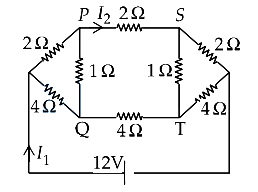 JEE Advanced 2012 Medium
 - A circular disc of radius carries surface charge density , where is a constant and is the distance from the center of the disc. Electric flux through a large spherical surface that encloses the charged disc completely is . Electric flux through another spherical surface of radius and concentric with the disc is . Then the ratio isJEE Advanced 2020 Hard
- Students I, II and III perform an experiment for measuring the acceleration due to gravity \((g)\) using a simple pendulum. They use different lengths of the pendulum and/or record time for different number of oscillations. The observations are shown in the table.
Least count for length \(=0.1 \mathrm{~cm}\)
Least count for time \(=0.1 \mathrm{~s}\)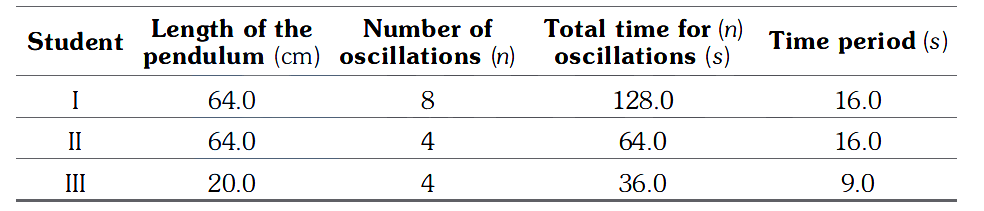
If \(E_{\mathrm{I}}, E_{\mathrm{II}}\) and \(E_{\mathrm{III}}\) are the percentage errors in \(g\), i.e., \(\left(\frac{\Delta g}{g} \times 100\right)\) for students I, II and III, respectively.JEE Advanced 2008 Medium - In the figure, the inner (shaded) region represents a sphere of radius , within which the electrostatic charge density varies with the radial distance from the center as , where is positive. In the spherical shell of outer radius , the electrostatic charge density varies as . Assume that dimensions are taken care of. All physical quantities are in their SI units.
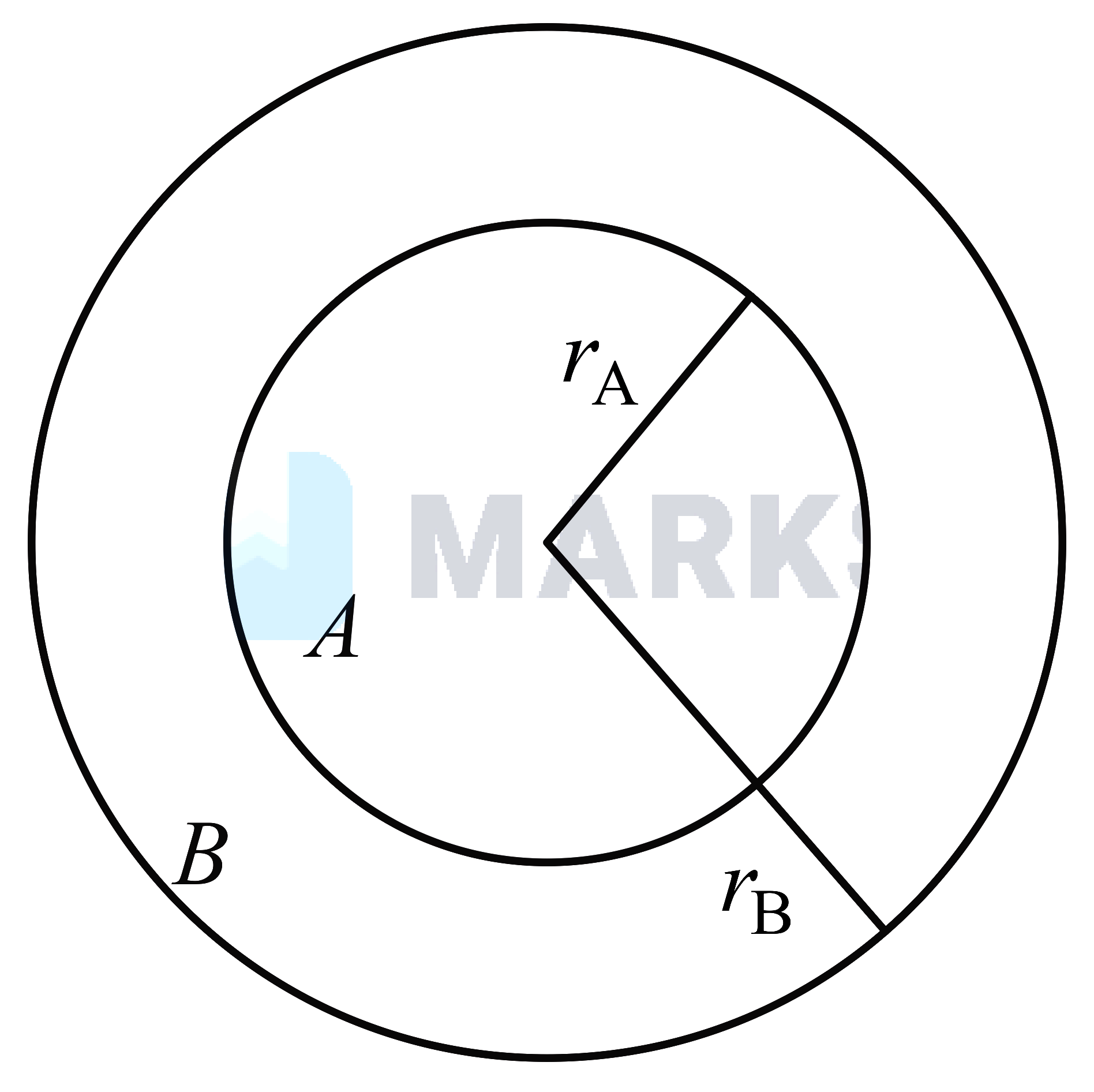
Which of the following statement(s) is/(are) correct?JEE Advanced 2022 Medium - A cylindrical tube, with its base as shown in the figure., is filled with water. It is moving down with a constant acceleration along a fixed inclined plane with angle . and are pressures at point and , respectively, located at the base of the tube. Let , where is density of water, is the inner diameter of the tube and is the acceleration due to gravity. Which of the following statement(s) is (are) correct?
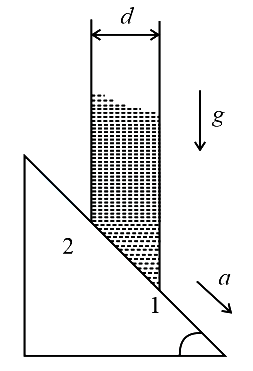 JEE Advanced 2021 Hard
 - Paragraph:
A small block of mass \(1 \mathrm{~kg}\) is released from rest at the top of a rough track. The track is a circular arc of radius \(40 \mathrm{~m}\). The block slides along the track without toppling and a frictional force acts on it in the direction opposite to the instantaneous velocity. The work done in overcoming the friction up to the point \(Q\), as shown in the figure below, is \(150 \mathrm{~J}\). (Take the acceleration due to gravity, \(g=10 \mathrm{~m} \mathrm{~s}^{-2}\) ).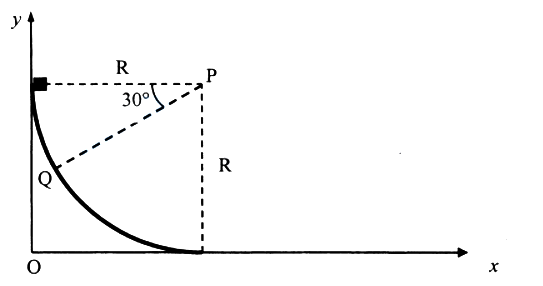
Question :
The magnitude of the normal reaction that acts on the block at the point \(Q\) isJEE Advanced 2013 Easy
More PYQs from JEE Advanced
- The correct statement(s) for orthoboric acid is/areJEE Advanced 2014 Easy
- A hollow pipe of length \(0.8 \mathrm{~m}\) is closed at one end. At its open end a \(0.5 \mathrm{~m}\) long uniform string is vibrating in its second harmonic and it resonates with the fundamental frequency of the pipe. If the tension in the wire is \(50 \mathrm{~N}\) and the speed of sound is \(320 \mathrm{~ms}^{-1}\), the mass of the string isJEE Advanced 2010 Medium
- A flat plate is moving normal to its plane through a gas under the action of a constant force F. The gas is kept at a very low pressure. The speed of the plate v I much less than the average speed u of the gas molecules. Which of the following options is true?JEE Advanced 2017 Medium
- Paragraph:
Let \(A_1, G_1, H_1\) denote the arithmetic, geometric and harmonic means respectively, of two distinct positive numbers. For \(n \geq 2\), let \(A_{n-1}\) and \(H_{n-1}\) has arithmetic, geometric and harmonic means as \(A_n, G_n, H_n\), respectively.
Question:
Which of the following statements is correct?JEE Advanced 2007 Hard - A charged shell of radius carries a total charge Given as the flux of electric field through a closed cylindrical surface of height radius and with its center same as that of the shell. Here, center of the cylinder is a point on the axis of the cylinder which is equidistant from its top and bottom surfaces. Which of the following option(s) is/are correct? [ is the permittivity of free space]JEE Advanced 2019 Medium
- Young’s modulus of elasticity is expressed in terms of three derived quantities, namely, the gravitational constant , Planck’s constant and the speed of light , as . Which of the following is the correct option?JEE Advanced 2023 Easy