


JEE Advanced · Physics · 24. Ray Optics
A large glass slab \(\left(\mu=\frac{5}{3}\right)\) of thickness 8 \(\mathrm{cm}\) is placed over a point source of light on a plane surface. It is seen that light emerges out of the top surface of the slab from a circular area of radius \(R \mathrm{~cm}\). What is the value of \(R\) ?
- A 2
- B 4
- C 6
- D 8
Answer & Solution
Correct Answer
(C) 6
Step-by-step Solution
Detailed explanation
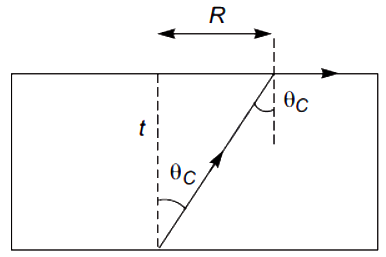
\(
\frac{R}{t}=\tan \theta_C
\)
or \(\quad R=t\left(\tan \theta_C\right)\)
\(\text { But, } \quad \sin \theta_C=\frac{1}{\mu}=\frac{3}{5} \)
\( \therefore \tan \theta_C=\frac{3}{4} \)
\( \therefore R=\frac{3}{4} t=\frac{3}{4}(8 \mathrm{~cm})=6 \mathrm{~cm}\)
Hence the answer is 6 .
See the Complete Solution
Get step-by-step explanations for this and 2.5 Lakh+ more JEE, NEET & CET questions.
- Unlock all solutions
- Practice the full chapter
- Track accuracy across PYQs
4.8 rated on Google Play · 14,000+ reviews
More questions from Physics
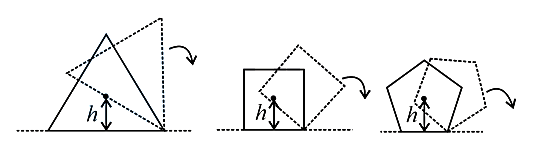
- Consider regular polygons with number of sides as shown in the figure. The center of mass of all the polygons is at height from the ground. They roll on a horizontal surface about the leading vertex without slipping and sliding as depicted. The maximum increase in height of the locus of the center of mass for each polygon is . Then, depends on and as
 JEE Advanced 2017 Medium
 - Paragraph:
Consider a simple \(R C\) circuit as shown in Figure \(1\).
Process 1: In the circuit the switch \(S\) is closed at \(t=0\) and the capacitor is fully charged to voltage \(V_{0}\) (i.e., charging continues for time \(T>>R C\) ). In the process some dissipation \(\left(E_{D}\right)\) occurs across the resistance \(R\). The amount of energy finally stored in the fully charged capacitor is \(E_{C}\).
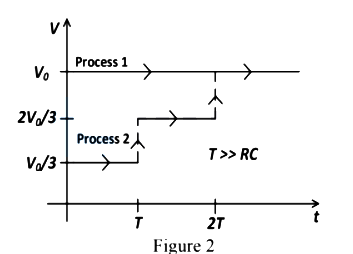
Process 2: In a different process the voltage is first set to \(\frac{V_{0}}{3}\) and maintained for a charging time \(T>>R C\). Then the voltage is raised to \(\frac{2 V_{0}}{3}\) without discharging the capacitor and again maintained for a time \(T>>R C\). The process is repeated one more time by raising the voltage to \(V_{0}\) and the capacitor is charged to the same final voltage \(V_{0}\) as in Process 1.
These two processes are depicted in Figure \(2 .\)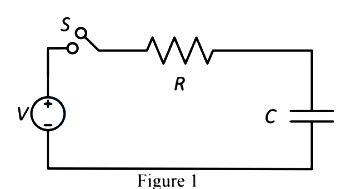
Question:
In Process 2, total energy dissipated across the resistance \(E_{D}\) is:JEE Advanced 2017 Medium - In a radioactive decay chain reaction, nucleus decays into nucleus. The ratio of the number of to number of particles emitted in this process is _______.JEE Advanced 2022 Easy
- A particle of mass is initially at rest in the -plane at a point , where and . The particle is accelerated at time with a constant acceleration along the positive -direction. Its angular momentum and torque with respect to the origin, in SI units, are represented by and , respectively. and are unit vectors along the positive and -directions, respectively. If then which of the following statement(s) is (are) correct?JEE Advanced 2021 Medium
- You are given many resistances, capacitors and inductors. These are connected to a variable DC voltage source (the first two circuits) or an AC voltage source of \(50 \mathrm{~Hz}\) frequency (the next three circuits) in different ways as shown in Column II. When a current \(I\) (steady state for DC or rms for \(A C\) ) flows through the circuit, the corresponding voltage \(V_1\) and \(V_2\) (indicated in circuits) are related as shown in Column I. Match the two
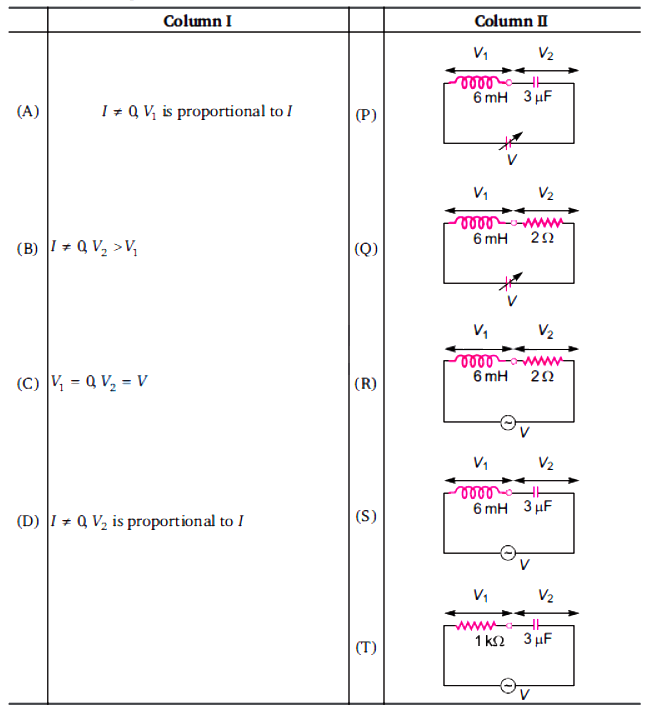 JEE Advanced 2010 Hard
 - A ring and a disc are initially at rest, side by side, at the top of an inclined plane which makes an angle with the horizontal. They start to roll without slipping at the same instant of time along the shortest path. If the time difference between their reaching the ground is , then the height of the top of the inclined plane (in meters) is __________. Take .JEE Advanced 2018 Easy
More PYQs from JEE Advanced
- If is the wavelength of X-ray line of copper (atomic number 29) and is the wavelength of the X-ray line of molybdenum (atomic number 42), then the ratio is close toJEE Advanced 2014 Medium
- Which of the following statement is correct in Infinitely long wire kept perpendicula to the paper carrying current inwards the given figure?
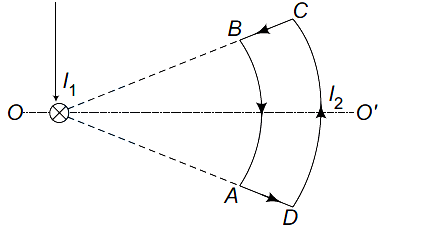 JEE Advanced 2006 Hard
 - Let \(f(x)=x^2\) and \(g(x)=\sin x\) for all \(x \in R\). Then, the set of all \(x\) satisfying \((\) fogogof \()(x)=(\operatorname{gogof})(x)\), where \((f \circ g)(x)=f(g(x))\) isJEE Advanced 2011 Hard
- Paragraph :
Electrical resistance of certain materials, known as superconductors, changes abruptly from a non-zero value to zero as their temperature is lowered below a critical temperature \(T_C(0)\). An interesting property of superconductors is that their critical temperature becomes smaller than \(T_C(0)\) if they are placed in a magnetic field i.e., the critical temperature \(T_C(B)\) is a function of the magnetic field strength \(B\). The dependence of \(T_C(B)\) on \(B\) is shown in the figure.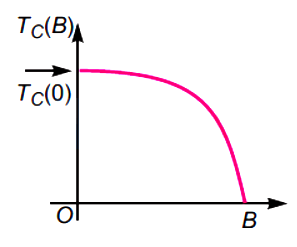
Question :
A superconductor has \(T_C(0)=100 \mathrm{~K}\). When a magnetic field of \(7.5\) Tesla is applied, its \(T_C\) decreases to \(75 \mathrm{~K}\). For this material one can definitely say that when (Note : \(\mathrm{T}\) = Tesla)JEE Advanced 2010 Medium - A piece of ice (heat capacity \(=2100 \mathrm{~J} \mathrm{~kg}^{-1}{ }^{\circ} \mathrm{C}^{-1}\) and latent heat \(=3.36 \times 10^5 \mathrm{~J} \mathrm{~kg}^{-1}\) ) of mass \(\mathrm{m}\) gram is at \(-5^{\circ} \mathrm{C}\) at atmospheric pressure. It is given \(420 \mathrm{~J}\) of heat so that the ice starts melting. Finally when the ice-water mixture is in equilibrium, it is found that \(1 \mathrm{~g}\) of ice has melted. Assuming there is no other heat exchange in the process, the value of \(m\) isJEE Advanced 2010 Medium
- Paragraph :
A special metal \(S\) conducts electricity without any resistance. A closed wire loop, made of \(S\), does not allow any change in flux through itself by inducing a suitable current to generate a compensating flux. The induced current in the loop cannot decay due to its zero resistance. This current gives rise to a magnetic moment which in turn repels the source of magnetic field or flux. Consider such a loop, of radius \(a\), with its center at the origin. A magnetic dipole of moment \(m\) is brought along the axis of this loop from infinity to a point at distance \(r(\gg a)\) from the center of the loop with its north pole always facing the loop, as shown in the figure below.
The magnitude of magnetic field of a dipole \(m\), at a point on its axis at distance \(r\), is \(\frac{\mu_{0}}{2 \pi} \frac{m}{r^{3}}\), where \(\mu_{0}\) is the permeability of free space. The magnitude of the force between two magnetic dipoles with moments, \(m_{1}\) and \(m_{2}\), separated by a distance \(r\) on the common axis, with their north poles facing each other, is \(\frac{k m_{1} m_{2}}{r^{4}}\), where \(k\) is a constant of appropriate dimensions. The direction of this force is along the line joining the two dipoles.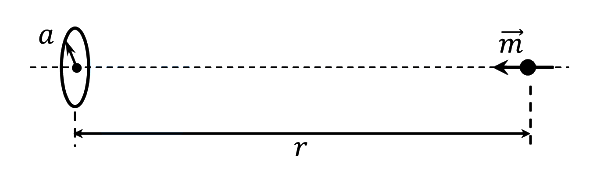
Question :
The work done in bringing the dipole from infinity to a distancefrom the centre of the loop by the given process is proportional to:JEE Advanced 2021 Hard