


JEE Advanced · Physics · 7. COM & Collisions
A point mass of \(1 \mathrm{~kg}\) collides elastically with a stationary point mass of \(5 \mathrm{~kg}\). After their collision, the \(1 \mathrm{~kg}\) mass reverses its direction and moves with a speed of \(2 \mathrm{~ms}^{-1}\). Which of the following statement(s) is/are correct for the system of these two masses?
- A Total momentum of the system is \(3 \mathrm{~kg}-\mathrm{ms}^{-1}\)
- B Momentum of \(5 \mathrm{~kg}\) mass after collision is \(4 \mathrm{~kg}-\mathrm{ms}^{-1}\)
- C Kinetic energy of the centre of mass is \(0.75 \mathrm{~J}\)
- D Total kinetic energy of the system is \(4 \mathrm{~J}\)
Answer & Solution
Correct Answer
(C) Kinetic energy of the centre of mass is \(0.75 \mathrm{~J}\)
Step-by-step Solution
Detailed explanation
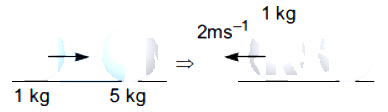
\(
\begin{aligned}
& v_1^{\prime}=\left(\frac{m_1-m_5}{m_1+m_5}\right) v_1+\left(\frac{2 m_5}{m_1+m_5}\right) v_5 \\
& -2=\left(\frac{1-5}{1+5}\right) v_1+0 \quad\left(\text { as } v_5=0\right) \\
& \therefore \quad v_1=3 \mathrm{~ms}^{-1} \\
& v_5^{\prime}=\left(\frac{m_5-m_1}{m_1+m_5}\right) v_5+\left(\frac{2 m_1}{m_1+m_2}\right) v_1 \\
& =0+\left(\frac{2 \times 1}{6}\right)(3)=1 \mathrm{~ms}^{-1} \\
& P_{\mathrm{CM}}=P_i=(1)(3) \\
& =3 \frac{\mathrm{kg}-\mathrm{m}}{\mathrm{s}} \\
& P_5{ }^{\prime}=(5)(1)=5 \frac{\mathrm{kg}-\mathrm{m}}{5} \\
& K_{\mathrm{CM}}=\frac{P_{\mathrm{CM}}^2}{2 M_{\mathrm{CM}}} \\
& =\frac{9}{2 \times 6}=0.75 \mathrm{~J} \\
& K_{\text {total }}=\frac{1}{2} \times 1 \times(3)^2 \\
& =4.5 \mathrm{~J}
\end{aligned}
\)
\(\therefore\) correct options are (a) and (c).
See the Complete Solution
Get step-by-step explanations for this and 2.5 Lakh+ more JEE, NEET & CET questions.
- Unlock all solutions
- Practice the full chapter
- Track accuracy across PYQs
4.8 rated on Google Play · 14,000+ reviews
More questions from Physics
- Consider one mole of helium gas enclosed in a container at initial pressure and volume . It expands isothermally to volume . After this, the gas expands adiabatically and its volume becomes . The work done by the gas during isothermal and adiabatic expansion processes are and , then is _________ .JEE Advanced 2020 Medium
- An electron and a proton are moving on straight parallel paths with same velocity. They enter a semi-infinite region of uniform magnetic field perpendicular to the velocity. Which of the following statement(s) is/are true?JEE Advanced 2011 Easy
- An infinitely long wire, located on the \(z\)-axis, carries a current \(I\) along the \(+z\)-direction and produces the magnetic field \(\vec{B}\). The magnitude of the line integral \(\int \vec{B} \cdot \overrightarrow{d l}\) along a straight line from the point \((-\sqrt{3} a, a, 0)\) to \((a, a, 0)\) is given by
[ \(\mu_0\) is the magnetic permeability of free space.]JEE Advanced 2024 Hard - Match the temperature of a black body given in List- with an appropriate statement in List-, and choose the correct option.
[Given: Wien’s constant as and ]List- List- The radiation at peak wavelength can lead to emission of photoelectrons from a metal of work function The radiation at peak wavelength is visible to human eye The radiation at peak emission wavelength will result in the widest central maximum of a single slit diffraction The power emitted per unit area is of that emitted by a blackbody at temperature The radiation at peak emission wavelength can be used to image human bones JEE Advanced 2023 Medium - The minimum kinetic energy needed by an alpha particle to cause the nuclear reaction in a laboratory frame is (in ). Assume that is at rest in the laboratory frame. The masses of and can be taken to be , and , respectively, where . The value of is
If the numerical value has more than two decimal places, truncate/round-off the value to TWO decimal places.JEE Advanced 2022 Medium - Shown in the figure is a semicircular metallic strip that has thickness and resistivity . Its inner radius is and outer radius is . If a voltage is applied between its two ends, a current flows in it. In addition, it is observed that a transverse voltage develops between its inner and outer surfaces due to purely kinetic effects of moving electrons (ignore any role of the magnetic field due to the current). Then (figure is schematic and not drawn to scale)
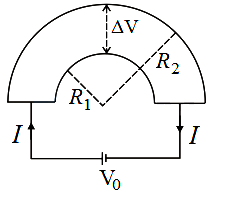 JEE Advanced 2020 Hard
More PYQs from JEE Advanced
- An audio transmitter \((T)\) and a receiver \((R)\) are hung vertically from two identical massless strings of length 8 m with their pivots well separated along the \(X\) axis. They are pulled from the equilibrium position in opposite directions along the \(X\) axis by a small angular amplitude \(\theta_0=\cos ^{-1}(0.9)\) and released simultaneously. If the natural frequency of the transmitter is 660 Hz and the speed of sound in air is \(330 \mathrm{~m} / \mathrm{s}\), the maximum variation in the frequency (in Hz ) as measured by the receiver (Take the acceleration due to gravity \(g=10 \mathrm{~m} / \mathrm{s}^2\) ) is \(\qquad\)
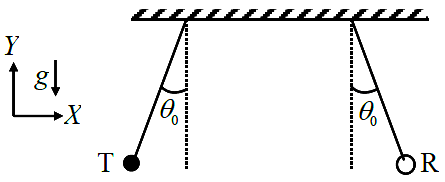 JEE Advanced 2025 Hard
 - The correct statement(s) regarding defects in solids is (are)JEE Advanced 2009 Medium
- Paragraph:
Properties such as boiling point, freezing point and vapour pressure of a pure solvent change when solute molecules are added to get homogeneous solution. These are called colligative properties. Applications of colligative properties are very useful in day-to-day life. One of its examples is the use of ethylene glycol and water mixture as anti-freezing liquid in the radiator automobiles.
A solution \(M\) is prepared by mixing ethanol and water. The mole fraction of ethanol in the mixtrue is \(0.9\)
Given Freezing point depression constant of water \(\left(k^{\text {water }}\right)=1.86 \mathrm{~K} \mathrm{~kg} \mathrm{~mol}^{-1}\)
Freezing point depression constant of ethanol \(\left(k_f^{\text {ethanol }}\right)=2.0 \mathrm{Kkg} \mathrm{mol}^{-1}\)
Boiling point elevation constant of water \(\left(k_b^{\text {water }}\right)=0.52 \mathrm{Kkg} \mathrm{mol}^{-1}\)
Boiling point elevation constant of ethanol \(\left(k_b^{\text {ethanol }}\right)=1.2 \mathrm{Kkg} \mathrm{mol}^{-1}\)
Standard freezing point of water \(=273 \mathrm{~K}\)
Standard freezing point of ethanol \(=155.7 \mathrm{~K}\)
Standard boiling point of water \(=373 \mathrm{~K}\)
Standard boiling point of ethanol \(=351.5 \mathrm{~K}\)
Vapour pressure of pure water \(=328 \mathrm{~mm}\) of \(\mathrm{Hg}\)
Vapour pressure of pure ethanol \(=40 \mathrm{~mm}\) of \(\mathrm{Hg}\)
Molecular weight of water \(=18 \mathrm{~g} \mathrm{~mol}^{-1}\)
Molecular weight of ethanol \(=46 \mathrm{~g} \mathrm{~mol}^{-1}\)
In answering the following questions, consider the solutions to be ideal dilute solutions and solutes to be non-volatile and non-dissociative.
Question:
The vapour pressure of the solution \(M\) isJEE Advanced 2008 Medium - Paragraph:
Football teams \(T_{1}\) and \(T_{2}\) have to play two games against each other. It is assumed that the outcomes of the two games are independent. The probabilities of \(T_{1}\) winning, drawing and losing a game against \(T_{2}\) are \(\frac{1}{2}, \frac{1}{6}\) and \(\frac{1}{3}\), respectively. Each team gets \(3\) points for a win, \(1\) point for a draw and \(0\) point for a loss in a game. Let \(X\) and \(Y\) denote the total points scored by teams \(T_{1}\) and \(T_{2}\), respectively, after two games.
Question:
\(P(X>Y)\) isJEE Advanced 2016 Easy - The graph between object distance \(u\) and image distance \(v\) for a lens is given below. The focal length of the lens is
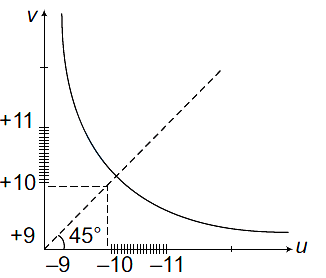 JEE Advanced 2006 Hard
 - Let be the image of the point with respect to the plane Then the equation of the plane passing through and containing the straight line isJEE Advanced 2016 Medium