


JEE Advanced · Physics · 16. Waves & Sound
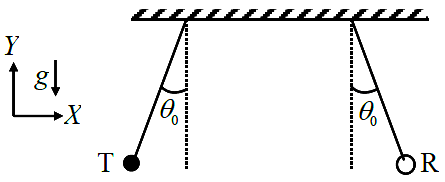
An audio transmitter \((T)\) and a receiver \((R)\) are hung vertically from two identical massless strings of length 8 m with their pivots well separated along the \(X\) axis. They are pulled from the equilibrium position in opposite directions along the \(X\) axis by a small angular amplitude \(\theta_0=\cos ^{-1}(0.9)\) and released simultaneously. If the natural frequency of the transmitter is 660 Hz and the speed of sound in air is \(330 \mathrm{~m} / \mathrm{s}\), the maximum variation in the frequency (in Hz ) as measured by the receiver (Take the acceleration due to gravity \(g=10 \mathrm{~m} / \mathrm{s}^2\) ) is \(\qquad\)
- A 32
- B 34
- C 33
- D 35
Answer & Solution
Correct Answer
(A) 32
Step-by-step Solution
Detailed explanation
\(\begin{aligned} & \cos \theta_0=1-\frac{\theta_0^2}{2}=0.9 \\ & \frac{\theta_0^2}{2}=0.1 \Rightarrow \theta_0=10.2=\frac{1}{\sqrt{5}}\end{aligned}\)
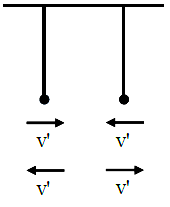
\(\begin{aligned} & f_{\max }=\frac{v+v^{\prime}}{v-v^{\prime}} f \\ & f_{\min }=\frac{v-v^{\prime}}{v+v^{\prime}} f \\ & \Delta f_{\max }=f_{\max }-f_{\min }=\frac{v+v^{\prime}}{v-v^{\prime}} f-\frac{v-v^{\prime}}{v+v^{\prime}} f \\ & =\frac{\left(v+v^{\prime}\right)^2-\left(v-v^{\prime}\right)^2}{v^2-v^{\prime 2}} f\end{aligned}\)
\(\Delta f_{\max }=\frac{4 v v^{\prime}}{v^2-v^{\prime 2}} f \qquad ....(i)\)
Here, \(\mathrm{v}^{\prime}=\ell \Omega_{\max }\)
\(=\ell \cdot \theta_0 \cdot \omega \quad(\omega=\text { angular frequency })\)
\(\begin{aligned} & =\ell \theta_0 \sqrt{\frac{\mathrm{~g}}{\ell}} \\ & \mathrm{v}^{\prime}=\theta_0 \sqrt{\mathrm{~g} \ell} \\ & \mathrm{v}^{\prime}=\frac{1}{\sqrt{5}} \sqrt{10 \times 8} \\ & \mathrm{v}^{\prime}=4\end{aligned}\)
Put in equation (i)
\(\begin{aligned} & \Delta \mathrm{f}_{\max }=\frac{4 \times 330 \times 4 \times 660}{330^2-4^2} \\ & \approx \frac{16 \times 330 \times 660}{330} \approx 32\end{aligned}\)
\(\begin{aligned} & f_{\max }=\frac{v+v^{\prime}}{v-v^{\prime}} f \\ & f_{\min }=\frac{v-v^{\prime}}{v+v^{\prime}} f \\ & \Delta f_{\max }=f_{\max }-f_{\min }=\frac{v+v^{\prime}}{v-v^{\prime}} f-\frac{v-v^{\prime}}{v+v^{\prime}} f \\ & =\frac{\left(v+v^{\prime}\right)^2-\left(v-v^{\prime}\right)^2}{v^2-v^{\prime 2}} f\end{aligned}\)
\(\Delta f_{\max }=\frac{4 v v^{\prime}}{v^2-v^{\prime 2}} f \qquad ....(i)\)
Here, \(\mathrm{v}^{\prime}=\ell \Omega_{\max }\)
\(=\ell \cdot \theta_0 \cdot \omega \quad(\omega=\text { angular frequency })\)
\(\begin{aligned} & =\ell \theta_0 \sqrt{\frac{\mathrm{~g}}{\ell}} \\ & \mathrm{v}^{\prime}=\theta_0 \sqrt{\mathrm{~g} \ell} \\ & \mathrm{v}^{\prime}=\frac{1}{\sqrt{5}} \sqrt{10 \times 8} \\ & \mathrm{v}^{\prime}=4\end{aligned}\)
Put in equation (i)
\(\begin{aligned} & \Delta \mathrm{f}_{\max }=\frac{4 \times 330 \times 4 \times 660}{330^2-4^2} \\ & \approx \frac{16 \times 330 \times 660}{330} \approx 32\end{aligned}\)
See the Complete Solution
Get step-by-step explanations for this and 2.5 Lakh+ more JEE, NEET & CET questions.
- Unlock all solutions
- Practice the full chapter
- Track accuracy across PYQs
4.8 rated on Google Play · 14,000+ reviews
More questions from Physics
- A uniform circular disc of mass and radius is rotating with an angular velocity of about its own axis, which is vertical. Two uniform circular rings, each of mass and radius , are gently placed symmetrically on the disc in such a manner that they are touching each other along the axis of the disc and are horizontal. Assume that the friction is large enough such that the rings are at rest relative to the disc and the system rotates about the original axis. The new angular velocity of the system isJEE Advanced 2013 Medium
- Paragraph:
\(\mathbf{P}_{17 \text { - } 19}\) : Paragraph for Questions Nos. 17 to 19 Two discs \(A\) and \(B\) are mounted coaxially on a vertical axle. The discs have moments of inertia I and 2I, respectively about the common axis. Disc \(A\) is imparted an initial angular velocity \(2 \omega\) using the entire potential energy of a spring compressed by a distance \(x_1\). Disc \(B\) is imparted an angular velocity \(\omega\) by a spring having the same spring constant and compressed by a distance \(x_2\). Both the discs rotate in the clockwise direction.Question:
The ratio \(\frac{x_1}{x_2}\) isJEE Advanced 2007 Easy - A piece of wire is bent in the shape of a parabola \(y=k x^2\) (y-axis vertical) with a bead of mass \(m\) on it. The bead can slide on the wire without friction. It stays at the lowest point of the parabola when the wire is at rest. The wire is now accelerated parallel to the \(x\)-axis with the constant acceleration \(a\). The distance of the new equilibrium position of the bead, where the bead can stays at rest with respect to the wire, from the \(y\)-axis isJEE Advanced 2009 Medium
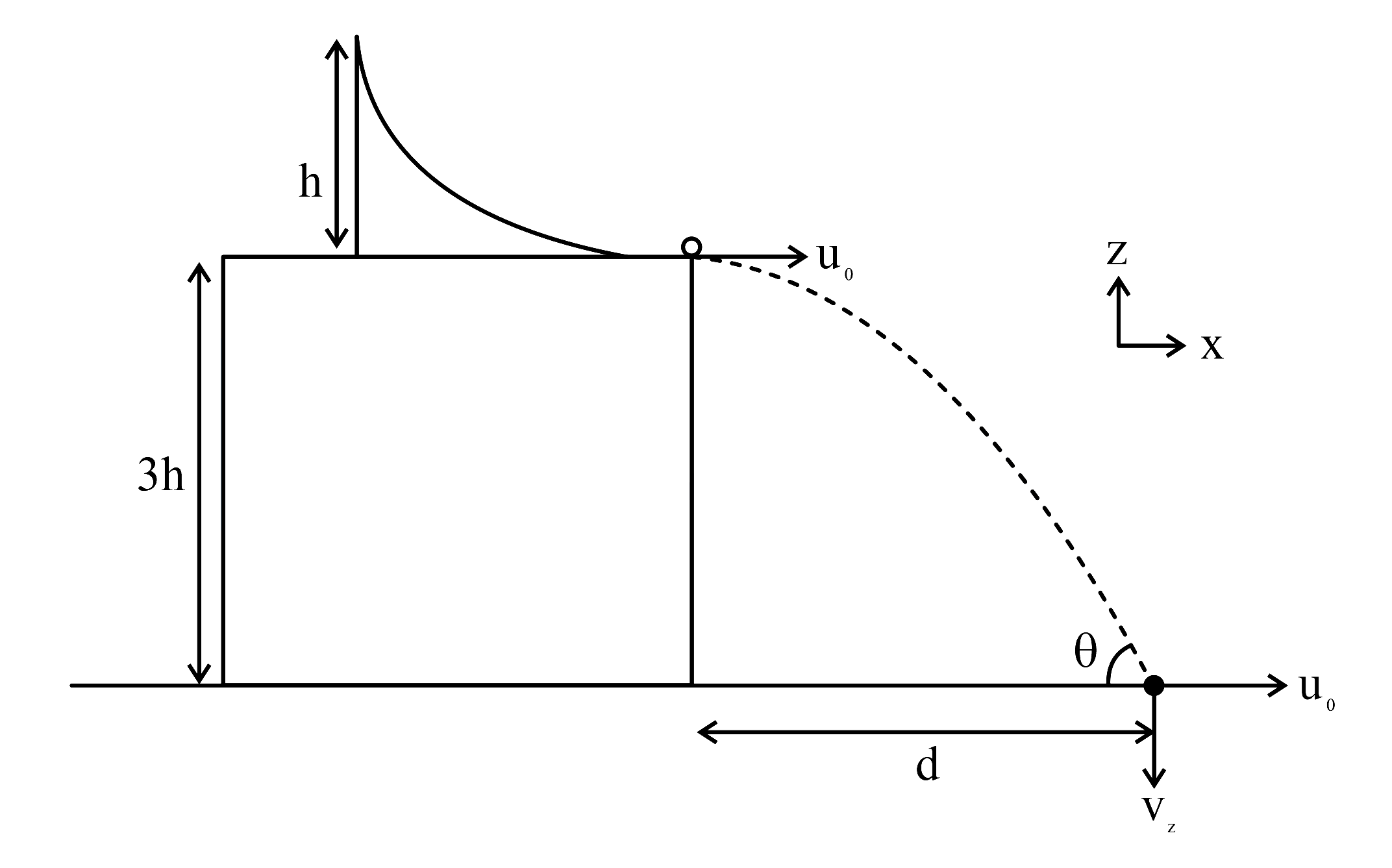
- A slide with a frictionless curved surface, which becomes horizontal at its lower end, is fixed on the terrace of a building of height from the ground, as shown in the figure. A spherical ball of mass is released on the slide from rest at a height from the top of the terrace. The ball leaves the slide with a velocity and falls on the ground at a distance from the building making an angle with the horizontal. It bounces off with a velocity and reaches a maximum height . The acceleration due to gravity is and the coefficient of restitution of the ground is . Which of the following statement(s) is(are) correct?
 JEE Advanced 2023 Hard
 - A particle of mass is projected from the ground with an initial speed at an angle with the horizontal. At the highest point of its trajectory, it makes a completely inelastic collision with another identical particle, which was thrown vertically upward from the ground with the same initial speed . The angle that the composite system makes with the horizontal immediately after the collision isJEE Advanced 2013 Medium
- Paragraph:
Scientists are working hard to develop nuclear fusion reactor. Nuclei of heavy hydrogen, \({ }_1^2 \mathrm{H}\) known as deuteron and denoted by \(D\) can be thought of as a candidate for fusion reactor. The \(D\) - \(D\) reaction is \({ }_1^2 \mathrm{H}+{ }_1^2 \mathrm{H} \rightarrow{ }_2^3 \mathrm{He}+n+\) energy. In the core of fusion reactor. A gas of heavy hydrogen is fully ionized into deuteron nuclei and electrons. This collection of \({ }_1^4 \mathrm{H}\) nuclei and electrons is known as plasma. The nuclei move randomly in the reactor core and occasionally come close enough for nuclear fusion to take place. Usually, the temperatures in the reactor core are too high and no material wall can be used to confine the plasma. Special techniques are used which confine the plasma for a time \(t_0\) before the particles fly away from the core. If n is the density (number/volume) of deutrons, the product t \(_0\) is called Lawson number. In one of the criteria, \(a\) reactor is termed successful if Lawson number is greater than \(5 \times 10^{14} \mathrm{scm}^{-3}\).
It may be helpful to use the following : Boltzmann constant \(k=8.6 \times 10^{-5} \mathrm{eV} / \mathrm{K}\); \(\frac{e^2}{4 \pi \varepsilon_0}=1.44 \times 10^{-9} \mathrm{eVm}\)
Question:
Results of calculations for four different designs of a fusion reactor using D-D reaction are given below. Which of these is most promising based on Lawson criterion?JEE Advanced 2009 Easy
More PYQs from JEE Advanced
- Let \(z_k=\cos \left(\frac{2 k \pi}{10}\right)+i \sin \left(\frac{2 k \pi}{10}\right) ; k=1,2, \ldots, 9\)
List - I List - II (A) For each \(z_k\) there exists a \(z_j\) such \(z_k \cdot z_j=1\) (P) True (B) There exists a \(k \in\{1,2, \ldots, 9\}\) such that \(z_1 \cdot z=z_k\) has no solution z in the set of complex numbers (Q) False (C) \(\frac{\left|1-z_1\right|\left|1-z_2\right|\ldots\left|1-z_9\right|}{10}\) equals (R) 1 (D) \(1-\sum_{k=1}^9 \cos \left(\frac{2 k \pi}{10}\right)\) equals (S) 2 JEE Advanced 2014 Hard - Paragraph :
When liquid medicine of density \(\rho\) is to be put in the eye, it is done with the help of a dropper. As the bulb on the top of the dropper is pressed, a drop forms at the opening of the dropper. We wish to estimate the size of the drop.
We first assume that the drop formed at the opening is spherical because that requires a minimum increase in its surface energy. To determine the size, we calculate the net vertical force due to the surface tension \(T\) when the radius of the drop is \(R\). When this force becomes smaller than the weight of the drop, the drop gets detached from the dropper.
Question :
If the radius of the opening of the dropper is \(r\), the vertical force due to the surface tension on the drop of radius \(R\) (assuming \(r< < R\) ) isJEE Advanced 2010 Medium - The number of solutions of the pair of equations \(2 \sin ^2 \theta-\cos 2 \theta=0\) and \(2 \cos ^2 \theta-3 \sin \theta=0\) in the interval \([0,2 \pi]\) isJEE Advanced 2007 Easy
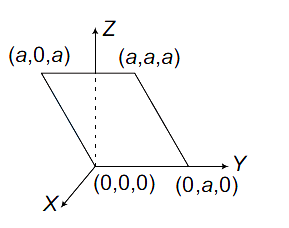
- Consider an electric field \(\mathbf{E}=E_0 \hat{\mathbf{x}}\) where \(\bar{E}_0\) is a constant. The flux through the shaded area ( as shown in the figure) due to this field is
 JEE Advanced 2011 Medium
 - To an evacuated vessel with movable piston under external pressure of \(1 \mathrm{~atm}\), \(0.1\) mole of He and \(1.0\) mole of an unknown compound (vapour pressure \(0.68 mathrm{~atm}\) at \(0^{\circ} \mathrm{C}\) ) are introduced. Considering the ideal gas behaviour, the total volume (in litre) of the gases at \(0^{\circ} \mathrm{C}\) is close toJEE Advanced 2011 Easy
- Let \(f\) be a real-valued function defined on the interval \((0, \infty)\), by \(f(x)=\ln x+\int_0^x \sqrt{1+\sin t} d t\). Then which of the following statement(s) is (are) true ?JEE Advanced 2010 Medium