


JEE Advanced · Physics · 8. Rotational Motion
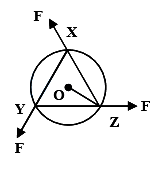
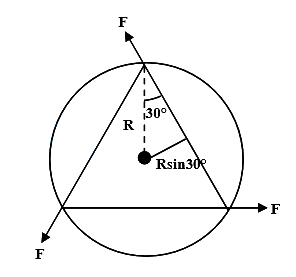
A uniform circular disc of mass 1.5 kg and radius 0.5 m is initially at rest on a horizontal frictionless surface. Three forces of equal magnitude are applied simultaneously along the three sides of an equilateral triangle XYZ with its vertices on the perimeter of the disc (see figure). One second after applying the forces, the angular speed of the disc in rad is
- A 1
- B 2
- C 3
- D 4
Answer & Solution
Correct Answer
(B) 2
Step-by-step Solution
Detailed explanation
rad/s
See the Complete Solution
Get step-by-step explanations for this and 2.5 Lakh+ more JEE, NEET & CET questions.
- Unlock all solutions
- Practice the full chapter
- Track accuracy across PYQs
4.8 rated on Google Play · 14,000+ reviews
More questions from Physics
- Paragraph:
In a mixture of \(\mathrm{H}-\mathrm{H}^{+}\)gas \(\left(\mathrm{He}^{+}\right.\)is singly ionised \(\mathrm{He}\) atom), \(\mathrm{H}\) atoms and \(\mathrm{He}^{+}\)ions are excited to their respective first excited states. Subsequently, \(\mathrm{H}\) atoms transfer their total excitation energy to \(\mathrm{He}^{+}\)ions (by collisions). Assume that the Bohr model of atom is exactly valid.
Question:
The wavelength of light emitted in the visible region by \(\mathrm{He}^{+}\)ions after collisions with \(\mathrm{H}\) atoms isJEE Advanced 2008 Medium - A positive point charge of \(10^{-8} \mathrm{C}\) is kept at a distance of 20 cm from the center of a neutral conducting sphere of radius 10 cm . The sphere is then grounded and the charge on the sphere is measured. The grounding is then removed and subsequently the point charge is moved by a distance of 10 cm further away from the center of the sphere along the radial direction. Taking \(\frac{1}{4 \pi \epsilon_0}=9 \times 10^9 \mathrm{Nm}^2 / \mathrm{C}^2\) (where \(\epsilon_0\) is the permittivity of free space), which of the following
statements is/are correct: :JEE Advanced 2025 Medium - Six point charges are kept at the vertices of a regular hexagon of side \(\mathrm{L}\) and centre \(O\), as shown in the figure.
Given that \(K=\frac{1}{4 \pi \varepsilon_{0}} \frac{q}{L^{2}}\), which of the following statement(s) is (are) correct?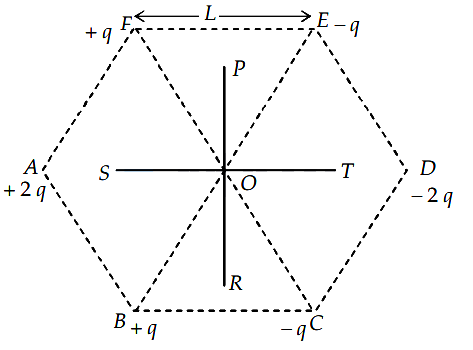 JEE Advanced 2012 Medium
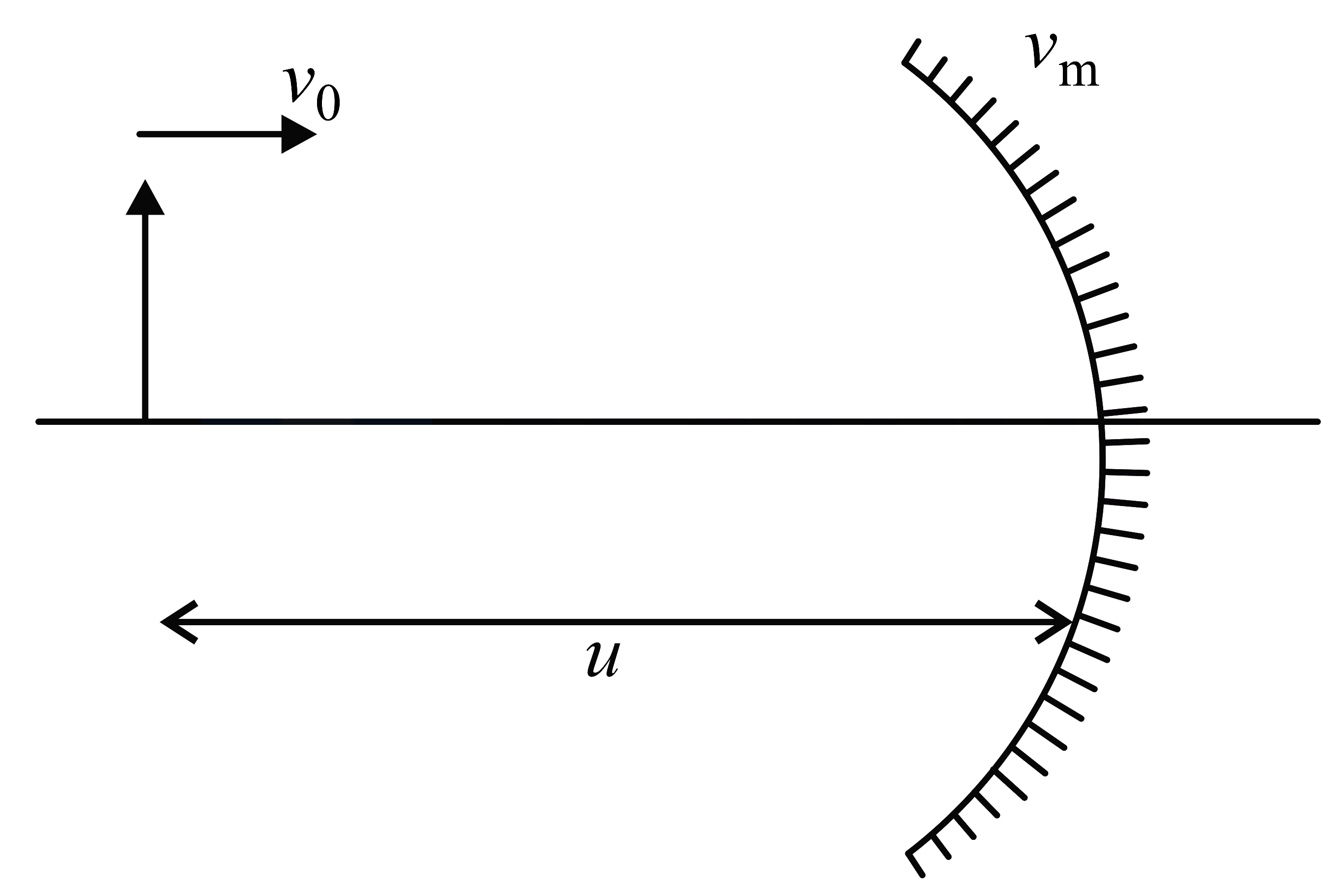
 - An object and a concave mirror of focal length both move along the principal axis of the mirror with constant speeds. The object moves with speed towards the mirror with respect to a laboratory frame. The distance between the object and the mirror at a given moment is denoted by . When , the speed of the mirror is such that the image is instantaneously at rest with respect to the laboratory frame, and the object forms a real image. The magnitude of is _______ .
 JEE Advanced 2022 Medium
 - A \(20 \mathrm{~cm}\) long string, having a mass of \(1.0 \mathrm{~g}\), is fixed at both the ends. The tension in the string is \(0.5 \mathrm{~N}\). The string is set into vibration using an external vibrator of frequency 100 \(\mathrm{Hz}\). Find the separation (in \(\mathrm{cm}\) ) between the successive nodes on the string.JEE Advanced 2009 Easy
- The general motion of a rigid body can be considered to be a combination of (i) a motion of its centre of mass about an axis, and (ii) its motion about an instantaneous axis passing through the centre of mass.
These axes need not be stationary. Consider, for example, a thin uniform disc welded (rigidly fixed) horizontally at its rim to a massless, stick, as shown in the figure. When the disc-stick system is rotated about the origin on a horizontal frictionless plane with angular speed \(\omega\), the motion at any instant can be taken as a combination of (i) a rotation of the centre of mass of the disc about the \(z\)-axis and (ii) a rotation of the disc through an instantaneous vertical axis passing through its centre of mass (as is seen from the changed orientation of points \(P\) and \(Q\) ). Both these motions have the same angular speed \(\omega\) in this case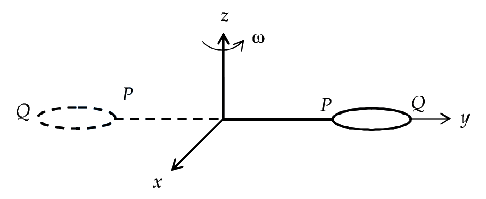
Now consider two similar systems as shown in the figure: Case
(a) the disc with its face vertical and parallel to \(x-z\) plane; Case
(b) the disc with its face making an angle of
\(45^{\circ}\) with \(x-y\) plane and its horizontal diameter parallel to \(x\)-axis. In both the cascs, the disc is welded at point \(\mathrm{P}\), and the systems are rotated with constant angular speed \(\omega\) about the \(z\) axis.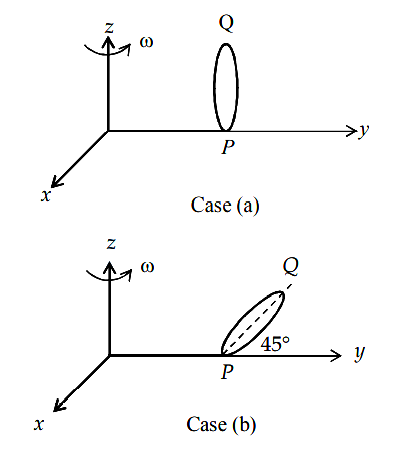
Question : Which of the following statements regarding the angular speed about the instantaneous axis (passing through the centre of mass) is correct?JEE Advanced 2012 Medium
More PYQs from JEE Advanced
- The stoichiometric reaction of of dimethyldichlorosilane with water results in a tetrameric cyclic product in yield. The weight (in ) of obtained is ____________
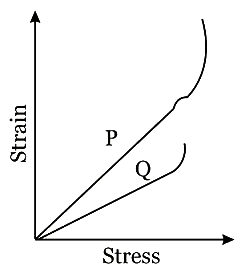
\(\left[\right.\)Use, molar mass\(.\left(\text{gmol} ^{-1}\right):\text H =1,\text C =12,\)\(\text O =16, \text{Si} =28, \text{Cl} =35.5]\)JEE Advanced 2023 Hard - In plotting stress versus strain curves for two materials \(P\) and \(Q\), a student by mistake puts strain on the \(y\)-axis and stress on the \(x\)-axis as shown in the figure. Then the correct statement(s) is(are)
 JEE Advanced 2015 Medium
 - Paragraph:
The coordination number of \(\mathrm{Ni}^{2+}\) is 4 .
\(\mathrm{NiCl}_2+\mathrm{KCN}\) (excess) \(\rightarrow A\) (cyano complex)
\(\mathrm{NiCl}_2+\) conc. \(\mathrm{HCl}\) (excess) \(\rightarrow B\) (chloro complex)
Question:
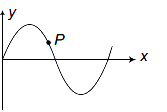
The IUPAC name of \(A\) and \(B\) areJEE Advanced 2006 Medium - A transverse sinusoidal wave moves along a string in the positive \(x\)-direction at a speed of \(10 \mathrm{~cm} / \mathrm{s}\). The wavelength of the wave is \(0.5 \mathrm{~m}\) and its amplitude is \(10 \mathrm{~cm}\). At a particular time \(t\), the snap-shot of the wave is shown in figure. The velocity of point \(P\) when its displacement is \(5 \mathrm{~cm}\) is
 JEE Advanced 2008 Easy
 - Statement 1 For practical purposes, the earth is used as a reference at zero potential in electrical circuits.
and Statement 2 The electrical potential of a sphere of radius \(R\) with charge \(Q\) uniformly distributed on the surface is given by \(\frac{Q}{4 \pi \varepsilon_0 R}\).JEE Advanced 2008 Easy - Let \(\alpha(a)\) and \(\beta(a)\) be the roots of the equation \((\sqrt[3]{1+a}-1) x^{2}+(\sqrt{1+a}-1) x+(\sqrt[6]{1+a}-1)=0\) where \(a\) \(>-1\). Then \(\lim _{a \rightarrow 0^{+}} \alpha(a)\) and \(\lim _{x \rightarrow 0^{+}} \beta(a)\) areJEE Advanced 2012 Medium