


JEE Advanced · Physics · 27. Atomic Physics
Paragraph:
In a mixture of \(\mathrm{H}-\mathrm{H}^{+}\)gas \(\left(\mathrm{He}^{+}\right.\)is singly ionised \(\mathrm{He}\) atom), \(\mathrm{H}\) atoms and \(\mathrm{He}^{+}\)ions are excited to their respective first excited states. Subsequently, \(\mathrm{H}\) atoms transfer their total excitation energy to \(\mathrm{He}^{+}\)ions (by collisions). Assume that the Bohr model of atom is exactly valid.
Question:
The wavelength of light emitted in the visible region by \(\mathrm{He}^{+}\)ions after collisions with \(\mathrm{H}\) atoms is
- A \(6.5 \times 10^{-7} \mathrm{~m}\)
- B \(5.6 \times 10^{-7} \mathrm{~m}\)
- C \(4.8 \times 10^{-7} \mathrm{~m}\)
- D \(4.0 \times 10^{-7} \mathrm{~m}\)
Answer & Solution
Correct Answer
(C) \(4.8 \times 10^{-7} \mathrm{~m}\)
Step-by-step Solution
Detailed explanation
Visible light lies in the range, \(\lambda_1=4000 Å\) to \(\lambda_2=7000 Å\).
Energy of photons corresponding to these wavelengths (in \(\mathrm{eV}\) ) would be;
\(
\begin{aligned}
& E_1=\frac{12375}{4000}=3.09 \mathrm{eV} \\
& E_2=\frac{12375}{7000}=1.77 \mathrm{eV}
\end{aligned}
\)
From energy level diagram of \(\mathrm{He}^{+}\)atom we can see that in transition from \(n=4\) to \(n=3\), energy of photon released will lie between \(E_1\) and \(E_2\).
\(
\Delta E_{43}=-3.4-(-6.04)=2.64 \mathrm{eV}
\)
Wavelength of photon corresponding to this energy.
\(
\lambda=\frac{12375}{2.64} Å=4687.5 Å=4.68 \times 10^{-7} \mathrm{~m}
\)
Therefore, (c) is the most correct option.
Energy of photons corresponding to these wavelengths (in \(\mathrm{eV}\) ) would be;
\(
\begin{aligned}
& E_1=\frac{12375}{4000}=3.09 \mathrm{eV} \\
& E_2=\frac{12375}{7000}=1.77 \mathrm{eV}
\end{aligned}
\)
From energy level diagram of \(\mathrm{He}^{+}\)atom we can see that in transition from \(n=4\) to \(n=3\), energy of photon released will lie between \(E_1\) and \(E_2\).
\(
\Delta E_{43}=-3.4-(-6.04)=2.64 \mathrm{eV}
\)
Wavelength of photon corresponding to this energy.
\(
\lambda=\frac{12375}{2.64} Å=4687.5 Å=4.68 \times 10^{-7} \mathrm{~m}
\)
Therefore, (c) is the most correct option.
See the Complete Solution
Get step-by-step explanations for this and 2.5 Lakh+ more JEE, NEET & CET questions.
- Unlock all solutions
- Practice the full chapter
- Track accuracy across PYQs
4.8 rated on Google Play · 14,000+ reviews
More questions from Physics
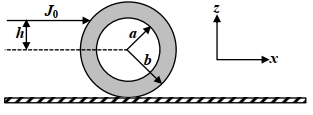
- An annular disk of mass , inner radius and outer radius is placed on a horizontal surface with coefficient of friction , as shown in the figure. At some time, an impulse is applied at a height above the center of the disk. If then the disk rolls without slipping along the -axis. Which of the following statement(s) is(are) correct?
 JEE Advanced 2023 Hard
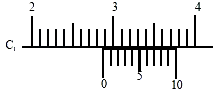
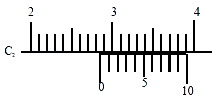
 - There are two vernier calipers both of which have divided into equal divisions on the main scale. The Vernier scale of one of the calipers has equal divisions that correspond to main scale divisions. The Vernier scale of the other caliper has equal divisions that correspond to main scale divisions. The readings of the two calipers are shown in the figure. The measured values (in ) by calipers and respectively, are
 JEE Advanced 2016 Easy
 - A container of fixed volume has a mixture of one mole of hydrogen and one mole of helium in equilibrium at temperature . Assuming the gases are ideal, the correct statement(s) is (are)JEE Advanced 2015 Easy
- A particle, of mass and charge , is initially at rest. At time , the particle comes under the influence of an electric field where and . Consider the effect of only the electrical force on the particle. Then the maximum speed, in , attained by the particle at subsequent times is ____________.JEE Advanced 2018 Medium
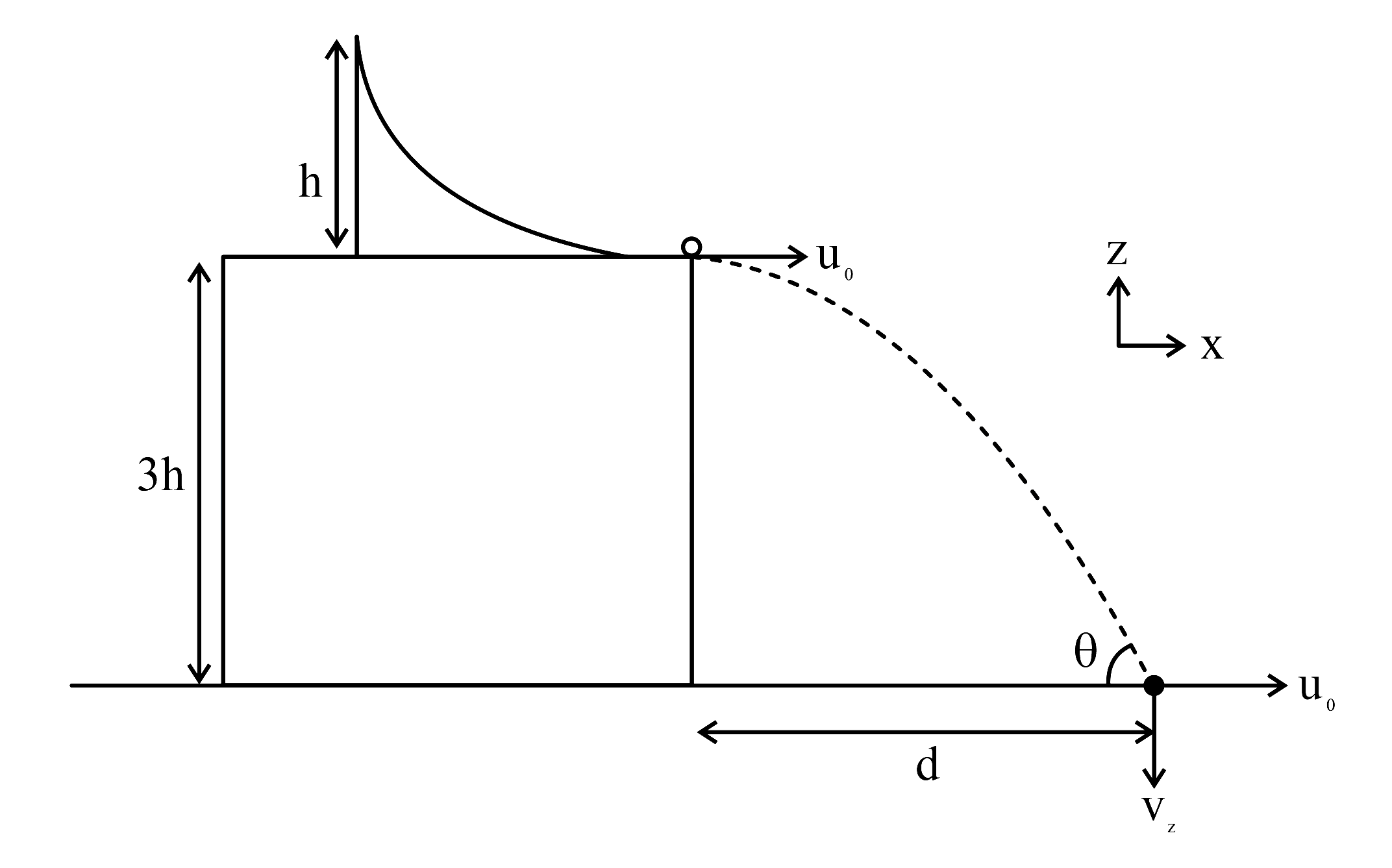
- A slide with a frictionless curved surface, which becomes horizontal at its lower end, is fixed on the terrace of a building of height from the ground, as shown in the figure. A spherical ball of mass is released on the slide from rest at a height from the top of the terrace. The ball leaves the slide with a velocity and falls on the ground at a distance from the building making an angle with the horizontal. It bounces off with a velocity and reaches a maximum height . The acceleration due to gravity is and the coefficient of restitution of the ground is . Which of the following statement(s) is(are) correct?
 JEE Advanced 2023 Hard
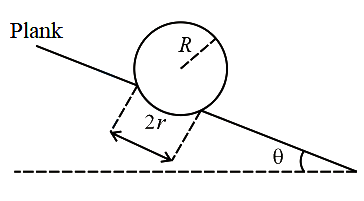
 - A football of radius is kept on a hole of radius made on a plank kept horizontally. One end of the plank is now lifted so that it gets tilted making an angle from the horizontal as shown in the figure below. The maximum value of so that the football does not start rolling down the plank satisfies (figure is schematic and not drawn to scale)
 JEE Advanced 2020 Easy
More PYQs from JEE Advanced
- The coefficient of in the expansion of isJEE Advanced 2015 Easy
- Addition of excess aqueous ammonia to a pink coloured aqueous solution of and gives an octahedral complex Y in the presence of air. In aqueous solution, complex Y behaves as 1 : 3 electrolyte. The reaction of X with excess HCl at room temperature results in the formation of a blue coloured complex Z. The calculated spin only magnetic moment of X and Z is 3.87 B.M., whereas it is zero for complex Y.
Among the following options, which statement(s) is(are) correct ?JEE Advanced 2017 Medium - At \(25^{\circ} \mathrm{C}\), the concentration of \(\mathrm{H}^{+}\)ions in \(1.00 \times 10^{-3} \mathrm{M}\) aqueous solution of a weak monobasic acid having acid dissociation constant \(\left(K_a\right)=4.00 \times 10^{-11}\) is \(\boldsymbol{X} \times 10^{-7} \mathrm{M}\). The value of \(\boldsymbol{X}\) is _____ .
Use: Ionic product of water \(\left(K_w\right)=1.00 \times 10^{-14}\) at \(25^{\circ} \mathrm{C}\)JEE Advanced 2025 Medium - A tin chloride undergoes the following reactions (not balanced)
is a monoanion having pyramidal geometry. Both and are neutral compounds. Choose the correct option(s).JEE Advanced 2019 Hard - One end of a horizontal thick copper wire of length and radius is welded to an end of another horizontal thin copper wire of length and radius. When the arrangement stretched by applying forces at two ends, the ratio of the elongation in the thin wire to that in the thick wire isJEE Advanced 2013 Easy
- One mole of a monoatomic ideal gas goes through a thermodynamic cycle, as shown in the volume versus temperature diagram. The correct statement(s) is/are:
[ is the gas constant]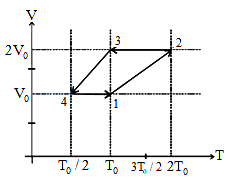 JEE Advanced 2019 Medium