


JEE Advanced · Physics · 16. Waves & Sound
A stationary source is emitting sound at a fixed frequency \(f_0\), which is reflected by two cars approaching the source. The difference between the frequencies of sound reflected from the cars is \(1.2 \%\) of \(f_0\). What is the difference in the speeds of the cars (in km per hour) to the nearest integer ? The cars are moving at constant speeds much smaller than the speed of sound which is \(330 \mathrm{~ms}^{-1}\).
- A 2
- B 3
- C 5
- D 7
Answer & Solution
Correct Answer
(D) 7
Step-by-step Solution
Detailed explanation
Firstly, car will be treated as an observer which is approaching the source. Then, it will be treated as a source, which is moving in the direction of sound.
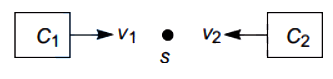
Hence,
\(f_1=f_0\left(\frac{v+v_1}{v-v_1}\right)\)
\(f_2 =f_0\left(\frac{v+v_2}{v-v_2}\right) \)
\( \therefore f_1-f_2 =\left(\frac{1.2}{100}\right) f_0 \)
\( =f_0\left[\frac{v+v_1}{v-v_1}-\frac{v+v_2}{v-v_2}\right] \)
\( \text { or }\left(\frac{1.2}{100}\right) f_0 =\frac{2 v\left(v_1-v_2\right)}{\left(v-v_1\right)\left(v-v_2\right)} f_0\)
As \(v_1\) and \(v_2\) are very very less than \(v\). We can write, \(\left(v-v_1\right)\) or \(\left(v-v_2\right) \approx v\)
\(
\therefore \left(\frac{1.2}{100}\right) f_0=\frac{2\left(v_1-v_2\right)}{v} f_0
\)
or \(\left(v_1-v_2\right)=\frac{v \times 1.2}{200}\)
\(
\begin{aligned}
& =\frac{330 \times 1.2}{200}=1.98 \mathrm{~ms}^{-1} \\
& =7.128 \mathrm{kmh}^{-1}
\end{aligned}
\)
\(\therefore\) The nearest integer is 7 .
Hence, \(\quad f_1=f_0\left(\frac{v+v_1}{v-v_1}\right)\)
\(f_2 =f_0\left(\frac{v+v_2}{v-v_2}\right) \)
\( \therefore f_1-f_2 =\left(\frac{1.2}{100}\right) f_0 \)
\( =f_0\left[\frac{v+v_1}{v-v_1}-\frac{v+v_2}{v-v_2}\right] \)
\( \text { or }\left(\frac{1.2}{100}\right) f_0 =\frac{2 v\left(v_1-v_2\right)}{\left(v-v_1\right)\left(v-v_2\right)} f_0\)
As \(v_1\) and \(v_2\) are very very less than \(v\). We can write, \(\left(v-v_1\right)\) or \(\left(v-v_2\right) \approx v\)
\(
\therefore \left(\frac{1.2}{100}\right) f_0=\frac{2\left(v_1-v_2\right)}{v} f_0
\)
or \(\left(v_1-v_2\right)=\frac{v \times 1.2}{200}\)
\(
\begin{aligned}
& =\frac{330 \times 1.2}{200}=1.98 \mathrm{~ms}^{-1} \\
& =7.128 \mathrm{kmh}^{-1}
\end{aligned}
\)
\(\therefore\) The nearest integer is 7 .
Hence,
\(f_1=f_0\left(\frac{v+v_1}{v-v_1}\right)\)
\(f_2 =f_0\left(\frac{v+v_2}{v-v_2}\right) \)
\( \therefore f_1-f_2 =\left(\frac{1.2}{100}\right) f_0 \)
\( =f_0\left[\frac{v+v_1}{v-v_1}-\frac{v+v_2}{v-v_2}\right] \)
\( \text { or }\left(\frac{1.2}{100}\right) f_0 =\frac{2 v\left(v_1-v_2\right)}{\left(v-v_1\right)\left(v-v_2\right)} f_0\)
As \(v_1\) and \(v_2\) are very very less than \(v\). We can write, \(\left(v-v_1\right)\) or \(\left(v-v_2\right) \approx v\)
\(
\therefore \left(\frac{1.2}{100}\right) f_0=\frac{2\left(v_1-v_2\right)}{v} f_0
\)
or \(\left(v_1-v_2\right)=\frac{v \times 1.2}{200}\)
\(
\begin{aligned}
& =\frac{330 \times 1.2}{200}=1.98 \mathrm{~ms}^{-1} \\
& =7.128 \mathrm{kmh}^{-1}
\end{aligned}
\)
\(\therefore\) The nearest integer is 7 .
Hence, \(\quad f_1=f_0\left(\frac{v+v_1}{v-v_1}\right)\)
\(f_2 =f_0\left(\frac{v+v_2}{v-v_2}\right) \)
\( \therefore f_1-f_2 =\left(\frac{1.2}{100}\right) f_0 \)
\( =f_0\left[\frac{v+v_1}{v-v_1}-\frac{v+v_2}{v-v_2}\right] \)
\( \text { or }\left(\frac{1.2}{100}\right) f_0 =\frac{2 v\left(v_1-v_2\right)}{\left(v-v_1\right)\left(v-v_2\right)} f_0\)
As \(v_1\) and \(v_2\) are very very less than \(v\). We can write, \(\left(v-v_1\right)\) or \(\left(v-v_2\right) \approx v\)
\(
\therefore \left(\frac{1.2}{100}\right) f_0=\frac{2\left(v_1-v_2\right)}{v} f_0
\)
or \(\left(v_1-v_2\right)=\frac{v \times 1.2}{200}\)
\(
\begin{aligned}
& =\frac{330 \times 1.2}{200}=1.98 \mathrm{~ms}^{-1} \\
& =7.128 \mathrm{kmh}^{-1}
\end{aligned}
\)
\(\therefore\) The nearest integer is 7 .
See the Complete Solution
Get step-by-step explanations for this and 2.5 Lakh+ more JEE, NEET & CET questions.
- Unlock all solutions
- Practice the full chapter
- Track accuracy across PYQs
4.8 rated on Google Play · 14,000+ reviews
More questions from Physics
- A hot air balloon is carrying some passengers, and a few sandbags of mass each so that its total mass is . Its effective volume giving the balloon its buoyancy is . The balloon is floating at an equilibrium height of . When number of sandbags are thrown out, the balloon rises to a new equilibrium height close to with its volume remain unchanged. If the variation of the density of air with height from the ground is where and the value of is _________.JEE Advanced 2020 Hard
- A disk of radius \(\frac{a}{4}\) having a uniformly distributed charge \(6 \mathrm{C}\) is placed in the \(x-y\) plane with its centre at \(\left(\frac{-a}{2}, 0,0\right)\). A rod of length a carrying a uniformly distributed charge \(8 \mathrm{C}\) is placed on the \(x\)-axis from \(x=\frac{a}{4}\) to \(x=\frac{5 a}{4}\). Two point charges \(-7 \mathrm{C}\) and \(3 \mathrm{C}\) are placed at \(\left(\frac{a}{4}, \frac{-a}{4}, 0\right)\) and \(\left(\frac{-3 a}{4}, \frac{3 a}{4}, 0\right)\), respectively. Consider a cubical surface formed by six surfaces \(x=\pm \frac{a}{2}, y=\pm \frac{a}{2}, z=\pm \frac{a}{2}\).
The electric flux through this cubical surface is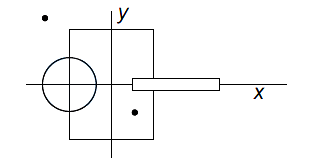 JEE Advanced 2009 Hard
 - Three plane mirrors form an equilateral triangle with each side of length . There is a small hole at a distance from one of the corners as shown in the figure. A ray of light is passed through the hole at an angle and can only come out through the same hole. The cross section of the mirror configuration and the ray of light lie on the same plane.
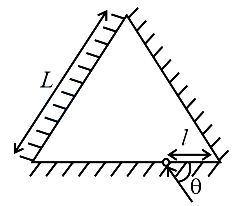
Which of the following statement(s) is(are) correct?JEE Advanced 2022 Medium - Four point charges, each of \(+q\), are rigidly fixed at the four corners of a square planar soap film of side \(a\). The surface tension of the soap film is \(\gamma\). The system of charges and planar film are in equilibrium, and \(a=k\left[\frac{q^2}{\gamma}\right]^{1 / N}\), where \(k\) is a constant. Then, \(N\) isJEE Advanced 2011 Hard
- Which of the following statement is correct in Infinitely long wire kept perpendicula to the paper carrying current inwards the given figure?
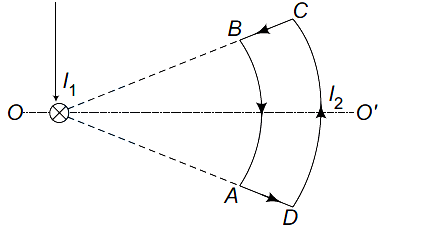 JEE Advanced 2006 Hard
 - The \(\beta\)-decay process, discovered around 1900 , is basically the decay of a neutron \((n)\). In the laboratory, a proton \((p)\) and an electron \(\left(e^{-}\right)\)are observed as the decay products of the neutron. Therefore, considering the decay of a neutron as a two-body decay process, it was predicted theoretically that the kinetic energy of the electron should be a constant. But experimentally, it was observed that the electron kinetic energy has continuous spectrum. Considering a three-body decay process, i.e.
\(n \rightarrow p+e^{-}+\bar{v}_{e}\), around 1930, Pauli explained the observed electron energy spectrum. Assuming the anti-neutrino \(\left(\bar{v}_{e}\right)\) to be massless and possessing negligible energy, and the neutron to be at rest, momentum and energy conservation principles are applied. From this calculation, the maximum kinetic energy of the electron is \(0.8 \times 10^{6} \mathrm{eV}\). The kinetic energy carried by the proton is only the recoil energy.
Question:
If the anti-neutrino had a mass of \(3 \mathrm{eV} / \mathrm{c}^{2}\) (where \(\mathrm{c}\) is the speed of light) instead of zero mass, what should be the range of the kinetic energy, \(K\), of the electron?JEE Advanced 2012 Hard
More PYQs from JEE Advanced
- Consider the following transformations of a compound .
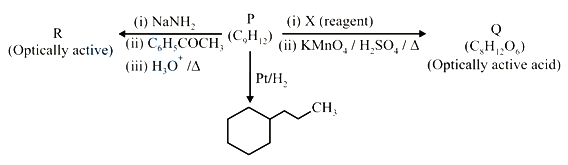
Choose the correct option(s).JEE Advanced 2020 Medium - Let be a differentiable function with and Let and for all Let denote denote .Then which of the following is (are) true?JEE Advanced 2015 Hard
- Paragraph: When potassium iodide is added to an aqueous solution of potassium ferricyanide, a reversible reaction is observed in which a complex \(\mathbf{P}\) is formed. In a strong acidic medium, the equilibrium shifts completely towards \(\mathbf{P}\). Addition of zinc chloride to \(\mathbf{P}\) in a slightly acidic medium results in a sparingly soluble complex Q.
Question: The number of zinc ions present in the molecular formula of \(\mathbf{Q}\) isJEE Advanced 2024 Medium - Bleaching powder and bleach solution are produced on a large scale and used in several household products. The effectiveness of bleach solution is often measured by iodometry.
Question:
\(25 \mathrm{~mL}\) of household solution was mixed with \(30 \mathrm{~mL}\) of \(0.50\) M KI and \(10 \mathrm{~mL}\) of \(4 \mathrm{~N}\) acetic acid. In the titration of the liberated iodine, \(48 \mathrm{~mL}\) of \(0.25 \mathrm{~N~} \mathrm{Na}_{2} \mathrm{~S}_{2} \mathrm{O}_{3}\) was used to reach the end point. The molarity of the household bleach solution isJEE Advanced 2012 Hard - A horizontal circular platform of radius 0.5 m and mass 0.45 kg is free to rotate about its axis. Two massless spring toy-guns, each carrying a steel ball of mass 0.05 kg are attached to the platform at a distance 0.25 m from the centre on its either sides along its diameter (see figure). Each gun simultaneously fires the balls horizontally and perpendicular to the diameter in opposite directions. After leaving the platform, the balls have horizontal speed of 9 with respect to the ground. The rotational speed of the platform in rad after the balls leave the platform is
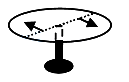 JEE Advanced 2014 Medium
 - One mole of an ideal gas undergoes two different cyclic processes and , as shown in the diagrams below. In cycle , processes and are isobaric, isothermal, isobaric and isochoric, respectively. In cycle , processes and are isothermal, isochoric, isobaric and isochoric, respectively. The total work done during cycle is and that during cycle is . The ratio is _____.
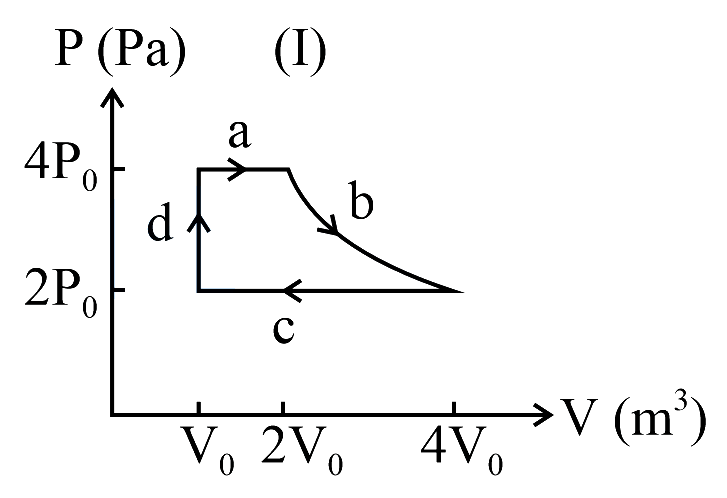
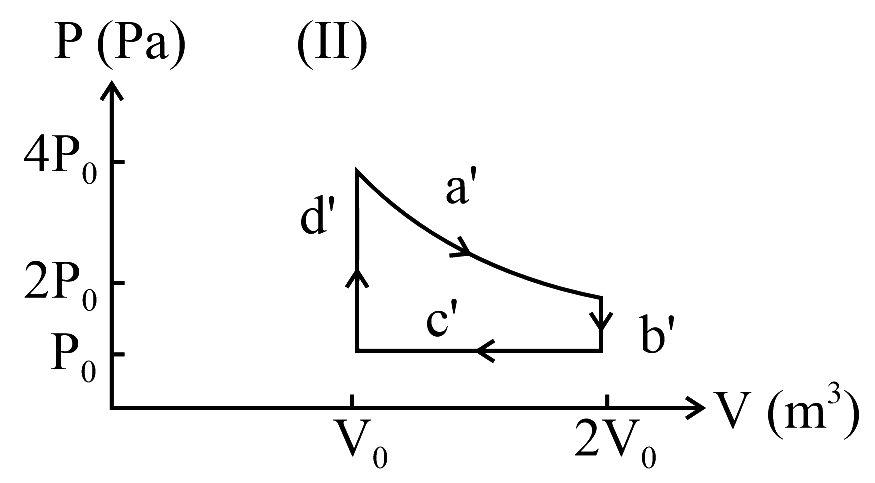 JEE Advanced 2023 Medium