


JEE Advanced · Physics · 15. Oscillations
A spring - block system is resting on a frictionless floor as shown in the figure. The spring constant is and the mass of the block is . Ignore the mass of the spring. Initially the spring is in an unstretched condition. Another block of mass 1.0kg moving with a speed of collides elastically with the first block. The collision is such that the 2.0kg block does not hit the wall. The distance, in metres, between the two blocks when the spring returns to its unstretched position for the first time after the collision is _________.
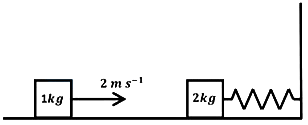
- A 0.55
- B 2.09
- C 1.25
- D 2.55
Answer & Solution
Correct Answer
(B) 2.09
Step-by-step Solution
Detailed explanation
Given here: and . Time period of spring is given as
Block returns to original position in
Block returns to original position in
See the Complete Solution
Get step-by-step explanations for this and 2.5 Lakh+ more JEE, NEET & CET questions.
- Unlock all solutions
- Practice the full chapter
- Track accuracy across PYQs
4.8 rated on Google Play · 14,000+ reviews
More questions from Physics
- Two large vertical and parallel metal plates having a separation of \(1 \mathrm{~cm}\) are connected to a DC voltage source of potential difference \(X\). A proton is released at rest midway between the two plates. It is found to move at \(45^{\circ}\) to the vertical JUST after release. Then \(X\) is nearlyJEE Advanced 2012 Medium
- A Hydrogen-like atom has atomic number . Photons emitted in the electronic transitions from level to level in these atoms are used to perform photoelectric effect experiment on a target metal. The maximum kinetic energy of the photoelectrons generated is . If the photoelectric threshold wavelength for the target metal is , the value of is _____.
[Given and , where is the Rydberg constant, is the Planck’s constant and is the speed of light in vacuum]JEE Advanced 2023 Medium - In a photoemission experiment, the maximum kinetic energies of photoelectrons from metals and are and , respectively, and they are related by . In this experiment, the same source of monochromatic light is used for metals and while a different source of monochromatic light is used for the metal . The work functions for metals and are and , respectively. The energy of the incident photon used for metal , in is ___.JEE Advanced 2021 Medium
- A spherical metal shell \(A\) of radius \(R_A\) and a solid metal sphere \(B\) of radius \(R_B < \left(R_A\right)\) are kept far apart and each is given charge \(+Q\). Now, they are connected by a thin metal wire. ThenJEE Advanced 2011 Hard
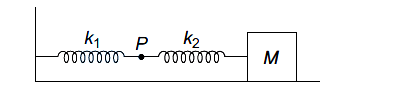
- The mass \(M\) shown in the figure oscillates in simple harmonic motion with amplitude \(A\). The amplitude of the point \(P\) is
 JEE Advanced 2009 Easy
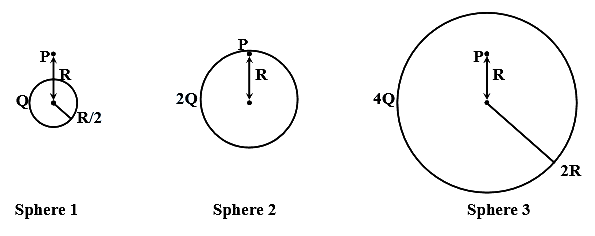
 - Charges Q, 2Q and 4Q are uniformly distributed in three dielectric solid spheres 1, 2 and 3 of radii R/2, R and 2R respectively, as shown in the figure. If magnitudes of the electric fields at point P at a distance R from the centre of spheres 1, 2 and 3 are and respectively, then
 JEE Advanced 2014 Easy
More PYQs from JEE Advanced
- Paragraph:
Modern trains are based on Maglev technology in which trains are magnetically leviated, which runs its EDS Maglev system.
There are coils on both sides of wheels. Due to motion of train, current induces in the coil of track which levitate it. This is in accordance with Lenz's law. If trains lower down then due to Lenz's law a repulsive force increases due to which train gets uplifted and if it goes much high then there is a net downward force disc to gravity. The advantage of Maglev train is that there is no friction between the train and the track, thereby reducing power consumption and enabling the train to attain very high speeds.
Disadvantage of Maglev train is that as it slows down the electromagnetic forces decreases and it becomes difficult to keep it leviated and as it moves forward according to Lenz law, there is an electromagnetic drag force.
Question:
Which force causes the train to elevate up?JEE Advanced 2006 Easy - A rectangular sheet of fixed perimeter with sides having their lengths in the ratio is converted into an open rectangular box by folding after removing squares of equal area from all four corners. If the total area of removed squares is , the resulting box has maximum volume. Then the lengths of the sides of the rectangular sheet are:JEE Advanced 2013 Hard
- Paragraph:
Copper is the most noble of the first row transition metals and occurs in small deposits in several countries. Ores of copper include chalcanthite \(\left(\mathrm{CuSO}_4 \cdot 5 \mathrm{H}_2 \mathrm{O}\right)\), atacamite \(\left(\mathrm{Cu}_2 \mathrm{Cl}(\mathrm{OH})_3\right)\), cuprite \(\left(\mathrm{Cu}_2 \mathrm{O}\right)\), copper glance \(\left(\mathrm{Cu}_2 \mathrm{~S}\right)\) and malachite \(\left(\mathrm{Cu}_2(\mathrm{OH})_2 \mathrm{CO}_3\right)\). However, 80\% of the world copper production comes from the ore chalcopyrite \(\left(\mathrm{CuFeS}_2\right)\). The extraction of copper from chalcopyrite involves partial roasting, removal of iron and self-reduction.
Question:
Iron is removed from chalcopyrite asJEE Advanced 2010 Easy - An electron in an excited state of ion has angular momentum . The de Broglie wavelength of the electron in this state is (where is the Bohr radius). The value of isJEE Advanced 2015 Easy
- The synthesis of 3-octyne is achieved by adding a bromoalkane into a mixture of sodium amide and an alkyne. The bromoalkane and alkyne respectively areJEE Advanced 2010 Easy
- List-I shows various functional dependencies of energy \((E)\) on the atomic number \((Z)\). Energies associated with certain phenomena are given in List-II. Choose the option that describes the correct match between the entries in List-I to those in List-II.
List - I List - II (P) \(E\text { propto } Z^2\) (1) energy of characteristic x-rays (Q) \(E\text { propto } (Z-1)^2\) (2) electrostatic part of the nuclear binding energy for stable nuclei with mass numbers in the range 30 to 170 (R) \(E \text { propto } Z(Z-1)\) (3) energy of continuous x-rays (S) E is practically independent of Z (4) average nuclear binding energy per nucleon for stable nuclei with mass number in the range 30 to 170 (5) energy of radiation due to electronic transitions from hydrogen-like atoms JEE Advanced 2025 Hard