


JEE Advanced · Physics · 15. Oscillations
A point mass is subjected to two simultaneous sinusoidal displacements in \(x\)-direction, \(x_1(t)=A \sin \omega t\) and \(x_2(t)=A \sin \left(\omega t+\frac{2 \pi}{3}\right)\). Adding a third sinusoidal displacement \(x_3(t)=B \sin (\omega t+\phi)\) bring the mass to a complete rest. The values of \(B\) and \(\phi\) are
- A \(\sqrt{2 A}, \frac{3 \pi}{4}\)
- B \(A, \frac{4 \pi}{3}\)
- C \(\sqrt{3} A, \frac{5 \pi}{6}\)
- D \(A, \frac{\pi}{3}\)
Answer & Solution
Correct Answer
(B) \(A, \frac{4 \pi}{3}\)
Step-by-step Solution
Detailed explanation
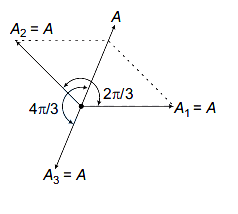
Resultant amplitude of \(x_1\) and \(x_2\) is \(A\) at angle \(\left(\frac{\pi}{3}\right)\) from \(A_1\). To make resultant of \(x_1, x_2\) and \(x_3\) to be zero. \(A_3\) should be equal to \(A\) at angle \(\phi=\frac{4 \pi}{3}\) as shown in figure.
\(\therefore\) Correct answer is (b).
Alternate Solution
If we substitute,
\(
x_1+x_2+x_3=0
\)
or \(A \sin \omega t+A \sin \left(\omega t+\frac{2 \pi}{3}\right)\)
\(
+B \sin (\omega t+\phi)=0
\)
Then, by applying simple mathematics, we can prove that
\(B =A\)
\(\text {and } \phi =\frac{4 \pi}{3}\)
Analysis of Question
(i) Question is simple.
(ii) Question can be solved by applying mathematics also.
(iii) Amplitudes of two or more sine or cosine functions of same frequency \(\omega\) can be added by vector method.
See the Complete Solution
Get step-by-step explanations for this and 2.5 Lakh+ more JEE, NEET & CET questions.
- Unlock all solutions
- Practice the full chapter
- Track accuracy across PYQs
4.8 rated on Google Play · 14,000+ reviews
More questions from Physics
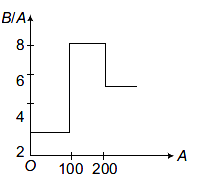
- Assume that the nuclear binding energy per nucleon \((B / A)\) versus mass number \((A)\) is as shown in the figure. Use this plot to choose the correct choice (s) given below.
 JEE Advanced 2008 Medium
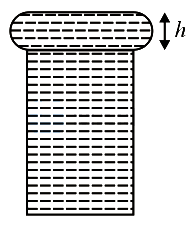
 - When water is filled carefully in a glass, one can fill it to a height above the rim of the glass due to the surface tension of water. To calculate just before water starts flowing, model the shape of the water above the rim as a disc of thickness having semicircular edges, as shown schematically in the figure. When the pressure of water at the bottom of this disc exceeds what can be withstood due to the surface tension, the water surface breaks near the rim and water starts flowing from there. If the density of water, its surface tension and the acceleration due to gravity are and respectively, the value of (in )is ________.
 JEE Advanced 2020 Hard
 - A temperature difference can generate e.m.f. in some materials. Let \(S\) be the e.m.f. produced per unit temperature difference between the ends of a wire, \(\sigma\) the electrical conductivity and \(\kappa\) the thermal conductivity of the material of the wire. Taking \(M, L, T, I\) and \(K\) as dimensions of mass, length, time, current and temperature, respectively, the dimensional formula of the quantity \(Z=\frac{S^2 \sigma}{\kappa}\) is :-JEE Advanced 2025 Easy
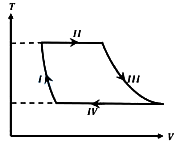
- One mole of a monatomic ideal gas undergoes a cyclic process as shown in the figure (where V is the volume and T is the temperature). Which of the statements below is (are) true?
 JEE Advanced 2018 Medium
 - At time , a disk of radius starts to roll without slipping on a horizontal plane with an angular acceleration of . A small stone is stuck to the disk. At , it is at the contact point of the disk and the plane. Later, at time , the stone detaches itself and flies off tangentially from the disk. The maximum height (in ) reached by the stone measured from the plane is . The value of is [Take .] If the numerical value has more than two decimal places, truncate/round-off the value to TWO decimal places.JEE Advanced 2022 Hard
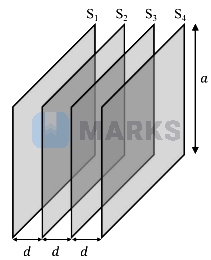
- Four identical thin, square metal sheets, \(S_1, S_2, S_3\) and \(S_4\), each of side \(a\) are kept parallel to each other with equal distance \(d(\ll a)\) between them, as shown in the figure. Let \(C_0=\varepsilon_0 a^2 / d\), where \(\varepsilon_0\) is the permittivity of free space.
Match the quantities mentioned in List-I with their values in List-II and choose the correct option.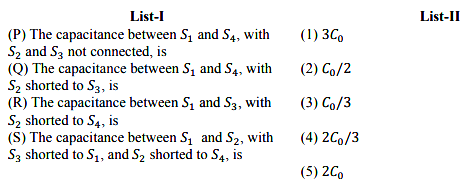 JEE Advanced 2024 Medium
More PYQs from JEE Advanced
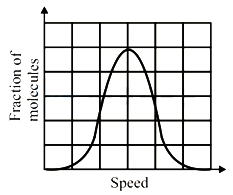
- If the distribution of molecular speeds of a gas is as per the figure shown below, then the ratio of the most probable, the average, and the root mean square speeds, respectively, is
 JEE Advanced 2020 Easy
 - The total number of cyclic structural as well as stereoisomers possible for a compound with the molecular formula \(=\mathrm{C}_5 \mathrm{H}_{10}\) isJEE Advanced 2009 Medium
- A solid sphere of mass and radius rolls without slipping on a fixed inclined plane with an angle of inclination from the horizontal. Two forces of magnitude each, parallel to the incline, act on the sphere, both at distance from the center of the sphere, as shown in the figure. The acceleration of the sphere down the plane is . (Take )
If the numerical value has more than two decimal places, truncate/round-off the value to TWO decimal places.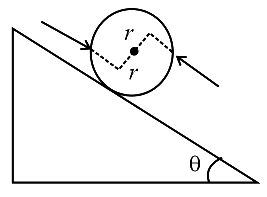 JEE Advanced 2022 Medium
 - List-I shows various functional dependencies of energy \((E)\) on the atomic number \((Z)\). Energies associated with certain phenomena are given in List-II. Choose the option that describes the correct match between the entries in List-I to those in List-II.
List - I List - II (P) \(E\text { propto } Z^2\) (1) energy of characteristic x-rays (Q) \(E\text { propto } (Z-1)^2\) (2) electrostatic part of the nuclear binding energy for stable nuclei with mass numbers in the range 30 to 170 (R) \(E \text { propto } Z(Z-1)\) (3) energy of continuous x-rays (S) E is practically independent of Z (4) average nuclear binding energy per nucleon for stable nuclei with mass number in the range 30 to 170 (5) energy of radiation due to electronic transitions from hydrogen-like atoms JEE Advanced 2025 Hard - The major products obtained from the reactions in List-II are the reactants for the named reactions mentioned in List-I. Match each entry in List-I with the appropriate entry in List-II and choose the correct options.
List - I List - II (P) Stephen reaction (1) 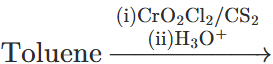
(Q) Sandmeyer reaction (2) 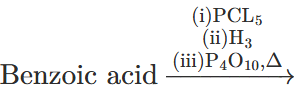
(R) Hoffmann bromamide degradation reaction (3) 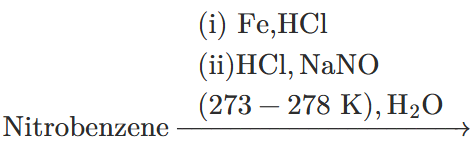
(S) Cannizzaro reaction (4) 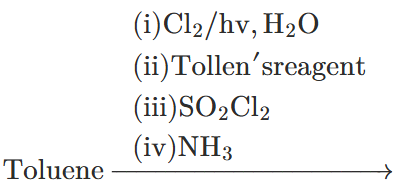
(5) 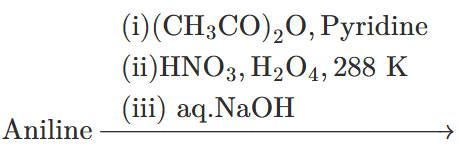 JEE Advanced 2025 Hard
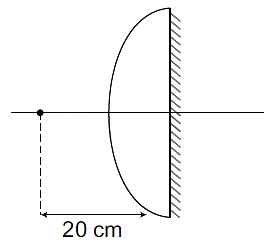
 - A point object is placed at distance of \(20 \mathrm{~cm}\) from a thin planoconvex lens of focal length \(15 \mathrm{~cm}\). The plane surface of the lens is now silvered. The image created by the system is at
 JEE Advanced 2006 Medium