


JEE Advanced · Physics · 5. Laws of Motion
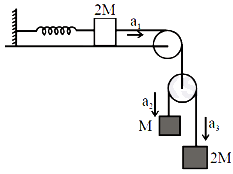
A block of mass is attached to a massless spring with spring-constant This block is connected to two other blocks of masses and using two massless pulleys and strings. The accelerations of the blocks are and as shown in figure. The system is released from rest with the spring in its unstretched state. The maximum extension of the spring is Which of the following option(s) is/are correct?
[ is the acceleration due to gravity. Neglect friction]
- A
- B When spring achieves an extension of for the first time, the speed of the block connected to the spring is
- C
- D At an extension of of the spring, the magnitude of acceleration of the block connected to the spring is
Answer & Solution
Correct Answer
(C)
Step-by-step Solution
Detailed explanation
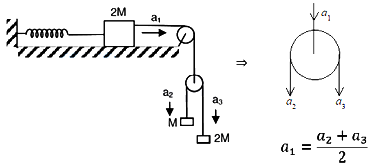
Using string constraint
is correct.
for other options use equivalent
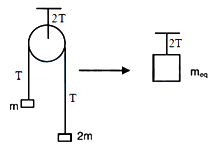
Equivalent mass
Or Reduced mass
(for a two-mass system)
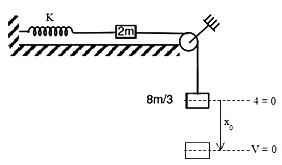
Using mechanical energy conservation
is incorrect
Option (B) \(\Rightarrow V_{\frac{x_0}{2}}=V_{\max }=\frac{x_0}{2} \omega=\frac{x_0}{2} \sqrt{\frac{k}{2 m+\frac{8 m}{3}}}=\) \(\frac{x_0}{2} \sqrt{\frac{3 k}{14 m}}=g \sqrt{\frac{32}{21 k}}\)
Option (D) \(\Rightarrow a_{\frac{x_0}{4}}=\frac{x_0}{4} \omega^2=\frac{x_0}{4} \frac{3 k}{14 m}=\frac{3 k x_0}{42 m}=\frac{8 g}{21}\)
For a simple harmonic motion maximum displacement from extreme to extreme
and
and
See the Complete Solution
Get step-by-step explanations for this and 2.5 Lakh+ more JEE, NEET & CET questions.
- Unlock all solutions
- Practice the full chapter
- Track accuracy across PYQs
4.8 rated on Google Play · 14,000+ reviews
More questions from Physics
- The general motion of a rigid body can be considered to be a combination of (i) a motion of its centre of mass about an axis, and (ii) its motion about an instantaneous axis passing through the centre of mass.
These axes need not be stationary. Consider, for example, a thin uniform disc welded (rigidly fixed) horizontally at its rim to a massless, stick, as shown in the figure. When the disc-stick system is rotated about the origin on a horizontal frictionless plane with angular speed \(\omega\), the motion at any instant can be taken as a combination of (i) a rotation of the centre of mass of the disc about the \(z\)-axis and (ii) a rotation of the disc through an instantaneous vertical axis passing through its centre of mass (as is seen from the changed orientation of points \(P\) and \(Q\) ). Both these motions have the same angular speed \(\omega\) in this case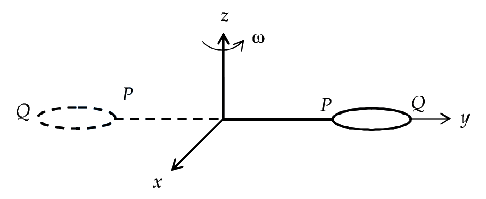
Now consider two similar systems as shown in the figure: Case
(a) the disc with its face vertical and parallel to \(x-z\) plane; Case
(b) the disc with its face making an angle of
\(45^{\circ}\) with \(x-y\) plane and its horizontal diameter parallel to \(x\)-axis. In both the cascs, the disc is welded at point \(\mathrm{P}\), and the systems are rotated with constant angular speed \(\omega\) about the \(z\) axis.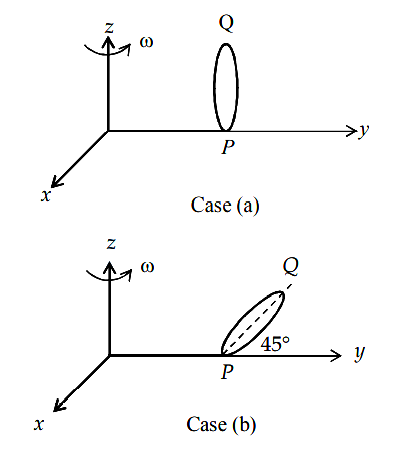
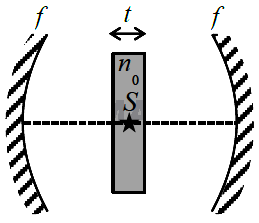
Question : Which of the following statements about the instantaneous axis (passing through the centre of mass) is correct?JEE Advanced 2012 Medium - Two identical concave mirrors each of focal length \(f\) are facing each other as shown in the schematic diagram. The focal length \(f\) is much larger than the size of the mirrors. A glass slab of thickness \(t\) and refractive index \(n_0\) is kept equidistant from the mirrors and perpendicular to their common principal axis. A monochromatic point light source \(S\) is embedded at the center of the slab on the principal axis, as shown in the schematic diagram. For the image to be formed on \(S\) itself, which of the following distances between the two mirrors is/are correct:
 JEE Advanced 2025 Hard
 - A student performs an experiment for determination of \(g\left(=\frac{4 \pi^2 l}{T^2}\right), l \approx 1 \mathrm{~m}\), and he commits an error of \(\Delta l\). For \(T\) he takes the time of \(n\) oscillations with the stop watch of least count \(\Delta T\) and he commits a human error of \(0.1 \mathrm{~s}\). For which of the following data, the measurement of \(g\) will be most accurate?JEE Advanced 2006 Easy
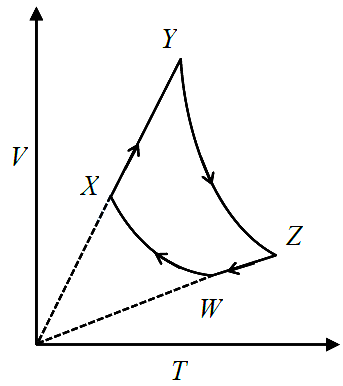
- An ideal monatomic gas of n moles is taken through a cycle \(W X Y Z W\) consisting of consecutive adiabatic and isobaric quasi-static processes, as shown in the schematic \(V-T\) diagram. The volume of the gas at \(W, X\) and \(Y\) points are, \(64 \mathrm{~cm}^3, 125 \mathrm{~cm}^3\) and \(250 \mathrm{~cm}^3\), respectively. If the absolute temperature of the gas \(T_W\) at the point \(W\) is such that \(n R T_W=1 \mathrm{~J}\) ( R is the universal gas constant), then the amount of heat absorbed (in J ) by the gas along the path \(X Y\) is \(\qquad\)
 JEE Advanced 2025 Hard
 - A ball is projected from the ground at an angle of with the horizontal surface. It reaches a maximum height of and returns to the ground. Upon hitting the ground for the first time, it loses half of its kinetic energy. Immediately after the bounce, the velocity of the ball makes an angle of with the horizontal surface. The maximum height it reaches after the bounce (in meters) is _____________.JEE Advanced 2018 Medium
- Two soap bubbles \(A\) and \(B\) are kept in a closed chamber where the air is maintained at pressure \(8 \mathrm{Nm}^{-2}\). The radii of bubbles \(A\) and \(B\) are \(2 \mathrm{~cm}\), respectively. Surface tension of the soap-water used to make bubbles is \(0.04\) \(\mathrm{Nm}^{-1}\). Find the ratio \(\frac{n_B}{n_A}\), where \(n_A\) and \(n_B\) are the number of moles of air in bubbles \(A\) and \(B\), respectively. [Neglect the effect of gravity]JEE Advanced 2009 Hard
More PYQs from JEE Advanced
- Among the following, the number of elements showing only one non-zero oxidation state is O, Cl, F, N, P, Sn, Tl, \(\mathrm{Na}, \mathrm{Ti}\)JEE Advanced 2010 Easy
- A rectangular sheet of fixed perimeter with sides having their lengths in the ratio is converted into an open rectangular box by folding after removing squares of equal area from all four corners. If the total area of removed squares is , the resulting box has maximum volume. Then the lengths of the sides of the rectangular sheet are:JEE Advanced 2013 Hard
- A charged particle is introduced at the origin with a given initial velocity . A uniform electric field and a uniform magnetic field exist everywhere. The velocity , electric field and a uniform magnetic field are given in the columns below
In which case will the particle move in a straight line with a constant velocity?Column 1 Column 2 Column 3 1. Electron with (i) (P) 2. Electron with (ii) (Q) 3.Proton with =0 (iii) (R) 4. Proton with (iv) (S) JEE Advanced 2017 Easy - In the following reaction sequence, the major product \(\mathbf{P}\) is formed.
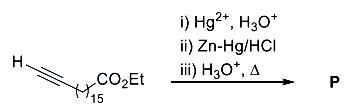
Glycerol reacts completely with excess \(\mathbf{P}\) in the presence of an acid catalyst to form \(\mathbf{Q}\). Reaction of \(\mathbf{Q}\) with excess \(\mathrm{NaOH}\) followed by the treatment with \(\mathrm{CaCl}_2\) yields Ca-soap \(\mathbf{R}\), quantitatively. Starting with one mole of \(\mathbf{Q}\), the amount of \(\mathbf{R}\) produced in gram is ________.
[Given, atomic weight: \(\mathrm{H}=1, \mathrm{C}=12,\) \(\mathrm{~N}=14, \mathrm{O}=16, \mathrm{Na}=23, \mathrm{Cl}=35,\) \(\mathrm{Ca}=40\)]JEE Advanced 2024 Easy - The carbon-based reduction method is NOT used for the extraction ofJEE Advanced 2013 Easy
- The differential equation \(\frac{d y}{d x}=\frac{\sqrt{1-y^2}}{y}\) determines a family of circles withJEE Advanced 2007 Easy