


JEE Advanced · Physics · 1. Math in Physics
A student performs an experiment for determination of \(g\left(=\frac{4 \pi^2 l}{T^2}\right), l \approx 1 \mathrm{~m}\), and he commits an error of \(\Delta l\). For \(T\) he takes the time of \(n\) oscillations with the stop watch of least count \(\Delta T\) and he commits a human error of \(0.1 \mathrm{~s}\). For which of the following data, the measurement of \(g\) will be most accurate?
- A \(\Delta L=0.5, \Delta T=0.1, n=20\)
- B \(\Delta L=0.5, \Delta T=0.1, n=50\)
- C \(\Delta L=0.5, \Delta T=0.01, n=20\)
- D \(\Delta L=0.1, \Delta T=0.05, n=50\)
Answer & Solution
Correct Answer
(D) \(\Delta L=0.1, \Delta T=0.05, n=50\)
Step-by-step Solution
Detailed explanation
\(\frac{\Delta g}{g}=\frac{\Delta l}{l}+2 \frac{\Delta T}{n}\)
In option (d) error in \(\Delta g\) is minimum and number of observations made are maximum. Hence, in this case error in \(g\) will be minimum.
In option (d) error in \(\Delta g\) is minimum and number of observations made are maximum. Hence, in this case error in \(g\) will be minimum.
See the Complete Solution
Get step-by-step explanations for this and 2.5 Lakh+ more JEE, NEET & CET questions.
- Unlock all solutions
- Practice the full chapter
- Track accuracy across PYQs
4.8 rated on Google Play · 14,000+ reviews
More questions from Physics
- For a radioactive material, its activity and rate of change of its activity are defined as and , where is the number of nuclei at time . Two radioactive sources (mean life ) and (mean life ) have the same activity at . Their rates of change of activities at are and , respectively. If , then the value of isJEE Advanced 2015 Medium
- Paragraph:
The figure shows a surface \(X Y\) separating two transparent media, medium-1 and medium-2. The lines \(a b\) and \(c d\) represent wavefronts of a light wave travelling in medium-1 and incident on \(X Y\). The lines ef and \(g h\) represent wavefronts of the light wave in medium-2 after refraction.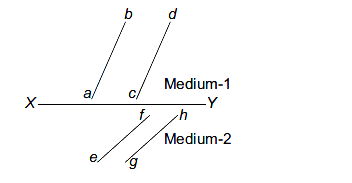
Question:
Light travels as aJEE Advanced 2007 Easy - A block of base \(10 \mathrm{~cm} \times 10 \mathrm{~cm}\) and height \(15 \mathrm{~cm}\) is kept on an inclined plane. The coefficient of friction between them is \(\sqrt{3}\). The inclination \(\theta\) of this inclined plane from the horizontal plane is gradually increased from \(0^{\circ}\). Then,JEE Advanced 2009 Medium
- Two spherical stars and emit blackbody radiation. The radius of is 400 times that of and emits times the power emitted from . The ratio of their wavelengths and at which the peaks occur in their respective radiation curves isJEE Advanced 2015 Easy
- A person sitting inside an elevator performs a weighing experiment with an object of mass 50 kg . Suppose that the variation of the height \(y\) (in m ) of the elevator, from the ground, with time \(t\) (in s ) is given by \(y=8\left[1+\sin \left(\frac{2 \pi t}{T}\right)\right]\), where \(T=40 \pi \mathrm{~s}\). Taking acceleration due to gravity, \(g=10 \mathrm{~m} / \mathrm{s}^2\), the maximum variation of the object's weight (in N ) as observed in the experiment is _______ .JEE Advanced 2025 Medium
- The diameter of a cylinder is measured using a vernier calipers with no zero error. It is found that the zero of the vernier scale lies between and of the main scale. The vernier scale has divisions equivalent to . The division of the vernier scale exactly coincides with one of the main scale divisions. The diameter of the cylinder is,JEE Advanced 2013 Easy
More PYQs from JEE Advanced
- The slope of the tangent to the curve at the point (1, 3) is ________.JEE Advanced 2014 Medium
- Paragraph:
The figure shows a surface \(X Y\) separating two transparent media, medium-1 and medium-2. The lines \(a b\) and \(c d\) represent wavefronts of a light wave travelling in medium-1 and incident on \(X Y\). The lines ef and \(g h\) represent wavefronts of the light wave in medium-2 after refraction.
Question:
Speed of light isJEE Advanced 2007 Easy - A plano-convex lens is made of a material of refractive index n. When a small object is placed 30 cm away in front of the curved surface of the lens, an image of double the size of the object is produced. Due to reflection from the convex surface of the lens, another faint image is observed at a distance of 10 cm away from the lens. Which of the following statement(s) is (are) true?JEE Advanced 2016 Hard
- If is a differentiable function such that for all and thenJEE Advanced 2017 Hard
- The correct order of acid strength of the following carboxylic acids is -
 JEE Advanced 2019 Medium
 - A charged shell of radius carries a total charge Given as the flux of electric field through a closed cylindrical surface of height radius and with its center same as that of the shell. Here, center of the cylinder is a point on the axis of the cylinder which is equidistant from its top and bottom surfaces. Which of the following option(s) is/are correct? [ is the permittivity of free space]JEE Advanced 2019 Medium