


JEE Advanced · Physics · 7. COM & Collisions
A thin ring of mass \(2 \mathrm{~kg}\) and radius \(0.5 \mathrm{~m}\) is rolling without slipping on a horizontal plane with velocity 1 \(\mathrm{m} / \mathrm{s}\). A small ball of mass \(0.1 \mathrm{~kg}\), moving with velocity \(20 \mathrm{~m} / \mathrm{s}\) in the opposite directions, hits the ring at a height of \(0.75 \mathrm{~m}\) and goes vertically up with velocity 10 \(\mathrm{m} / \mathrm{s}\). Immediately after the collision
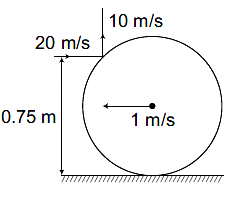
- A the ring has pure rotation about its stationary \(\mathrm{CM}\)
- B the ring comes to a complete stop
- C friction between the ring and the ground is to the left
- D there is no friction between the ring and the ground
Answer & Solution
Correct Answer
(C) friction between the ring and the ground is to the left
Step-by-step Solution
Detailed explanation
The data is incomplete. Let us assume that friction from ground on ring is not impulsive during impact.
From linear momentum conservation in horizontal direction, we have
\(
\begin{aligned}
& (-2 \times 1)+(0.1 \times 20) \\
& =(0.1 \times 0)+(2 \times v) \stackrel{\text {-ve }}{\leftarrow} \stackrel{+v e}{\rightarrow}
\end{aligned}
\)
Here, \(v\) is the velocity of \(\mathrm{CM}\) of ring after impact.
Solving the above equation, we have
\(
v=0
\)
Thus, CM becomes stationary.
\(\therefore\) Correct answer is (a).
Linear impulse during impact
(i) In horizontal direction \(J_1=\Delta P=0.1 \times 20=2 \mathrm{Ns}\)
(ii) In vertical direction
\(
J_2=\Delta P=0.1 \times 10=1 \mathrm{Ns}
\)
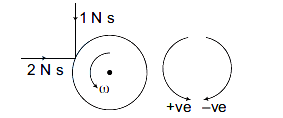
Writing the equation (about \(\mathrm{CM}\) )
Angular impulse
\(=\) Change in angular momentum
\(
\begin{aligned}
& 1 \times\left(\frac{\sqrt{3}}{2} \times \frac{1}{2}\right)-2 \times 0.5 \times \frac{1}{2} \\
& =2 \times(0.5)^2\left[\omega-\frac{1}{0.5}\right]
\end{aligned}
\)
Solving this equation \(\omega\) comes out to be positive or \(\omega\) anti-clockwise. So just after collision rightwards slipping is taking place.
Hence, friction is leftwards.
Therefore, option (c) is also correct.
\(\therefore\) Correct options are (a) and (c).
Note In JEE 2011 official answer key, correct option were given \(\mathrm{a}, \mathrm{ac}\).
Analysis of Question
(i) Question is moderately difficult.
(ii) In such type of problems impulse due to friction during collision is ignored.
From linear momentum conservation in horizontal direction, we have
\(
\begin{aligned}
& (-2 \times 1)+(0.1 \times 20) \\
& =(0.1 \times 0)+(2 \times v) \stackrel{\text {-ve }}{\leftarrow} \stackrel{+v e}{\rightarrow}
\end{aligned}
\)
Here, \(v\) is the velocity of \(\mathrm{CM}\) of ring after impact.
Solving the above equation, we have
\(
v=0
\)
Thus, CM becomes stationary.
\(\therefore\) Correct answer is (a).
Linear impulse during impact
(i) In horizontal direction \(J_1=\Delta P=0.1 \times 20=2 \mathrm{Ns}\)
(ii) In vertical direction
\(
J_2=\Delta P=0.1 \times 10=1 \mathrm{Ns}
\)
Writing the equation (about \(\mathrm{CM}\) )
Angular impulse
\(=\) Change in angular momentum
\(
\begin{aligned}
& 1 \times\left(\frac{\sqrt{3}}{2} \times \frac{1}{2}\right)-2 \times 0.5 \times \frac{1}{2} \\
& =2 \times(0.5)^2\left[\omega-\frac{1}{0.5}\right]
\end{aligned}
\)
Solving this equation \(\omega\) comes out to be positive or \(\omega\) anti-clockwise. So just after collision rightwards slipping is taking place.
Hence, friction is leftwards.
Therefore, option (c) is also correct.
\(\therefore\) Correct options are (a) and (c).
Note In JEE 2011 official answer key, correct option were given \(\mathrm{a}, \mathrm{ac}\).
Analysis of Question
(i) Question is moderately difficult.
(ii) In such type of problems impulse due to friction during collision is ignored.
See the Complete Solution
Get step-by-step explanations for this and 2.5 Lakh+ more JEE, NEET & CET questions.
- Unlock all solutions
- Practice the full chapter
- Track accuracy across PYQs
4.8 rated on Google Play · 14,000+ reviews
More questions from Physics
- Paragraph:
A point charge \(Q\) is moving in a circular orbit of radius \(R\) in the \(x-y\) plane with an angular velocity \(\omega .\) This can be considered as equivalent to a loop carrying a steady current \(\frac{Q \omega}{2 \pi}\). A uniform magnetic field along the positive \(z\)-axis is now switched on, which increases at a constant rate from 0 to \(B\) in one second. Assume that the radius of the orbit remains constant. The application of the magnetic field induces an emf in the orbit. The induced emf is defined as the work done by an induced electric field in moving a unit positive charge around a closed loop. It is known that, for an orbiting charge, the magnetic dipole moment is proportional to the angular momentum with a proportionality constant \(\gamma\).
Question:
The magnitude of the induced electric field in the orbit at any instant of time during the time interval of the magnetic field change isJEE Advanced 2013 Medium - A small mass \(m\) is attached to a massless string whose other end is fixed at \(P\) as shown in the figure. The mass is undergoing circular motion in the \(x-y\) plane with centre at \(O\) and constant angular speed \(\omega\). If the angular momentum of the system, calculated about \(O\) and \(P\) are denoted by \(\vec{L}_{O}\) and \(\vec{L}_{P}\) respectively, then
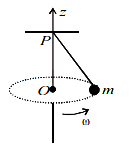 JEE Advanced 2012 Easy
 - An optical component and an object \(S\) placed along its optic axis are given in Column I. The distance between the object and the component can be varied. The properties of images are given in Column II. Match all the properties of images from Column II with the appropriate components given in Column I. Indicate your answer by darkening the appropriate bubble of the \(4 \times 4\) matrix given in the ORS.
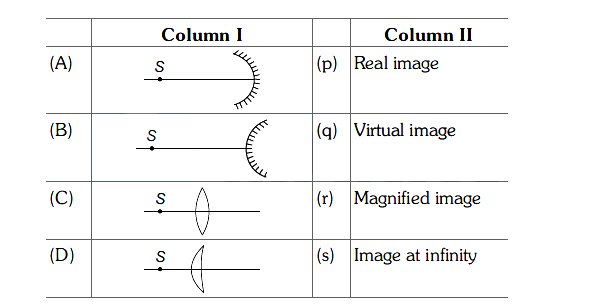 JEE Advanced 2008 Easy
 - A particle of mass is moving in one dimension under a force that delivers a constant power to the particle. If the initial speed of the particle is zero, the speed after isJEE Advanced 2013 Medium
- When light of a given wavelength is incident on a metallic surface, the minimum potential needed to stop the emitted photoelectrons is . This potential drops to if another source with wavelength four times that of the first one and intensity half of the first one is used. What are the wavelength of the first source and the work function of the metal, respectively? [Take .]JEE Advanced 2022 Easy
- A vibrating string of certain length \(l\) under a tension \(T\) resonates with a mode corresponding to the first overtone (third harmonic) of an air column of length \(75 \mathrm{~cm}\) inside a tube closed at one end. The string also generates 4 beat/s when excited along with a tuning fork of frequency \(n\). Now when the tension of the string is slightly increased the number of beats reduces to 2 per second. Assuming the velocity of sound in air to be \(340 \mathrm{~m} / \mathrm{s}\), the frequency \(n\) of the tuning fork (in \(\mathrm{Hz}\) ) isJEE Advanced 2008 Medium
More PYQs from JEE Advanced
- For any positive integer , let be defined by
where for any and . Then which of the following statements is (are) TRUE ?JEE Advanced 2021 Medium - Let denote the parabola Let , and let and be two distinct points on such that the lines and are tangents to . Let be the focus of . Then which of the following statements is (are) TRUE?JEE Advanced 2021 Medium
- Among the following, the correct statement(s) for electrons in an atom is(are)JEE Advanced 2024 Easy
- A straight line \(L\) through the point \((3,-2)\) is inclined at an angle \(60^{\circ}\) to the line \(\sqrt{3} x+y=1\). If \(L\) also intersects the \(X\)-axis, then the equation of \(L\) isJEE Advanced 2011 Easy
- Two spherical planets \(P\) and \(Q\) have the same uniform density \(\rho\), masses \(M_{P}\) and \(M_{Q}\) and surface areas \(A\) and 4A respectively. A spherical planet \(R\) also has uniform density \(\rho\) and its mass is \(\left(M_{P}+M_{Q}\right)\). The escape velocities from the planets \(P, Q\) and \(R\) are \(V_{P}, V_{Q}\) and \(V_{R}\), respectively. ThenJEE Advanced 2012 Medium
- Let , be the matrix such that if is divisible by , otherwise . Then which of the following statements is(are) true?JEE Advanced 2023 Easy