


JEE Advanced · Mathematics · 30. Vector Algebra
The vector(s) which is/are coplanar with vectors \(\hat{\mathbf{i}}+\hat{\mathbf{j}}+2 \hat{\mathbf{k}}\) and \(\hat{\mathbf{i}}+2 \hat{\mathbf{j}}+\hat{\mathbf{k}}\), are perpendicular to the vector \(\hat{\mathbf{i}}+\hat{\mathbf{j}}+\hat{\mathbf{k}}\) is/are
- A
\(\hat{\mathbf{j}}-\hat{\mathbf{k}}\)
- B
\(-\hat{\mathbf{i}}+\hat{\mathbf{j}}\)
- C
\(\hat{\mathbf{i}}-\hat{\mathbf{j}}\)
- D
\(-\hat{\mathbf{j}}+\hat{\mathbf{k}}\)
Answer & Solution
Correct Answer
(D)
\(-\hat{\mathbf{j}}+\hat{\mathbf{k}}\)
Step-by-step Solution
Detailed explanation
Let \(\mathbf{a}=\hat{\mathbf{i}}+\hat{\mathbf{j}}+2 \hat{\mathbf{k}}, \mathbf{b}=\hat{\mathbf{i}}+2 \hat{\mathbf{j}}+\hat{\mathbf{k}}\) and \(\mathbf{c}=\hat{\mathbf{i}}+\hat{\mathbf{j}}+\hat{\mathbf{k}}\)
\(\therefore\) A vector coplanar to \(\mathbf{a}\) and \(\mathbf{b}\), and perpendicular to \(\mathbf{c}\).
Now, \(\quad \lambda(\mathbf{a} \times \mathbf{b}) \times \mathbf{c}\)
\(\Rightarrow \quad \lambda\{(\mathbf{a} \cdot \mathbf{c}) \mathbf{b}-(\mathbf{b} \cdot \mathbf{c}) \mathbf{a}\}\)
\(\Rightarrow \quad \lambda\{(1+1+4)(\hat{\mathbf{i}}+2 \hat{\mathbf{j}}+\hat{\mathbf{k}})\)
\(-(1+2+1)(\hat{\mathbf{i}}+\hat{\mathbf{j}}+2 \hat{\mathbf{k}})\}\)
\(\Rightarrow \lambda\{6 \hat{\mathbf{i}}+12 \hat{\mathbf{j}}+6 \hat{\mathbf{k}}-6 \hat{\mathbf{i}}-6 \hat{\mathbf{j}}-12 \hat{\mathbf{k}}\}\)
\(\Rightarrow \lambda\{6 \hat{\mathbf{j}}-6 \hat{\mathbf{k}}\} \Rightarrow 6 \lambda(\hat{\mathbf{j}}-\hat{\mathbf{k}})\)
For \(\lambda=\frac{1}{6} \Rightarrow\) Option (a) is correct.
For \(\lambda=-\frac{1}{6} \Rightarrow\) Option (d) is correct.
\(\therefore\) A vector coplanar to \(\mathbf{a}\) and \(\mathbf{b}\), and perpendicular to \(\mathbf{c}\).
Now, \(\quad \lambda(\mathbf{a} \times \mathbf{b}) \times \mathbf{c}\)
\(\Rightarrow \quad \lambda\{(\mathbf{a} \cdot \mathbf{c}) \mathbf{b}-(\mathbf{b} \cdot \mathbf{c}) \mathbf{a}\}\)
\(\Rightarrow \quad \lambda\{(1+1+4)(\hat{\mathbf{i}}+2 \hat{\mathbf{j}}+\hat{\mathbf{k}})\)
\(-(1+2+1)(\hat{\mathbf{i}}+\hat{\mathbf{j}}+2 \hat{\mathbf{k}})\}\)
\(\Rightarrow \lambda\{6 \hat{\mathbf{i}}+12 \hat{\mathbf{j}}+6 \hat{\mathbf{k}}-6 \hat{\mathbf{i}}-6 \hat{\mathbf{j}}-12 \hat{\mathbf{k}}\}\)
\(\Rightarrow \lambda\{6 \hat{\mathbf{j}}-6 \hat{\mathbf{k}}\} \Rightarrow 6 \lambda(\hat{\mathbf{j}}-\hat{\mathbf{k}})\)
For \(\lambda=\frac{1}{6} \Rightarrow\) Option (a) is correct.
For \(\lambda=-\frac{1}{6} \Rightarrow\) Option (d) is correct.
See the Complete Solution
Get step-by-step explanations for this and 2.5 Lakh+ more JEE, NEET & CET questions.
- Unlock all solutions
- Practice the full chapter
- Track accuracy across PYQs
4.8 rated on Google Play · 14,000+ reviews
More questions from Mathematics
- Which of the following values of satisfy the equation ?JEE Advanced 2015 Medium
- For any complex number , let , where . Let and be real numbers such that for all complex numbers satisfying , the ordered pair lies on the circle
Then which of the following statements is(are) TRUE?JEE Advanced 2021 Hard - If is a differentiable function such that for all and thenJEE Advanced 2017 Hard
- In a non-right-angled triangle let denote the lengths of the sides opposite to the angles at respectively. The median from meets the side at the perpendicular from meets the side at , and and intersect at If and the radius of the circumcircle of the equals then which of the following options is/are correct?JEE Advanced 2019 Hard
- A particle \(P\) starts from the point \(z_0=1+2 i\), where \(i=\sqrt{-1}\). It moves first horizontally away from origin by 5 units and then vertically away from origin by 3 units to reach a point \(z_1\). From \(z_1\) the particle moves \(\sqrt{2}\) units in the direction of the vector \(\hat{\mathbf{i}}+\hat{\mathbf{j}}\) and then it moves through an angle \(\frac{\pi}{2}\) in anti-clockwise direction on a circle with centre at origin, to reach a point \(z_2\). The point \(z_2\) is given byJEE Advanced 2008 Medium
- For (the set of all real numbers), , Then a =JEE Advanced 2013 Hard
More PYQs from JEE Advanced
- Paragraph:
Read the following passage and answer the questions.
For every function \(f(x)\) which is twice differentiable, these will be good approximation of \(\int_a^b f(x) d x \cong\left(\frac{b-a}{2}\right)\{f(a)+f(b)\}\). Now, if we take \(c=\frac{a+b}{2}\), then using above again, we get \(\int_a^b f(x) d x=\int_a^c f(x) d x+\int_c^b f(x) d x \cong \frac{b-a}{4}\{f(a)+f(b)+2 f(c)\}\) and so on.
We get approximation for value of \(\int_a^b f(x) d x\).Question:
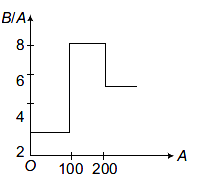
If \(\lim _{t \rightarrow a} \frac{\int_a^t f(x) d x-\frac{(t-a)}{2}\{f(t)+f(a)\}}{(t-a)^3}=0\), then degree of polynomial function \(f(x)\) at most isJEE Advanced 2006 Hard - Assume that the nuclear binding energy per nucleon \((B / A)\) versus mass number \((A)\) is as shown in the figure. Use this plot to choose the correct choice (s) given below.
 JEE Advanced 2008 Medium
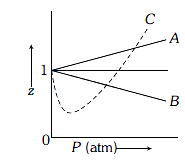
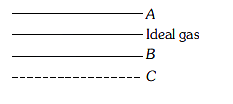
 - The given graph represent the variations of compressibility factor \((Z)=\frac{P V}{n R T}\) versus \(P\), for three real gases \(A, B\) and \(C\). Identify the only incorrect statement
 JEE Advanced 2006 Medium
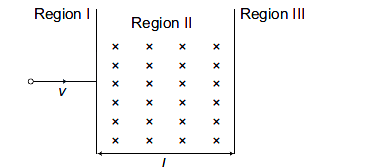
 - A particle of mass \(m\) and charge \(q\), moving with velocity \(v\) enters Region II normal to the boundary as shown in the figure. Region II has a uniform magnetic field \(B\) perpendicular to the plane of the paper. The length of the Region II is \(l\). Choose the correct choice(s)
 JEE Advanced 2008 Hard
 - Paragraph:
Let \(a\), b and \(c\) be three real numbers satisfying \(\left[\begin{array}{lll}a & b & c\end{array}\right]\left[\begin{array}{lll}1 & 9 & 7 \\ 8 & 2 & 7 \\ 7 & 3 & 7\end{array}\right]=\left[\begin{array}{lll}0 & 0 & 0\end{array}\right]\)Question:
Let \(b=6\), with \(a\) and \(c\) satisfying Eq. (E). If \(\alpha\) and \(\beta\) are the roots of the quadratic equation \(a x^2+b x+c=0\), then \(\sum_{n=0}^{\infty}\left(\frac{1}{\alpha}+\frac{1}{\beta}\right)^n\) isJEE Advanced 2011 Easy - Consider the following frequency distribution :
Value 4 5 8 9 6 12 11 Frequency 5 \(f_1\) \(f_2\) 2 1 1 3
Suppose that the sum of the frequencies is 19 and the median of this frequency distribution is 6. For the given frequency distribution, let \(\alpha\) denote the mean deviation about the mean, \(\beta\) denote the mean deviation about the median, and \(\sigma^2\) denote the variance.
Match each entry in List-I to the correct entry in List-II and choose the correct option.
\(\begin{array}{|l|l|l|l|} \hline & \text{LIST - I} & & \text{LIST - II} \\ \hline (P) & 7 f_1+9 f_2 \text{ is equal to} & (1) & 146 \\ \hline (Q) & 19 \alpha \text{ is equal to} & (2) & 47 \\ \hline (R) & 19 \beta \text{ is equal to} & (3) & 48 \\ \hline (S) & 19 \sigma^2 \text{ is equal to} & (4) & 145 \\ \hline & & (5) & 55 \\ \hline \end{array}\)JEE Advanced 2025 Easy