


JEE Advanced · Mathematics · 20. Statistics
Consider the following frequency distribution :
| Value | 4 | 5 | 8 | 9 | 6 | 12 | 11 |
|---|---|---|---|---|---|---|---|
| Frequency | 5 | \(f_1\) | \(f_2\) | 2 | 1 | 1 | 3 |
Suppose that the sum of the frequencies is 19 and the median of this frequency distribution is 6. For the given frequency distribution, let \(\alpha\) denote the mean deviation about the mean, \(\beta\) denote the mean deviation about the median, and \(\sigma^2\) denote the variance.
Match each entry in List-I to the correct entry in List-II and choose the correct option.
\(\begin{array}{|l|l|l|l|} \hline & \text{LIST - I} & & \text{LIST - II} \\ \hline (P) & 7 f_1+9 f_2 \text{ is equal to} & (1) & 146 \\ \hline (Q) & 19 \alpha \text{ is equal to} & (2) & 47 \\ \hline (R) & 19 \beta \text{ is equal to} & (3) & 48 \\ \hline (S) & 19 \sigma^2 \text{ is equal to} & (4) & 145 \\ \hline & & (5) & 55 \\ \hline \end{array}\)
- A \((\mathrm{P}) \rightarrow(5),(\mathrm{Q}) \rightarrow(3),(\mathrm{R}) \rightarrow(2),(\mathrm{S}) \rightarrow(4)\)
- B \((\mathrm{P}) \rightarrow(5),(\mathrm{Q}) \rightarrow(2),(\mathrm{R}) \rightarrow(3),(\mathrm{S}) \rightarrow(1)\)
- C \((\mathrm{P}) \rightarrow(5),(\mathrm{Q}) \rightarrow(3),(\mathrm{R}) \rightarrow(2),(\mathrm{S}) \rightarrow(1)\)
- D \((\mathrm{P}) \rightarrow(3),(\mathrm{Q}) \rightarrow(2),(\mathrm{R}) \rightarrow(5),(\mathrm{S}) \rightarrow(4)\)
Answer & Solution
Correct Answer
(C) \((\mathrm{P}) \rightarrow(5),(\mathrm{Q}) \rightarrow(3),(\mathrm{R}) \rightarrow(2),(\mathrm{S}) \rightarrow(1)\)
Step-by-step Solution
Detailed explanation
\(\begin{array}{|c|c|c|c|c|c|c|} \hline X_i & f_{\mathrm{i}} & \begin{array}{l} \bar{x}=7 \\ d_i = \left|x_i-\bar{x}\right| \end{array} & \begin{array}{l} \mathrm{M}=6 \\ \mathrm{ei} = |\mathrm{xi}-\mathrm{M}| \end{array} & \sum f_{\mathrm{i}} \mathrm{d}_{\mathrm{i}} & \sum f_{\mathrm{i}} \mathrm{e}_{\mathrm{i}} & \Sigma f_{\mathrm{i}} \mathrm{d}_{\mathrm{i}}^2 \\ \hline 4 & 5 & 3 & 2 & 15 & 10 & 45 \\ \hline 5 & 4 & 2 & 1 & 8 & 4 & 16 \\ \hline 6 & 1 & 1 & 0 & 1 & 0 & 1 \\ \hline 8 & 3 & 1 & 2 & 3 & 6 & 3 \\ \hline 9 & 2 & 2 & 3 & 4 & 6 & 8 \\ \hline 11 & 3 & 4 & 5 & 12 & 15 & 48 \\ \hline 12 & 1 & 5 & 6 & 5 & 6 & 25 \\ \hline & & & & 48 & 47 & 146 \\ \hline \end{array}\)
\(\begin{aligned} & f_1=4 \\ & f_2=3 \\ & \alpha=\frac{48}{19}, \beta=\frac{47}{19}, \sigma^2=\frac{146}{19}\end{aligned}\)
\(\begin{aligned} & f_1=4 \\ & f_2=3 \\ & \alpha=\frac{48}{19}, \beta=\frac{47}{19}, \sigma^2=\frac{146}{19}\end{aligned}\)
See the Complete Solution
Get step-by-step explanations for this and 2.5 Lakh+ more JEE, NEET & CET questions.
- Unlock all solutions
- Practice the full chapter
- Track accuracy across PYQs
4.8 rated on Google Play · 14,000+ reviews
More questions from Mathematics
- Let for all be a continuous function. For if is the area of the region bounded by then isJEE Advanced 2015 Medium
- Let \(\alpha=\frac{1}{\sin 60^{\circ} \sin 61^{\circ}}+\frac{1}{\sin 62^{\circ} \sin 63^{\circ}}+\ldots+\) \(\frac{1}{\sin 118^{\circ} \sin 119^{\circ}}\)
Then the value of \(\left(\frac{\operatorname{cosec} 1^{\circ}}{\alpha}\right)^2\) is __________JEE Advanced 2025 Hard - Consider the square in the figure. Let be the points of intersections (dots in the picture) in some order. We say that and are friends if they are adjacent along a row or along a column. Assume that each point has an equal chance of being chosen.
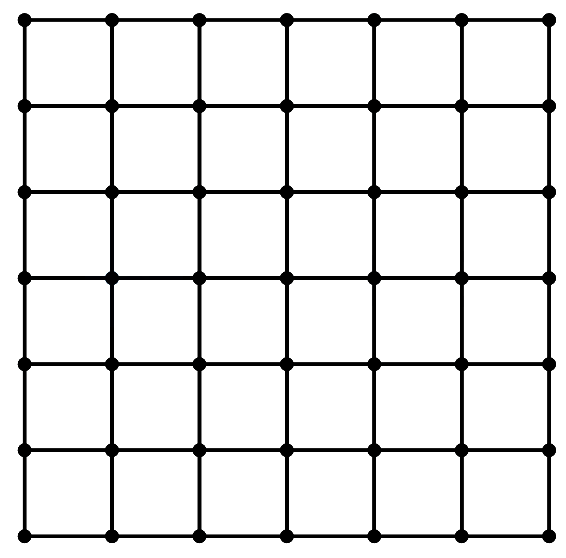
(There are two questions based on , the question given below is one of them)
Let be the probability that a randomly chosen point has many friends, . Let be a random variable such that for , the probability . Then the value of isJEE Advanced 2023 Hard - Consider the family of all circles whose centers lie on the straight line If this family of circles is represented by the differential equation where are functions of , then which of the following statements is (are) true ?JEE Advanced 2015 Easy
- Let \(\theta \in\left(0, \frac{\pi}{4}\right)\) and \(t_1=(\tan \theta)^{\tan \theta},\) \(t_2=(\tan \theta)^{\cot \theta}\) and \(t_4=(\cot \theta)^{\tan \theta}\), thenJEE Advanced 2006 Easy
- Let \(\mathbb{R}^2\) denote \(\mathbb{R} \times \mathbb{R}\). Let \(S=\left\{(a, b, c): a, b, c \in \mathbb{R} \text { and } a x^2+2 b x y+c y^2>0 \text { for all }(x, y) \in \mathbb{R}^2-\{(0,0)\}\right\} .\)
Then which of the following statements is (are) TRUE?JEE Advanced 2024 Easy
More PYQs from JEE Advanced
- Extraction of copper from copper pyrite involvesJEE Advanced 2016 Medium
- Paragraph :
A uniform thin cylindrical disk of mass \(M\) and radius \(R\) is attached to two identical massless springs of spring constant \(k\) which are fixed to the wall as shown in the figure. The springs are attached to the axle of the disk symmetrically on either side at a distance \(d\) from its centre. The axle is massless and both the springs and the axle are in a horizontal plane. The unstretched length of each spring is \(L\). The disk is initially at its equilibrium position with its centre of mass \((C M)\) at a distance Lfrom the wall. The disk rolls without slipping with velocity \(\mathbf{v}_0=v_0 \hat{\mathbf{i}}\) The coefficient of friction is \(\mu\).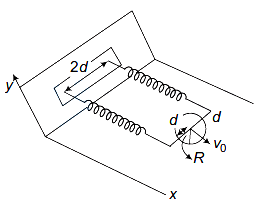
Question :
The net external force acting on the disk when its centre of mass is at displacement \(x\) with respect to its equilibrium position isJEE Advanced 2008 Medium - Let be a triangle. Let If and then which of the following is (are) true ?JEE Advanced 2015 Medium
- A small circular loop of area and resistance is fixed on a horizontal -plane with the center of the loop always on the axis of a long solenoid. The solenoid has turns per unit length and carries current counter clockwise as shown in the figure. The magnetic field due to the solenoid is in direction. List-I gives time dependences of in terms of a constant angular frequency . List-II gives the torques experienced by the circular loop at time , Let .
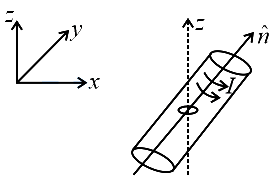
Which one of the following options is correct?List-I List-II (i) (p) (ii) (q) (iii) (r) (iv) (s) (t) JEE Advanced 2022 Hard - Adsorption of phenol from its aqueous solution on to fly ash obeys Freundlich isotherm. At a given temperature, from \(10 \mathrm{mg} \mathrm{g}^{-1}\) and \(16 \mathrm{mg} \mathrm{g}^{-1}\) aqueous phenol solutions, the concentrations of adsorbed phenol are measured to be \(4 \mathrm{mg} \mathrm{g}^{-1}\) and \(10 \mathrm{mg} \mathrm{g}^{-1}\), respectively. At this temperature, the concentration (in \(\mathrm{mg} \mathrm{g}^{-1}\) ) of adsorbed phenol from \(20 \mathrm{mg} \mathrm{g}^{-1}\) aqueous solution of phenol will be \(\qquad\) .
Use : \(\log _{10} 2=0.3\)JEE Advanced 2025 Hard - One mole of an ideal gas at in thermal contact with its surroundings expands isothermally from to against a constant pressure of . In this process, the change in entropy of the surroundings in is:JEE Advanced 2016 Medium