


JEE Advanced · Chemistry · 16. Solutions
Vessel-1 contains \(\mathbf{w}_2 \mathrm{~g}\) of a non-volatile solute \(\mathbf{X}\) dissolved in \(\mathbf{w}_1 \mathrm{~g}\) of water. Vessel- 2 contains \(\mathbf{w}_2 \mathrm{~g}\) of another non-volatile solute \(\mathbf{Y}\) dissolved in \(\mathbf{w}_1 \mathrm{~g}\) of water. Both the vessels are at the same temperature and pressure. The molar mass of \(\mathbf{X}\) is \(80 \%\) of that of \(\mathbf{Y}\). The van't Hoff factor for \(\mathbf{X}\) is 1.2 times of that of \(\mathbf{Y}\) for their respective concentrations.
The elevation of boiling point for solution in Vessel-1 is ________. \(\%\) of the solution in Vessel-2.
- A 100
- B 150
- C 200
- D 250
Answer & Solution
Correct Answer
(B) 150
Step-by-step Solution
Detailed explanation
Vessel-I
\(\left(\Delta \mathrm{T}_{\mathrm{b}}\right)_{\mathrm{I}}=\mathrm{i}_{\mathrm{x}} \frac{\mathrm{w}_2}{\mathrm{M}_{\mathrm{x}}} \cdot \frac{1}{\mathrm{w}_1} \times 1000 \times \mathrm{K}_{\mathrm{b}}\)
\(\mathrm{M}_{\mathrm{X}}=\) Molar mass of ' X '
Vessel-II
\(\left(\Delta \mathrm{T}_{\mathrm{b}}\right)_{\mathrm{II}}=\mathrm{i}_{\mathrm{Y}} \frac{\mathrm{w}_2}{\mathrm{M}_{\mathrm{Y}}} \cdot \frac{1}{\mathrm{w}_1} \times 1000 \times \mathrm{K}_{\mathrm{b}}\)
\(M_Y=\) Molar mass of ' \(Y\) '
\(\begin{aligned}
& \frac{\left(\Delta T_b\right)_{\mathrm{I}}}{\left(\Delta \mathrm{T}_{\mathrm{b}}\right)_{\mathrm{II}}} \times 100=\frac{\mathrm{i}_{\mathrm{x}}}{\mathrm{i}_{\mathrm{Y}}} \cdot \frac{\mathrm{M}_{\mathrm{Y}}}{\mathrm{M}_{\mathrm{x}}} \times 100 \\
& =1.2 \times \frac{100}{80} \times 100 \\
& =150 \%
\end{aligned}\)
\(\left(\Delta \mathrm{T}_{\mathrm{b}}\right)_{\mathrm{I}}=\mathrm{i}_{\mathrm{x}} \frac{\mathrm{w}_2}{\mathrm{M}_{\mathrm{x}}} \cdot \frac{1}{\mathrm{w}_1} \times 1000 \times \mathrm{K}_{\mathrm{b}}\)
\(\mathrm{M}_{\mathrm{X}}=\) Molar mass of ' X '
Vessel-II
\(\left(\Delta \mathrm{T}_{\mathrm{b}}\right)_{\mathrm{II}}=\mathrm{i}_{\mathrm{Y}} \frac{\mathrm{w}_2}{\mathrm{M}_{\mathrm{Y}}} \cdot \frac{1}{\mathrm{w}_1} \times 1000 \times \mathrm{K}_{\mathrm{b}}\)
\(M_Y=\) Molar mass of ' \(Y\) '
\(\begin{aligned}
& \frac{\left(\Delta T_b\right)_{\mathrm{I}}}{\left(\Delta \mathrm{T}_{\mathrm{b}}\right)_{\mathrm{II}}} \times 100=\frac{\mathrm{i}_{\mathrm{x}}}{\mathrm{i}_{\mathrm{Y}}} \cdot \frac{\mathrm{M}_{\mathrm{Y}}}{\mathrm{M}_{\mathrm{x}}} \times 100 \\
& =1.2 \times \frac{100}{80} \times 100 \\
& =150 \%
\end{aligned}\)
See the Complete Solution
Get step-by-step explanations for this and 2.5 Lakh+ more JEE, NEET & CET questions.
- Unlock all solutions
- Practice the full chapter
- Track accuracy across PYQs
4.8 rated on Google Play · 14,000+ reviews
More questions from Chemistry
- is known to undergo radioactive decay to form by emitting alpha and bet a particles. A rock initially contained of . If the number of alpha particles that it would emit during its radioactive decay of to in three half-lives is , then what is the value of ?JEE Advanced 2020 Medium
- For the reaction, \(\mathbf{X}(s) \rightleftharpoons \mathbf{Y}(s)+\mathbf{Z}(g)\), the plot of \(\ln \frac{p_{\mathbf{Z}}}{p^{\theta}}\) versus \(\frac{10^{4}}{T}\) is given below (in solid line), where \(p_{\mathbf{Z}}\) is the pressure (in bar) of the gas \(\mathbf{Z}\) at temperature \(T\) and \(p^{\theta}=1\) bar.
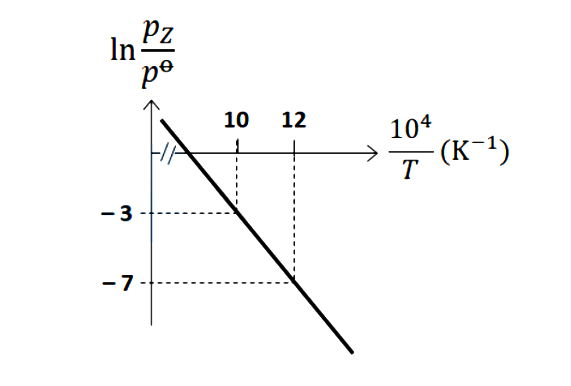
(Given, \(\frac{\mathrm{d}(\ln K)}{\mathrm{d}\left(\frac{1}{T}\right)}=-\frac{\Delta H^{\theta}}{R}\), where the equilibrium constant, \(K=\frac{p_{z}}{p^{\theta}}\) and the gas constant, \(\mathrm{R}=8.314 \mathrm{~J} \mathrm{~K}^{-1} \mathrm{~mol}^{-1}\) )
The value of standard enthalpy, (in ) for the given reaction is ___.JEE Advanced 2021 Hard - Match the specified conditions in solids listed in Column I with their properties in Column II. Indicate your answer by darkening the appropriate bubbles of the \(4 \times 4\) matrix given in the ORS.
Column I Column II A. Simple cubic and face-centered cubic p. Have these cell parameters \(a=b=c \text { and } \alpha=\beta=\gamma\) B. Cubic and rhombohedral q. Are two crystal systems C. Cubic and tetragonal r. Have only two crystallographic angles of \(90^{\circ}\) D. Hexagonal and monoclinic s. Belong to same crystal system JEE Advanced 2007 Easy - The arrangement of X- ions around A+ ion in solid AX is given in the figure (not drawn to scale). If the radius of X- is 250 pm, the radius of A+ is
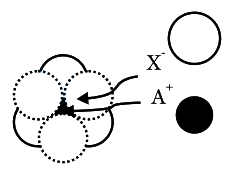 JEE Advanced 2013 Hard
 - In a conductometric titration, small volume of titrant of higher concentration is added stepwise to a larger volume of titrate of much lower concentration, and the conductance is measured after each addition.
The limiting ionic conductivity \(\left(\Lambda_0\right)\) values (in \(\mathrm{mS} \mathrm{m}^2 \mathrm{~mol}^{-1}\)) for different ions in aqueous solutions are given below:
For different combinations of titrates and titrants given in List-I, the graphs of 'conductance' versus 'volume of titrant' are given in List-II.
Match each entry in List-I with the appropriate entry in List-II and choose the correct option.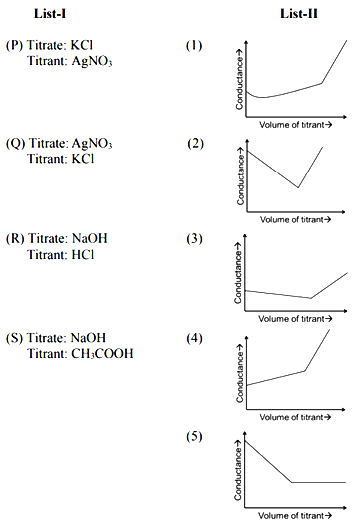 JEE Advanced 2024 Easy
 - The weight percentage of hydrogen in , formed in the following reaction sequence, is
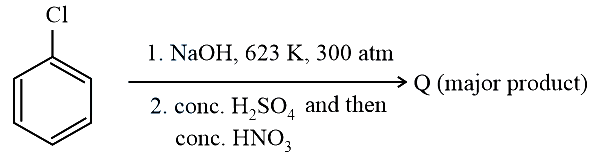
[Given: Atomic mass of \(H =1, C =12,\) \(N=14, O =16, S=32, Cl \) \(=35\) ]JEE Advanced 2022 Easy
More PYQs from JEE Advanced
- The centres of two circles \(C_1\) and \(C_2\) each of unit radius are at a distance of 6 units from each other. Let \(P\) be the mid-point of the line segment joining the centres of \(C_1\) and \(C_2\) and \(C\) be a circle touching circles \(C_1\) and \(C_2\) externally. If a common tangents to \(C_1\) and \(C\) passing through \(P\) is also a common tangent to \(C_2\) and \(C\), then the radius of the circle \(C\) isJEE Advanced 2009 Easy
- A heavy nucleus , at rest, undergoes fission where and are two lighter nuclei. Let , where and are the masses of and , respectively. and are the kinetic energies of and , respectively. The speeds of and are and , respectively. If is the speed of light, which of the following statement(s) is (are) correct?JEE Advanced 2021 Medium
- Adsorption of phenol from its aqueous solution on to fly ash obeys Freundlich isotherm. At a given temperature, from \(10 \mathrm{mg} \mathrm{g}^{-1}\) and \(16 \mathrm{mg} \mathrm{g}^{-1}\) aqueous phenol solutions, the concentrations of adsorbed phenol are measured to be \(4 \mathrm{mg} \mathrm{g}^{-1}\) and \(10 \mathrm{mg} \mathrm{g}^{-1}\), respectively. At this temperature, the concentration (in \(\mathrm{mg} \mathrm{g}^{-1}\) ) of adsorbed phenol from \(20 \mathrm{mg} \mathrm{g}^{-1}\) aqueous solution of phenol will be \(\qquad\) .
Use : \(\log _{10} 2=0.3\)JEE Advanced 2025 Hard - Six cards and six envelopes are numbered 1, 2, 3, 4, 5, 6 and cards are to be placed in envelopes so that each envelope contains exactly one card and no card is placed in the envelope bearing the same number and more over the card numbered 1 is always placed in envelope numbered 2. Then the number of ways it can be done isJEE Advanced 2014 Medium
- The number of real solutions of the equation lying in the interval is____.
(Here, the inverse trigonometric functions assume values in
respectively.)JEE Advanced 2018 Hard - The point \(P\) is the intersection of the straight line joining the points \(Q(2,3,5)\) and \(R(1,-1,4)\) with the plane \(5 x-4 y-\) \(z=1\). If \(S\) is the foot of the perpendicular drawn from the point \(T(2,1,4)\) to \(Q R\), then the length of the line segment \(P S\) isJEE Advanced 2012 Medium